Savory Cabbage and Ground Beef Skillet

This Savory Cabbage and Ground Beef Skillet is a delicious and hearty one-dish meal that combines the flavors of stuffed cabbage rolls without the fuss. Inspired by a craving for stuffed cabbage leaves and the need to use up fresh cabbage, this recipe features seasoned ground beef, tender rice, and vibrant tomatoes, all topped with steamed cabbage that adds a delightful crunch. Perfect for busy weeknights, this skillet meal is not only quick to prepare but also packed with flavor, making it a family favorite that’s sure to satisfy everyone at the table.
6
Servings
400
Calories
9
Ingredients
Ingredients
Ground Beef
1 lb (N/A)
Onion
1 (Chopped)
White Rice
1/2 cup (Rinsed)
Diced Tomatoes
2 (15 ounce) cans (N/A)
Beef Broth
1 (15 ounce) can (N/A)
Italian Seasoning
1 teaspoon or to taste (N/A)
Salt
To taste (N/A)
Pepper
To taste (N/A)
Cabbage
1 head (Cut into pieces)
Instructions
1
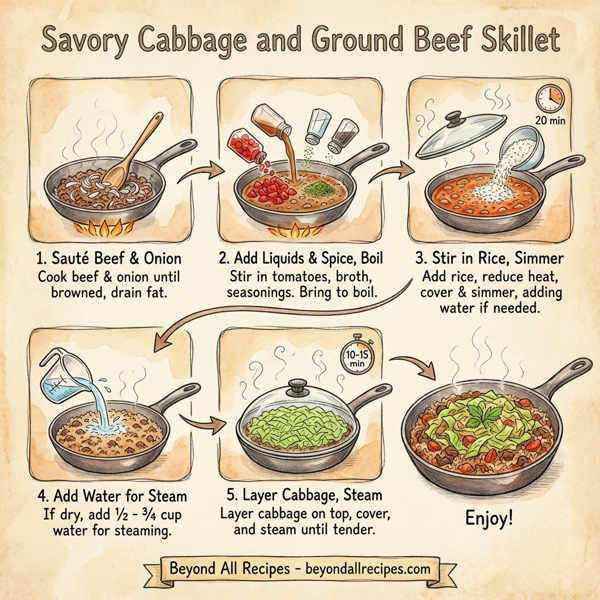
In a large, high-sided skillet, heat the ground beef and chopped onion over medium heat. Cook until the beef is browned and no longer pink, and the onion is softened. Drain any excess fat.
2
Add the diced tomatoes, beef broth, Italian seasoning, salt, and pepper to the skillet. Stir well and bring the mixture to a rapid boil.
3
Once boiling, stir in the rinsed white rice. If the mixture appears too dry, add a splash of water to ensure that the rice cooks properly. Return to a boil, then reduce the heat to a simmer. Allow it to cook for about 20 minutes, checking occasionally and adding water as necessary to prevent sticking, while the rice absorbs the flavors.
4
After the rice and beef mixture is cooked through and flavors are melded, if there’s little liquid left, add 1/2 to 3/4 cup of water to the skillet to facilitate steaming.
5
With the liquid adjusted, layer the cut cabbage over the beef mixture. Cover the skillet to trap the steam and adjust the heat to medium-low. Let it steam for 10-15 minutes, or until the cabbage is tender but still has a slight crunch, making sure there is enough liquid in the skillet to maintain steam and prevent burning.
Nutrition Information
20g
Fat
32g
Carbs
28g
Protein
5g
Fiber
Frequently Asked Questions
Frequently Asked Questions
What is the Savory Cabbage and Ground Beef Skillet?
It is a hearty one-dish meal that captures the flavors of traditional stuffed cabbage rolls in an easy-to-make skillet format.
How many servings does this recipe provide?
This recipe makes approximately 6 servings.
What are the main ingredients for this skillet meal?
The main ingredients include ground beef, chopped onion, white rice, diced tomatoes, beef broth, and a head of cabbage.
How many calories are in one serving?
There are approximately 400 calories per serving.
What is the protein content per serving?
Each serving contains about 28 grams of protein.
How much fat is in this dish?
There are 20 grams of fat per serving.
What are the carbohydrate and fiber counts?
Each serving has 32 grams of carbohydrates and 5 grams of fiber.
Do I need to rinse the rice before adding it?
Yes, the recipe specifies using 1/2 cup of rinsed white rice for the best results.
How long does it take to steam the cabbage?
The cabbage should be steamed over the beef and rice mixture for 10 to 15 minutes.
What kind of seasoning is used in this recipe?
The dish is seasoned with Italian seasoning, salt, and pepper.
Can I use a different type of broth?
While the recipe calls for beef broth to complement the ground beef, you could substitute it with vegetable or chicken broth if necessary.
How do I prevent the rice from sticking to the skillet?
Check the skillet occasionally while the rice simmers and add a splash of water if the mixture appears too dry.
What is the best way to cut the cabbage?
The cabbage should be cut into bite-sized pieces to ensure even steaming and ease of eating.
Should I drain the fat from the ground beef?
Yes, after browning the beef and onions, you should drain any excess fat before adding the other ingredients.
Can I use brown rice instead of white rice?
You can, but brown rice requires more liquid and a longer cooking time, so you would need to adjust the broth amount and simmering period accordingly.
Is this recipe considered a healthy meal?
Yes, it is tagged as a healthy meal and contains a good balance of protein, vegetables, and fiber.
How much liquid should be in the pan before adding cabbage?
If the liquid has been mostly absorbed by the rice, add 1/2 to 3/4 cup of water before layering the cabbage to facilitate steaming.
What heat setting should I use for simmering the rice?
After bringing the mixture to a boil, reduce the heat to a simmer (low or medium-low).
Is this dish spicy?
No, it uses mild Italian seasoning, salt, and pepper, making it very family-friendly.
Can I add more vegetables to this skillet?
Certainly! Carrots, bell peppers, or celery would make great additions to the beef and onion sauté.
What type of skillet is recommended?
A large, high-sided skillet is recommended to accommodate the bulk of the cabbage and allow for steaming.
How long does the rice take to cook initially?
The rice needs about 20 minutes of simmering to absorb the flavors and soften before adding the cabbage.
Can I freeze the leftovers?
Yes, this dish freezes well. Store it in an airtight container for up to 3 months.
What can I serve with this dish?
Since it is a complete one-dish meal, it is great on its own, but it also pairs well with a side of crusty bread or a dollop of sour cream.
How do I know when the cabbage is finished?
The cabbage is ready when it is tender to the fork but still retains a slight, delightful crunch.
Can I use fresh tomatoes instead of canned?
Yes, you can substitute 2 (15 ounce) cans of diced tomatoes with roughly 3-4 cups of freshly chopped tomatoes, though you may need a bit more salt.
Is this recipe gluten-free?
The ingredients (beef, rice, cabbage, vegetables) are naturally gluten-free; however, always check your beef broth and Italian seasoning labels to ensure they have no hidden gluten.
How much ground beef is needed?
The recipe calls for 1 lb of ground beef.
What size can of beef broth is required?
You will need one 15-ounce can of beef broth.
What makes this recipe easier than traditional stuffed cabbage?
Unlike traditional rolls, there is no need to blanch individual leaves or roll them; everything is cooked together in one skillet.