Authentic Thai Panang Curry Salmon
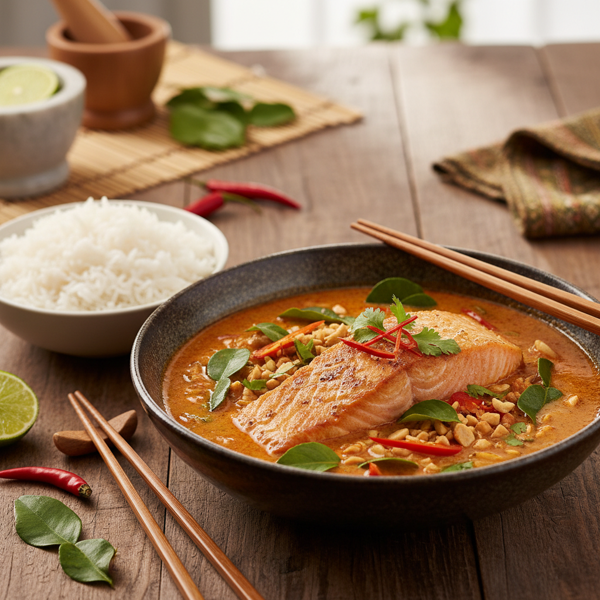
This Authentic Thai Panang Curry Salmon captures the essence of your favorite dish from the local Thai restaurant, bringing exotic flavors right to your kitchen. Inspired by a traditional recipe from the Mae Ploy Curry Paste container, this dish features tender salmon fillets simmered in a rich, aromatic Panang curry sauce made with creamy coconut milk. The perfectly balanced spiciness can be adjusted to suit your palate, making it a versatile choice for any dinner. Pair it with fragrant Thai Jasmine rice and a medley of colorful steamed vegetables for a complete meal that will impress family and friends alike. Experiment with different brands of coconut milk to discover your perfect texture and flavor; the AROY-D brand from Thailand is highly recommended. This recipe serves four and is ideal for a cozy night in or an impressive gathering!
4
Servings
465
Calories
8
Ingredients

Ingredients
Panang curry paste
1/4 cup ((I used Mae Ploy brand))
Canola oil
1 tablespoon (for stir-frying)
Salmon fillets
16-20 ounces (cut into 4 serving size portions)
Coconut milk
16 ounces (1 can, divided)
Water
1/2-3/4 cup
Sugar
1 3/4 teaspoons
Fresh kaffir lime leaves
as needed (for garnish)
Sliced Thai red chilies
as needed (for garnish)
Instructions
1
In a large skillet or wok, heat the canola oil over medium heat. Add the Panang curry paste and stir-fry for about 1-2 minutes until it becomes fragrant.
2
Gradually pour in 1 cup of coconut milk, stirring continuously until the mixture is well blended and bubbling gently.
3
Carefully place the salmon fillets in the skillet, cooking for 2-3 minutes on one side before gently turning them over.
4
Add the remaining coconut milk and water, stirring gently to combine. Bring the mixture to a boil, then reduce the heat to medium and let it simmer until the salmon is cooked through, about 3-4 minutes.
5
Once the salmon is cooked, sprinkle the sugar over the dish, stirring it in. Taste and adjust the seasoning if needed.
6
Serve hot, garnished with fresh kaffir lime leaves and sliced Thai red chilies. Accompany with Thai Jasmine rice and a variety of freshly steamed vegetables.
Nutrition Information
27g
Fat
11g
Carbs
39g
Protein
Frequently Asked Questions
Frequently Asked Questions
What is Authentic Thai Panang Curry Salmon?
It is a traditional Thai dish featuring tender salmon fillets simmered in a rich, aromatic Panang curry sauce made with creamy coconut milk and spices.
Which brand of Panang curry paste is recommended?
The recipe developer suggests using the Mae Ploy brand curry paste for an authentic flavor profile.
What is the best brand of coconut milk to use for this curry?
The AROY-D brand from Thailand is highly recommended for achieving the perfect texture and flavor.
How many servings does this recipe provide?
This recipe is designed to serve four people.
What are the nutritional values per serving?
Each serving contains approximately 465 calories, 27g of fat, 11g of carbohydrates, and 39g of protein.
How much salmon do I need for this recipe?
You will need between 16 and 20 ounces of salmon fillets, cut into four portions.
What garnishes are used for Panang Curry Salmon?
The dish is garnished with fresh kaffir lime leaves and sliced Thai red chilies.
What should I serve alongside the salmon curry?
It is best served with fragrant Thai Jasmine rice and a medley of freshly steamed vegetables.
How do I start the cooking process?
Heat canola oil in a large skillet or wok over medium heat and stir-fry the curry paste for 1-2 minutes until fragrant.
How is the coconut milk added to the dish?
The coconut milk is added in stages: first 1 cup is blended with the paste, and the remainder is added later with the water.
How long does the salmon need to simmer?
After bringing the mixture to a boil, reduce the heat and let the salmon simmer for 3-4 minutes until cooked through.
Can I adjust the spiciness of the curry?
Yes, the spiciness can be adjusted to suit your palate by changing the amount of curry paste or chilies used.
Why is sugar added to the recipe?
Sugar is added at the end of the cooking process to balance the heat and savory notes of the curry.
How much water is required for the sauce?
The recipe calls for 1/2 to 3/4 cup of water to help achieve the desired sauce consistency.
What type of oil is best for stir-frying the paste?
Canola oil is recommended for its neutral flavor and appropriate smoke point.
Is this recipe considered healthy?
Yes, with high protein content (39g) and the inclusion of salmon and vegetables, it is considered a healthy meal choice.
Can I use other types of fish?
While this recipe specifically uses salmon, the Panang sauce is versatile and can be used with other seafood.
How much Panang curry paste do I need?
The recipe requires 1/4 cup of Panang curry paste.
What is the total amount of coconut milk used?
You will need one 16-ounce can of coconut milk.
Should I cook the salmon on both sides?
Yes, the instructions suggest cooking for 2-3 minutes on one side before gently turning the fillets over.
Is the salmon boiled or simmered?
The mixture is briefly brought to a boil, but the salmon is primarily simmered over medium heat to ensure it stays tender.
How much sugar should I add?
The recipe calls for 1 3/4 teaspoons of sugar.
What texture should the curry sauce have?
The sauce should be rich, creamy, and well-blended with the curry paste.
Are the kaffir lime leaves eaten?
They are primarily used as a garnish to provide an aromatic scent, though they are technically edible if sliced very thinly.
Is this a good recipe for a dinner party?
Yes, its exotic flavors and impressive presentation make it ideal for an gathering with friends and family.
How long does the entire dish take to cook?
The active cooking time is approximately 10-15 minutes once the ingredients are prepared.
Do I need a special pan to make this?
A large skillet or a wok is recommended to provide enough space for the salmon and the sauce.
Can I use frozen salmon?
Yes, but you should ensure the salmon is fully thawed and patted dry before cooking.
Is the sauce gluten-free?
Most Panang curry pastes and coconut milks are gluten-free, but you should check the label of your specific curry paste brand.
How do I know when the salmon is done?
The salmon is done when it is opaque throughout and flakes easily with a fork, which takes about 3-4 minutes of simmering.