Zesty Muscadine-Melon Jam
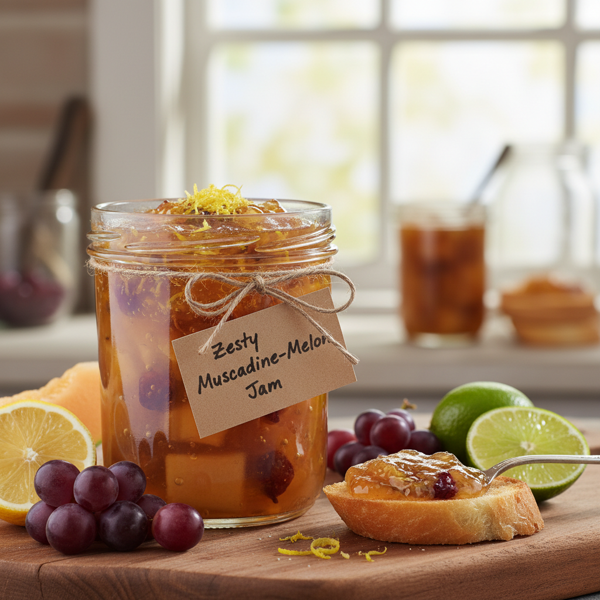
Transform your summer bounty into delightful Zesty Muscadine-Melon Jam that captures the essence of fresh southern fruits. This recipe combines the rich, sweet-tart flavor of muscadine grapes or scuppernongs with the invigorating zest of lemon, creating a jam that perfectly balances sweetness and tartness. After testing numerous variations, this jam emerged as a family favorite, praised for its ideal consistency and vibrant flavor. Whether slathered on toast, drizzled over desserts, or gifted in a beautiful jar, this jam is sure to impress your family and friends. The preparation time accounts for cooking the fruit, while the cooking time excludes the jar processing in the boiling water bath.
10
Servings
10
Calories
4
Ingredients
Ingredients
Muscadine grapes or Scuppernong grapes
5 lbs (Cut skin and pop out the pulp)
Sugar
3 lbs (None)
Lemon
1 (Peel and juice)
Water
1/2-1 cup (Add as needed to prevent sticking)
Instructions
1
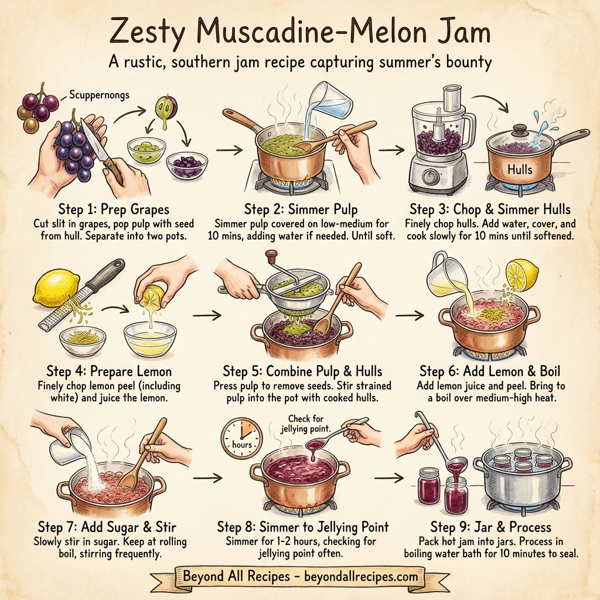
Begin by preparing the grapes. Cut a slit in the skin of each grape and gently pop the pulp along with the seed capsule out of the hull. Place the pulp into one pot and the hulls into another.
2
In a pot with the pulp, simmer on low-medium heat, covered, for approximately 10 minutes, or until the fruit is soft enough to press through a sieve or food mill. If needed, add a little water to prevent sticking.
3
Meanwhile, finely chop the hulls using a food processor and return them to their pot. Add just enough water to prevent sticking while simmering, then cover and cook slowly for about 10 minutes or until the hulls are softened.
4
Prepare the lemon by peeling and chopping the peel finely, ensuring to use the entire peel, including the white part for maximum jelling effect. Juice the lemon into a separate bowl.
5
Next, press the pulp through a sieve or food mill to remove the seeds. Stir the strained pulp into the pot containing the cooked hulls, and mix well.
6
Add the lemon juice and finely chopped lemon peel to the pot. Bring the mixture to a boil over medium-high heat.
7
Once boiling, slowly stir in the sugar, and bring back to a boil. Keep the mixture at a rolling boil while stirring frequently.
8
Continue to simmer for about 1 to 2 hours, checking frequently for the jellying point, which may vary based on the fruit's natural pectin content and your specific conditions.
9
Once the jellying point is reached, pack the hot jam into sterilized jars, leaving some headspace. Process the jars in a boiling water bath for 10 minutes to ensure proper sealing.
Nutrition Information
0g
Fat
3g
Carbs
0g
Protein
Frequently Asked Questions
Frequently Asked Questions
What are the primary fruits used in Zesty Muscadine-Melon Jam?
The primary fruits used are Muscadine grapes or Scuppernong grapes, complemented by fresh lemon.
How many pounds of grapes do I need for this recipe?
You will need 5 lbs of Muscadine or Scuppernong grapes.
How much sugar is required for the jam?
This recipe requires 3 lbs of sugar.
What is the first step in preparing the grapes?
Begin by cutting a slit in the skin of each grape and popping the pulp and seed capsule out of the hull into a separate pot.
Do I need to cook the grape hulls?
Yes, the hulls should be finely chopped in a food processor and simmered with a little water for about 10 minutes until softened.
How long should I simmer the grape pulp?
The pulp should be simmered on low-medium heat for approximately 10 minutes or until soft enough to press through a sieve.
Why is lemon used in this jam recipe?
Lemon provides an invigorating zest that balances the sweetness and the white part of the peel helps with the jelling effect.
Should I include the lemon peel in the jam?
Yes, the entire lemon peel should be finely chopped and included for maximum jelling and flavor.
How do I remove the seeds from the muscadines?
After simmering the pulp, press it through a sieve or food mill to effectively remove the seeds.
When do I add the sugar to the mixture?
Add the sugar slowly once the combined fruit and lemon mixture has reached a boil over medium-high heat.
How long does the final jam mixture need to simmer?
The mixture should simmer for about 1 to 2 hours until it reaches the jellying point.
How can I tell when the jam is ready?
Check frequently for the jellying point, which depends on the natural pectin content and cooking conditions.
Is water necessary for this recipe?
Yes, use 1/2 to 1 cup of water as needed to prevent the fruit from sticking to the pot during the initial simmering phases.
What is the recommended processing method for the jars?
Process the sterilized jars in a boiling water bath for 10 minutes to ensure a proper seal.
Should I leave space at the top of the jars?
Yes, leave some headspace in the jars before processing them in the water bath.
How many servings does this recipe produce?
This recipe yields approximately 10 servings.
What is the calorie count per serving?
Each serving contains approximately 10 calories.
Does this jam contain any fat?
No, this jam contains 0g of fat.
How many carbohydrates are in a serving?
There are 3g of carbohydrates per serving.
Is there any protein in Zesty Muscadine-Melon Jam?
No, this jam contains 0g of protein.
Can I use a food processor for this recipe?
Yes, a food processor is recommended for finely chopping the grape hulls.
What makes this jam 'zesty'?
The combination of the tart muscadines and the juice and finely chopped peel of a whole lemon provides the zesty flavor profile.
Are scuppernongs different from muscadines?
Scuppernongs are a specific variety of muscadine grape; both work equally well in this recipe.
What is the best way to serve this jam?
It is delicious slathered on toast, drizzled over desserts, or served as a preserve.
Does the cooking time include the water bath processing?
No, the stated cooking time excludes the 10-minute jar processing in the boiling water bath.
How many ingredients are in this recipe?
There are 4 main ingredients: grapes, sugar, lemon, and water.
Is this recipe suitable for gifting?
Yes, it is noted as a wonderful gift when placed in a beautiful jar.
Why must the hulls be cooked separately from the pulp initially?
The pulp contains seeds that must be sieved out, while the hulls need to be softened and chopped before being recombined.
What type of heat should I use for boiling the jam?
Maintain a rolling boil over medium-high heat while stirring frequently after the sugar is added.
What is the overall flavor profile of this preserve?
It is a sweet-tart jam that captures the essence of fresh Southern summer fruits.