Ultimate Homemade Chicken Stock
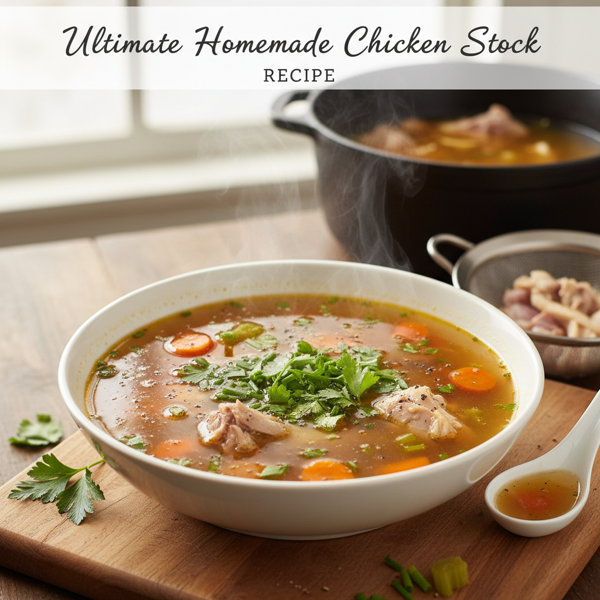
Unlock the secret to restaurant-quality soups and sauces with this Ultimate Homemade Chicken Stock recipe. It's rich, flavorful, and made with your leftover chicken bones and a fresh medley of vegetables. This stock is perfect for enhancing the taste of your favorite dishes or as a base for hearty soups. Plus, making your own stock is an excellent way to reduce food waste while creating something delicious. Store it in your freezer for a burst of flavor at your fingertips whenever you need it!
10
Servings
22
Calories
9
Ingredients
Ingredients
Chicken bones
2 one-gallon bags (Saved and stored in the freezer)
Celery
2 stalks (Chopped)
Carrots
2 (Chopped)
Parsley stems
1-2 bunches (Fresh, trimmed)
Onions
2 (Quartered)
Bay leaves
3-5 (Whole)
Water
12 quarts (Cold)
Salt
to taste
Black pepper
to taste
Instructions
1
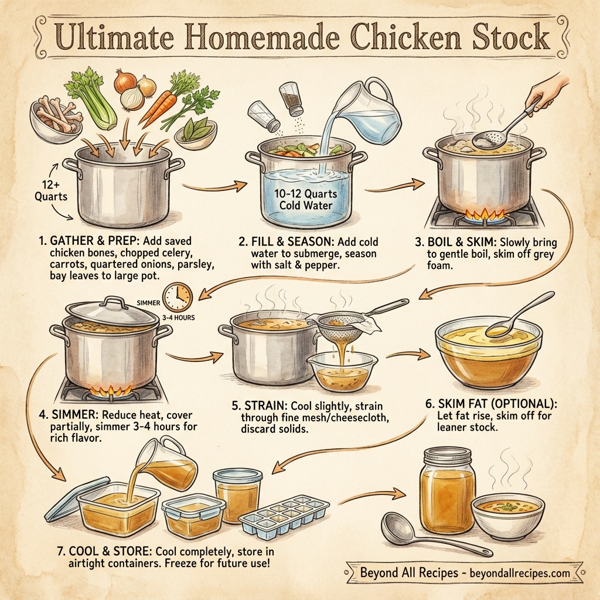
Gather all your saved chicken bones and place them in a large stock pot with a capacity of at least 12 quarts.
2
Thoroughly wash and chop the celery and carrots. Cut the onions into quarters.
3
Add the chopped celery, carrots, quartered onions, parsley stems, and bay leaves into the pot with the chicken bones.
4
Fill the pot with 10 to 12 quarts of cold water, ensuring that the ingredients are fully submerged.
5
Season the mixture with salt and pepper to taste.
6
Slowly bring the mixture to a gentle boil over medium heat, skimming off any grey foam that forms on the surface to ensure a clear stock.
7
Once boiling, reduce the heat to a simmer, cover partially with a lid, and let it cook for 3 to 4 hours. The longer it simmers, the richer the flavor.
8
After simmering, remove the pot from the heat and allow it to cool slightly.
9
Strain the stock through a fine mesh sieve or cheesecloth into another large pot or container, discarding the solids.
10
If desired, allow the stock to sit for a few minutes so the fat rises to the top, and then skim it off with a spoon for a leaner stock.
11
Let the stock cool completely before storing it in airtight containers. It can be frozen for future use—consider using ice cube trays for smaller portions!
Nutrition Information
1.4g
Fat
1g
Carbs
2g
Protein
Frequently Asked Questions
Frequently Asked Questions
What is the Ultimate Homemade Chicken Stock?
It is a rich, flavorful stock made from leftover chicken bones and vegetables, perfect for restaurant-quality soups and sauces.
How many servings does this recipe provide?
This recipe yields approximately 10 servings.
What are the main ingredients for this chicken stock?
The main ingredients include chicken bones, celery, carrots, onions, parsley stems, bay leaves, water, salt, and black pepper.
How many chicken bones should I use?
You should use two one-gallon bags of saved chicken bones, ideally stored in the freezer until use.
How much water is required for the stock?
You will need 10 to 12 quarts of cold water to fully submerge the ingredients.
What size stock pot do I need?
A large stock pot with a capacity of at least 12 quarts is recommended.
How should I prepare the vegetables?
Chop 2 stalks of celery and 2 carrots, and quarter 2 onions.
How many bay leaves are used in the recipe?
The recipe calls for 3 to 5 whole bay leaves.
How long does the chicken stock need to simmer?
The stock should simmer for 3 to 4 hours; a longer simmer results in a richer flavor.
What should I do if foam forms on the surface?
Skim off any grey foam that forms on the surface while bringing the mixture to a boil to ensure a clear stock.
How many calories are in one serving of this stock?
There are approximately 22 calories per serving.
What is the fat content per serving?
Each serving contains about 1.4g of fat.
How much protein is in each serving?
There are 2g of protein per serving.
Are there any carbohydrates in the chicken stock?
Yes, there is approximately 1g of carbohydrates per serving.
How do I strain the stock once it is finished cooking?
Strain the stock through a fine mesh sieve or cheesecloth into another large container, discarding the solids.
How can I make a leaner chicken stock?
Allow the stock to sit for a few minutes so the fat rises to the top, then skim it off with a spoon.
Can I freeze this chicken stock?
Yes, it can be frozen in airtight containers. Using ice cube trays is a great way to store smaller portions.
What kind of parsley is used?
Use 1-2 bunches of fresh, trimmed parsley stems.
Should the pot be covered while simmering?
Yes, the pot should be partially covered with a lid while simmering.
Is it better to use cold or hot water to start the stock?
Cold water is preferred as it helps ensure the stock remains clear and flavor is extracted properly.
How much salt and pepper should I add?
Salt and black pepper should be added to taste.
What is the benefit of making homemade stock?
Making your own stock reduces food waste and provides a superior, natural flavor compared to store-bought options.
What heat setting should I use to bring the stock to a boil?
Slowly bring the mixture to a gentle boil over medium heat.
Can I use this stock as a base for hearty soups?
Absolutely, it is designed specifically as a high-quality base for hearty soups and savory sauces.
Is there any sugar in this recipe?
No, this recipe contains 0g of sugar.
How many total ingredients are used?
There are 9 distinct ingredients in this recipe.
Should I let the stock cool before storing?
Yes, let the stock cool completely before placing it in airtight containers for storage.
What tags are associated with this recipe?
Tags include chicken stock, homemade stock, clear soup, freezer friendly, and poultry.
Is there any fiber in this stock?
The fiber content for this stock is 0g.
What should I do with the carrots and celery after simmering?
The carrots and celery are used for flavor extraction and should be discarded after straining the stock.