Tropical Raspberry-Mango Bliss Jam
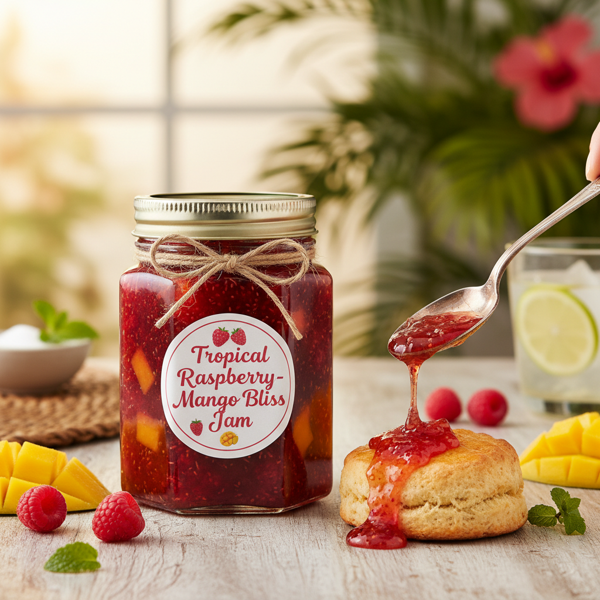
Indulge in the vibrant flavors of summer with this Tropical Raspberry-Mango Bliss Jam. Perfect for spreading on toast, dolloping on desserts, or adding to smoothies, this jam combines the sweetness of ripe mangoes with the tartness of fresh raspberries, all brought together with a hint of zesty lemon. Making this jam is easier than you think, and with just a few simple ingredients, you'll have the perfect homemade gift that captures the essence of tropical fruits. Ideal for breakfast, brunch, or anytime you crave something fruity and refreshing!
7
Servings
108
Calories
5
Ingredients
Ingredients
Mangoes
3 cups (finely chopped, pitted, peeled (about 3 pounds))
Red Raspberries
1 1/2 cups (crushed (about 1 1/2 pints))
Lemon Juice
2 tablespoons (freshly squeezed)
Fruit Pectin
1 package (1 3/4 ounce) (standard fruit pectin)
Granulated Sugar
5 1/2 cups (measured)
Instructions
1
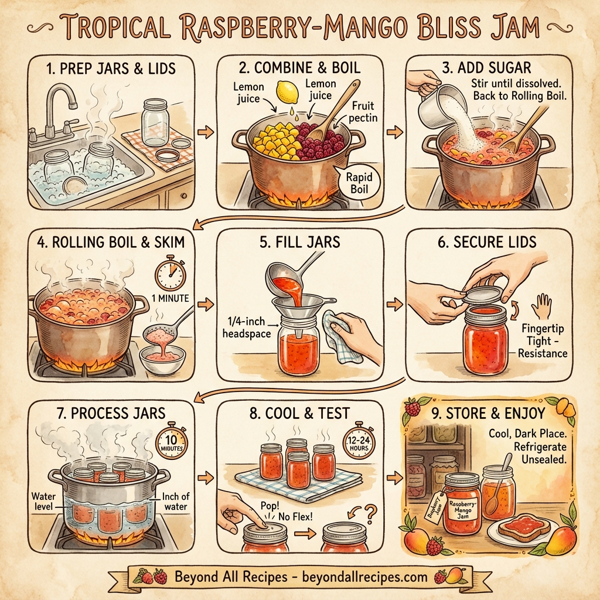
Start by thoroughly washing your canning jars and lids in hot, soapy water. Rinse well and dry. Alternatively, run them through the dishwasher.
2
In a large, heavy-bottomed saucepot, combine the finely chopped mangoes, crushed raspberries, lemon juice, and fruit pectin. Mix well and bring to a rapid boil over high heat, stirring occasionally to prevent sticking.
3
Once boiling, add the granulated sugar all at once, stirring continuously until the sugar completely dissolves. Bring the mixture back to a rolling boil.
4
Maintain a hard boil for 1 minute while stirring constantly. After 1 minute, remove the pot from heat and carefully skim any foam from the surface.
5
Using a ladle, fill the hot jars with the jam, leaving about a 1/4-inch headspace at the top. Wipe the rims of the jars with a clean cloth to remove any residue.
6
Place the canning lids on top of the jars, and screw the bands down evenly and firmly until you feel resistance – this is referred to as fingertip tight.
7
Process the jars in a boiling-water canner for 10 minutes. Ensure the water covers the jars by at least an inch.
8
After processing, remove the jars from the canner and let them cool on a clean towel or cooling rack for 12-24 hours. Test the seal by pressing the center of each lid; it should not flex.
9
Store the sealed jars in a cool, dark place. Unsealed jars can be refrigerated and used within a few weeks.
Nutrition Information
0g
Fat
27g
Carbs
0.3g
Protein
1g
Fiber
Frequently Asked Questions
Frequently Asked Questions
What is Tropical Raspberry-Mango Bliss Jam?
Tropical Raspberry-Mango Bliss Jam is a vibrant homemade preserve that combines the sweetness of ripe mangoes with the tartness of fresh raspberries and a hint of zesty lemon.
What are the primary ingredients in this jam?
The main ingredients are 3 cups of finely chopped mangoes, 1 1/2 cups of crushed red raspberries, 2 tablespoons of fresh lemon juice, 1 package of fruit pectin, and 5 1/2 cups of granulated sugar.
How many mangoes do I need for this recipe?
You will need approximately 3 pounds of mangoes to yield 3 cups of finely chopped, pitted, and peeled fruit.
How should the raspberries be prepared?
The raspberries should be crushed; you will need about 1 1/2 pints of fresh red raspberries to get 1 1/2 cups of crushed fruit.
What type of pectin is used in the Tropical Raspberry-Mango Bliss Jam?
This recipe uses one 1.75-ounce package of standard fruit pectin.
How much sugar is required for this jam?
The recipe calls for 5 1/2 cups of measured granulated sugar.
What is the first step in the jam-making process?
The first step is to thoroughly wash your canning jars and lids in hot, soapy water, rinse them well, and dry them.
How long do I boil the jam after adding the sugar?
Once the mixture returns to a rolling boil after adding sugar, maintain a hard boil for exactly 1 minute while stirring constantly.
Why should I skim the foam from the surface of the jam?
Skimming the foam after removing the pot from heat helps ensure a clear, aesthetically pleasing jam without air bubbles or cloudy residue.
How much headspace should be left in the jars?
You should leave about a 1/4-inch headspace at the top of the jars when filling them with jam.
What does fingertip tight mean when closing the jars?
Fingertip tight means screwing the bands down evenly and firmly until you feel resistance, but without using excessive force.
How long should the jars be processed in a boiling-water canner?
The jars should be processed in a boiling-water canner for 10 minutes.
How much water should cover the jars during the canning process?
Ensure the boiling water covers the jars by at least one inch.
How long do the jars need to cool after processing?
Let the jars cool on a clean towel or cooling rack for 12 to 24 hours.
How do I test if the jars have sealed correctly?
Press the center of each lid; if it does not flex or pop up and down, the jar is properly sealed.
Where is the best place to store sealed jam jars?
Sealed jars should be stored in a cool, dark place.
What should I do with jars that do not seal?
Unsealed jars should be refrigerated and consumed within a few weeks.
How many servings does this recipe yield?
This recipe yields approximately 7 servings (usually equating to 7 half-pint jars).
What is the calorie count per serving?
Each serving contains approximately 108 calories.
Does this jam contain any fat or cholesterol?
No, this jam contains 0g of fat and is cholesterol-free.
How many carbohydrates are in a serving?
Each serving contains 27g of carbohydrates.
How much protein and fiber is in the jam?
Each serving provides 0.3g of protein and 1g of dietary fiber.
What flavor category does this recipe fall under?
It is categorized as Fruit Preserves.
Can this jam be used for desserts?
Yes, it is excellent for dolloping on desserts, adding to smoothies, or spreading on toast.
Is fresh lemon juice required?
The recipe specifies 2 tablespoons of freshly squeezed lemon juice for the best flavor and acidity.
What tags are associated with this recipe?
Associated tags include jam, fruit preserves, mango, raspberry, homemade, canning, tropical, spread, breakfast, and dessert.
Is this recipe suitable for gifts?
Yes, it is described as the perfect homemade gift that captures the essence of tropical fruits.
Can I use a dishwasher to prepare the jars?
Yes, you can run the jars and lids through a dishwasher as an alternative to hand washing.
What type of pot is recommended for cooking the jam?
A large, heavy-bottomed saucepot is recommended to prevent sticking and ensure even heating.
How do I prepare the mangoes for the recipe?
Mangoes should be pitted, peeled, and then finely chopped.