Savory Roasted Garlic and Sage Parker House Rolls

Indulge in the warm, comforting flavors of these Savory Roasted Garlic and Sage Parker House Rolls, perfect for any occasion. Infused with the rich taste of roasted garlic and the aromatic essence of fresh sage, these rolls are soft and buttery with a delightful hint of sweetness from the sugar. Ideal as a side for festive meals or simply enjoyed warm with butter, this recipe yields 28 delicious rolls that can be shared with family and friends. Elevate your bread-baking skills and treat your loved ones to these irresistible, pillowy rolls.
N/A
Servings
N/A
Calories
9
Ingredients
Ingredients
garlic head
1 (Roasted)
fresh sage leaves
3 large plus smaller leaves for garnish (Finely chopped and reserved for garnish)
warm milk
1 1/4 cups (Heated to 110°F)
active dry yeast
1/2 ounce (Two packages)
unsalted butter
10 tablespoons plus more for bowl and pan (Melted)
sugar
3 tablespoons (Granulated)
salt
1 1/4 tablespoons (Fine)
all-purpose flour
5 1/2 cups (Plus more for dusting)
large eggs
3 (Lightly beaten)
Instructions
1
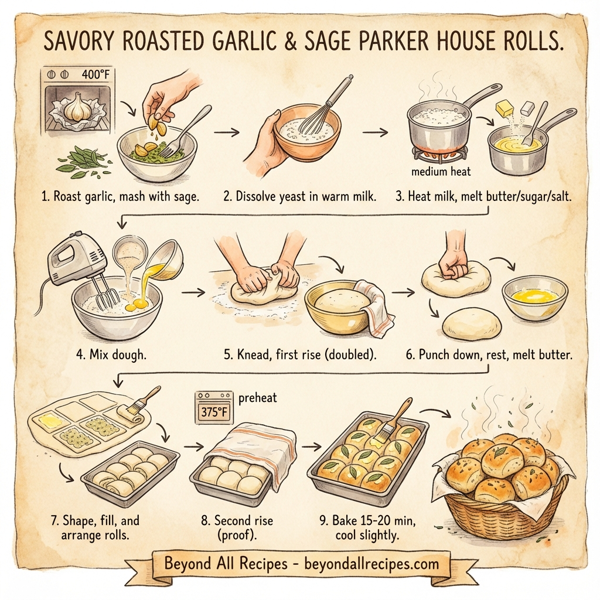
Preheat your oven to 400°F (200°C). Wrap the head of garlic in aluminum foil and roast it in the oven for 30-40 minutes, or until the cloves are soft. After roasting, allow the garlic to cool slightly, then squeeze the cloves out of their skins into a bowl. Mash the garlic to form a puree and finely chop the large sage leaves to mix into the puree. Set this flavorful filling aside.
2
In a small bowl, combine 1/2 cup of warm milk (about 110°F) with the active dry yeast, allowing it to dissolve for approximately 5 minutes.
3
In a medium saucepan over medium-high heat, bring the remaining 3/4 cup of milk to a boil. Remove from heat and add 6 tablespoons of butter, the sugar, and salt, stirring until the butter is fully melted. Set this mixture aside to cool slightly.
4
In the bowl of an electric mixer, place 4 1/2 cups of all-purpose flour and create a well in the center. Pour the yeast mixture, butter mixture, and the lightly beaten eggs into the well. Using the dough hook, mix at low speed for about 2 minutes until the ingredients begin to come together.
5
Transfer the dough to a lightly floured surface. Knead the dough for 5-10 minutes until it is soft, smooth, and no longer sticky, adding the remaining 1 cup of flour as necessary. Lightly butter a large bowl and an 11x17-inch baking pan. Place the dough in the prepared bowl, turning it to coat with butter. Cover it with a clean kitchen towel and let it rise in a warm place until it doubles in size, approximately 1.5 hours.
6
After the dough has risen, punch it down and let it rest for 10 minutes. Melt the remaining 4 tablespoons of butter for use later.
7
Divide the dough in half. Roll one piece out on a floured surface into a rectangle measuring about 10x12 inches. Cut the rectangle into five 2-inch-wide strips, and then cut each strip into three 4-inch-long rectangles. Take one rectangle, brush half with melted butter, and spread about 1/8 teaspoon of the garlic-sage filling over the butter. Fold the rectangle in half, ensuring a 1/2-inch overhang at the bottom, then transfer it to the prepared baking pan. Repeat this process for the remaining rectangles, arranging the rolls so they overlap slightly.
8
Cover the baking pan with a clean kitchen towel and let the rolls proof in a warm place until they double in size, about 30 minutes. Preheat the oven to 375°F (190°C) during this time.
9
Once risen, brush the tops of the rolls with melted butter and place 3 sage leaves on top of each roll. Bake for 15-20 minutes, or until the tops are golden brown. Allow the rolls to cool slightly before serving them warm.
Nutrition Information
Frequently Asked Questions
Frequently Asked Questions
What are Savory Roasted Garlic and Sage Parker House Rolls?
These are soft, buttery yeast rolls infused with the flavors of roasted garlic and fresh sage, folded into a classic Parker House shape.
How many rolls does this recipe produce?
This recipe yields approximately 28 delicious rolls.
How long do I need to roast the garlic for the filling?
The garlic head should be roasted at 400 degrees Fahrenheit for 30 to 40 minutes until the cloves are soft.
What temperature should the milk be for activating the yeast?
The milk should be warm, approximately 110 degrees Fahrenheit (43 degrees Celsius).
How long should the yeast dissolve in the warm milk?
Allow the active dry yeast to dissolve in the warm milk for about 5 minutes.
Can I use salted butter for these rolls?
Yes, you can use salted butter, but you may want to slightly reduce the amount of added salt in the dough.
What is the total amount of butter used in this recipe?
The recipe calls for 10 tablespoons of unsalted butter plus extra for greasing the bowl and pan.
How much flour is required for the dough?
The recipe uses 5 and 1/2 cups of all-purpose flour in total, including what is added during kneading.
How many eggs are needed?
This recipe requires 3 large eggs, which should be lightly beaten before adding to the dough.
How long should I knead the dough?
Knead the dough on a floured surface for 5 to 10 minutes until it is smooth and no longer sticky.
How long is the first rising period?
The dough needs to rise in a warm place for about 1.5 hours or until it doubles in size.
What temperature should I bake the rolls at?
The rolls should be baked at 375 degrees Fahrenheit (190 degrees Celsius).
How long do the rolls need to bake?
Bake the rolls for 15 to 20 minutes until the tops are golden brown.
How do I prepare the garlic and sage filling?
Mash roasted garlic cloves into a puree and mix in finely chopped fresh sage leaves.
What size baking pan is recommended?
An 11x17-inch baking pan is ideal for this recipe.
How do I shape the Parker House rolls?
Roll the dough into rectangles, brush with butter and garlic filling, then fold in half with a slight overhang.
What is the purpose of punching down the dough?
Punching down the dough releases air bubbles and allows the gluten to relax before shaping.
How long is the second rise (proofing)?
The rolls should proof in the pan for about 30 minutes before baking.
Can I use dried sage instead of fresh?
Fresh sage is preferred for flavor and garnish, but you can use 1/3 the amount of dried sage in the filling if fresh is unavailable.
Should the rolls be served warm or cold?
These rolls are best enjoyed warm, ideally with a side of butter.
How do I garnish the rolls?
Place three small sage leaves on top of each roll after brushing them with butter before they go into the oven.
What should I do if my dough is too sticky?
Gradually add more all-purpose flour during the kneading process until the dough is smooth and manageable.
Is active dry yeast the same as instant yeast?
No, active dry yeast needs to be dissolved in liquid first, whereas instant yeast can be mixed directly with dry ingredients.
How much sugar is in the recipe?
The recipe calls for 3 tablespoons of granulated sugar.
Can I make the dough ahead of time?
Yes, you can refrigerate the dough for its first rise overnight, though you should let it come to room temperature before shaping.
Are these rolls suitable for a holiday dinner?
Absolutely, the aromatic sage and roasted garlic make them a perfect side for festive meals like Thanksgiving or Christmas.
What does 'doubled in size' mean for dough?
It means the volume of the dough has physically grown to twice its original size due to carbon dioxide produced by the yeast.
How should I store leftovers?
Store leftover rolls in an airtight container at room temperature for up to 2 days.
How do I reheat the rolls?
Reheat them in a 300 degree Fahrenheit oven for 5-10 minutes or until warmed through.
Can I freeze these rolls?
Yes, you can freeze the baked rolls for up to 3 months; thaw and reheat before serving.