Savory Oyster Sauce Stir-Fried Chinese Broccoli

Experience the vibrant flavors of Cantonese cuisine with this Savory Oyster Sauce Stir-Fried Chinese Broccoli dish. Bursting with umami from the rich oyster sauce and enhanced by the delicate crunch of blanched gai lan, this recipe combines simplicity with mouthwatering taste. Enjoy this quick and easy preparation as a side dish or a light meal—perfect for weeknight dinners or special occasions. Impress your family or guests with a touch of authenticity from the heart of Chinese culinary tradition!
N/A
Servings
38
Calories
8
Ingredients
Ingredients
Chinese broccoli
10 ounces (washed, trimmed, and cut into 2-inch pieces)
Salt
1 teaspoon (for seasoning the water)
Baking soda
1 teaspoon (to enhance green color and texture)
Fresh ginger
1 slice (for infusing flavor into the blanching water)
Chicken broth or water
1/2 cup (to combine with oyster sauce)
Oyster sauce
3 tablespoons (for the main flavor in the sauce)
Rice wine or dry sherry
1 tablespoon (to add depth to the sauce)
Sugar
1 teaspoon (to balance the flavors in the sauce)
Instructions
1
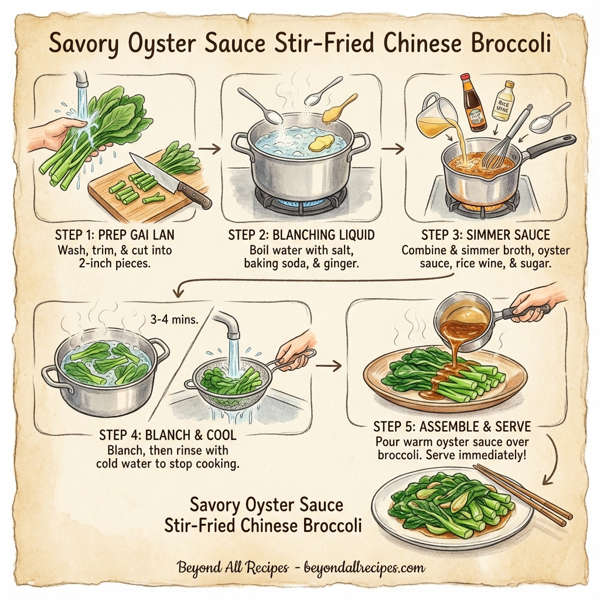
Begin by carefully washing the Chinese broccoli (gai lan) under running water. Trim the ends if necessary, then cut the stalks into bite-sized pieces, roughly 2 inches long to ensure even cooking.
2
In a large saucepan, fill with enough water to fully submerge the chopped gai lan. Add in the teaspoon of salt, baking soda, and a slice of fresh ginger to infuse flavor. Bring the water to a rolling boil.
3
While you wait for the water to boil, prepare the flavorful oyster sauce mixture. In a small saucepan, combine chicken broth (or water), oyster sauce, rice wine (or dry sherry), and sugar. Heat on medium fire until it reaches a boil, then reduce the heat and let it simmer to keep warm while you blanch the broccoli.
4
Once the water is boiling, carefully add the cut Chinese broccoli. Blanch for 3 to 4 minutes, or until the stalks become tender yet still retain their crispness. Quickly rinse the gai lan under cold running water to stop the cooking process and maintain its vibrant green color. Make sure to drain well.
5
Transfer the blanched Chinese broccoli to a serving dish and generously pour the warm oyster sauce over the top, ensuring each piece is coated. Serve immediately for the best flavor and texture.
Nutrition Information
1.25g
Fat
5g
Carbs
1g
Protein
0.75g
Fiber
112.5mg
Sodium
Frequently Asked Questions
Frequently Asked Questions
What is Chinese broccoli?
Chinese broccoli, also known as gai lan, is a leafy green vegetable common in Cantonese cuisine characterized by thick stalks and dark green leaves.
How should I prepare the Chinese broccoli before cooking?
Wash the gai lan under running water, trim the ends if necessary, and cut the stalks into bite-sized pieces roughly 2 inches long.
Why is salt added to the blanching water?
Salt is added to the water to season the broccoli and help preserve its color and texture during the boiling process.
What is the role of baking soda in this recipe?
Baking soda is added to the boiling water to enhance the vibrant green color and improve the texture of the blanched broccoli.
Why is fresh ginger added to the boiling water?
A slice of fresh ginger is used to infuse the blanching water with a delicate aromatic flavor that complements the gai lan.
How long should the Chinese broccoli be blanched?
The broccoli should be blanched for 3 to 4 minutes until the stalks are tender but still retain a crisp texture.
Why do I need to rinse the gai lan in cold water after boiling?
Rinsing the broccoli under cold running water stops the cooking process immediately and helps maintain its bright green appearance.
What are the main components of the stir-fry sauce?
The sauce is composed of chicken broth or water, oyster sauce, rice wine or dry sherry, and a teaspoon of sugar.
How do I prepare the oyster sauce mixture?
Combine the sauce ingredients in a small saucepan, bring to a boil, and then reduce the heat to a simmer to keep it warm.
Can I make this dish suitable for vegans?
Yes, you can make a vegan version by using a vegetarian mushroom-based oyster sauce and using water instead of chicken broth.
What can be used as a substitute for rice wine?
Dry sherry can be used as a substitute for rice wine to add a similar depth of flavor to the sauce.
How many calories are in one serving of this dish?
This recipe contains approximately 38 calories per serving.
Is this recipe considered low-fat?
Yes, it is very low in fat, with only 1.25g per serving.
What is the sodium content of this recipe?
The dish contains approximately 112.5mg of sodium per serving.
Why is sugar used in the sauce?
Sugar is used in the sauce to balance the savory and salty notes of the oyster sauce.
How much oyster sauce is required for this recipe?
The recipe calls for 3 tablespoons of oyster sauce.
When should I serve this dish?
For the best flavor and texture, the dish should be served immediately after pouring the warm sauce over the broccoli.
What culinary tradition does this dish belong to?
This dish is rooted in the Cantonese culinary tradition of Chinese cuisine.
Can I use regular broccoli instead of gai lan?
While you can use regular broccoli, the flavor and texture will be different from the authentic taste of Chinese broccoli.
What amount of Chinese broccoli is used?
The recipe specifies 10 ounces of Chinese broccoli.
Is this a quick recipe to make?
Yes, it is a quick and easy preparation that is perfect for weeknight dinners.
What is the carbohydrate count per serving?
There are 5g of carbohydrates in each serving.
How much protein does this dish provide?
Each serving provides 1g of protein.
Does this recipe contain fiber?
Yes, each serving contains approximately 0.75g of fiber.
What is the first step in making this recipe?
The first step is to wash and trim the Chinese broccoli and cut the stalks into 2-inch pieces.
How is the sauce applied to the broccoli?
After draining the broccoli, transfer it to a dish and generously pour the warm oyster sauce over the top.
Can I use water instead of chicken broth for the sauce?
Yes, water is a perfectly acceptable substitute for chicken broth in the sauce mixture.
What texture should the broccoli have after cooking?
The broccoli should be tender in the stalks yet still retain a delicate crunch.
How many ingredients are involved in this recipe?
There are 8 ingredients total: Chinese broccoli, salt, baking soda, ginger, broth, oyster sauce, rice wine, and sugar.
What is the overall flavor profile of this dish?
The dish is savory and bursting with umami from the oyster sauce, complemented by the fresh taste of blanched greens.