Savory Mennonite Meat Buns
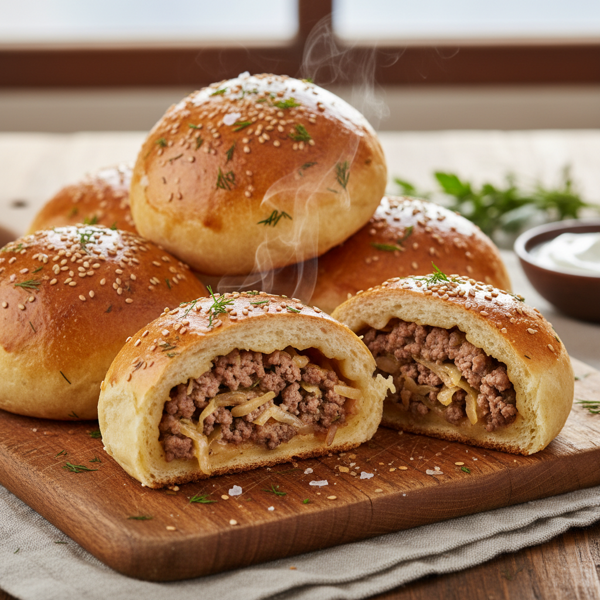
Savory Mennonite Meat Buns, known as Fleisch Perisky, are a beloved traditional treat that finds its place at festive tables, particularly during Christmas. These delightful buns are filled with a flavorful blend of seasoned ground beef and savory herbs, making them perfect as an accompaniment to hearty borscht or as a delicious snack or appetizer on their own. The recipe, passed down from a talented Mennonite lady in Winnipeg, results in deeply satisfying buns that can be made in large batches; I've personally prepared over 300 dozen in the bustling weeks leading to Christmas! Their versatility allows for freezing, so you can always have a tasty meal ready at hand. If you have extra dough, consider transforming it into sweet or savory rolls like zweibach or plain buns. Get ready to impress your family and friends with these comforting meat buns that are sure to become a cherished favorite!
N/A
Servings
N/A
Calories
16
Ingredients
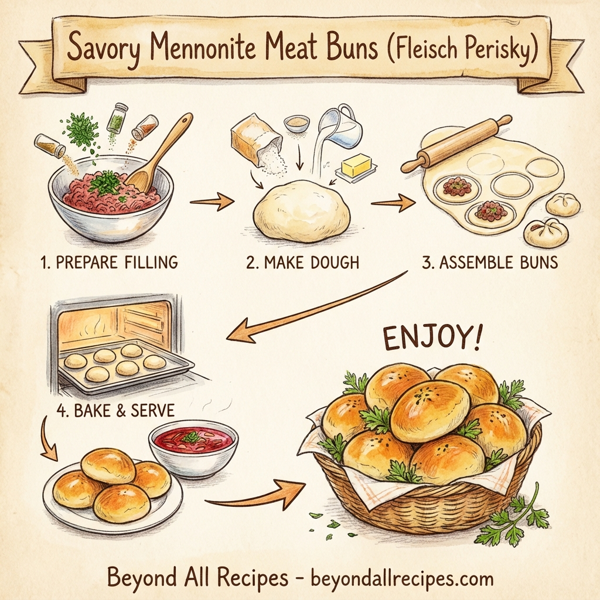
Ingredients
warm water
1 cup
granulated sugar
4 teaspoons
fast rising yeast
3 tablespoons
margarine
1/2 cup (melted)
lard
1/2 cup (melted)
salt
1 tablespoon
warm milk
5 cups
egg
1 (beaten)
all-purpose flour
12 cups (or more as needed)
lean ground beef
2 lbs (browned)
margarine
1/2 cup (for gravy)
all-purpose flour
2 tablespoons (for gravy)
water
2 cups (for gravy)
Lipton Onion Soup Mix
2 envelopes
no-name onion soup mix
1/2 package
fine dry breadcrumb
1-2 cups (as needed to bind filling)
Instructions
Nutrition Information
Frequently Asked Questions
Frequently Asked Questions
What are Savory Mennonite Meat Buns?
Savory Mennonite Meat Buns, also known as Fleisch Perisky, are a traditional yeast bread treat filled with a flavorful blend of seasoned ground beef and savory herbs.
What is the traditional name for these meat buns?
The traditional Mennonite name for these savory meat-filled buns is Fleisch Perisky.
What are the best occasions to serve Fleisch Perisky?
They are a beloved traditional treat for festive tables, particularly during Christmas, but they are also excellent as snacks or appetizers.
What should I serve with Mennonite Meat Buns?
These buns are perfect as an accompaniment to a bowl of hearty borscht.
Can Fleisch Perisky be frozen for later use?
Yes, their versatility allows for freezing, making it easy to have a tasty meal ready at hand whenever needed.
What type of meat is used in the filling?
The recipe calls for 2 lbs of lean ground beef, which should be browned before being used in the filling.
How is the filling seasoned?
The meat filling is seasoned using Lipton Onion Soup Mix and another no-name onion soup mix for a savory flavor profile.
What is used to bind the meat filling together?
Fine dry breadcrumbs (1-2 cups) are used to bind the beef filling so it stays together inside the buns.
What type of yeast is required for the dough?
The recipe requires 3 tablespoons of fast rising yeast.
How much flour is needed for the dough?
You will need approximately 12 cups of all-purpose flour, or more as needed to reach the right consistency.
Can I use this dough for other types of rolls?
Yes, if you have extra dough, you can transform it into sweet or savory rolls like zweibach or plain buns.
What fats are used in the bun dough?
The dough uses a combination of 1/2 cup of melted margarine and 1/2 cup of melted lard.
Does the recipe use milk or water?
The recipe uses both: 1 cup of warm water for the yeast mixture and 5 cups of warm milk for the main dough.
How many eggs are in the dough recipe?
The recipe calls for one beaten egg.
Is there sugar in the meat bun dough?
Yes, 4 teaspoons of granulated sugar are added to the dough mixture.
What is the origin of this specific recipe?
This recipe was passed down from a Mennonite lady in Winnipeg, Canada.
How is the gravy for the filling made?
The filling includes a gravy made from 1/2 cup margarine, 2 tablespoons of all-purpose flour, and 2 cups of water.
How many packages of soup mix are needed?
You will need 2 envelopes of Lipton Onion Soup Mix and 1/2 package of a no-name onion soup mix.
Can this recipe be scaled up for large groups?
Yes, the recipe is very batch-friendly; the author mentions making over 300 dozen in the weeks leading up to Christmas.
What is the texture of the filling?
The filling is deeply satisfying and savory, held together by a gravy and breadcrumb binder.
What kind of beef should I use?
The recipe specifically recommends using lean ground beef.
Is the lard in the dough melted or solid?
The 1/2 cup of lard should be melted before being added to the dough.
Is the margarine in the filling for the beef or the dough?
Margarine is used in both: 1/2 cup is melted for the dough, and another 1/2 cup is used to create the gravy for the meat filling.
Is the milk for the dough supposed to be cold?
No, the recipe calls for 5 cups of warm milk to help the yeast activate properly.
How much salt is added to the dough?
The dough recipe includes 1 tablespoon of salt.
What is the main category of this dish?
This dish is categorized as a Mennonite traditional yeast bread, often served as an appetizer or snack.
Are there any specific herbs mentioned in the description?
While the description mentions 'savory herbs,' the flavor primarily comes from the onion soup mixes used in the filling.
How much water is used in the gravy?
The filling's gravy requires 2 cups of water.
Can these be served as a main meal?
Yes, because they are filled with meat and encased in bread, they can serve as a tasty, comforting meal on their own.
What kind of yeast preparation is needed?
The yeast should be combined with 1 cup of warm water and 4 teaspoons of granulated sugar to start the dough.