Savory Herb-Crusted Roast Beef Tenderloin with Rich Red Wine Reduction

Elevate your dining experience with this Savory Herb-Crusted Roast Beef Tenderloin, featuring a flavorful red wine reduction sauce infused with shallots and fresh thyme. Perfect for special occasions or an impressive family dinner, this recipe guides you through mastering the art of perfectly roasted beef tenderloin, complemented by a luxurious sauce that brings depth and richness to each slice. Ideal for sharing, this dish is sure to become a favorite at your table.
N/A
Servings
496
Calories
14
Ingredients
Ingredients
Unsalted Butter
8 tablespoons (divided)
Shallots
3/4 cup (finely chopped (from 2-3 large shallots))
Red Wine
1 1/4 cups
Beef Broth
3 cups
Fresh Thyme Sprigs
6
Kosher Salt
1/4 teaspoon
Ground Black Pepper
1/8 teaspoon
Sugar
1 teaspoon
All-Purpose Flour
2 tablespoons
Center-Cut Beef Tenderloin Roast
2-3 lb
Kosher Salt
1 teaspoon (for seasoning)
Fresh Ground Black Pepper
1/2 teaspoon ((1/4 teaspoon per pound of beef))
Vegetable Oil
2 tablespoons
Beef Broth
1/4 cup
Instructions
1
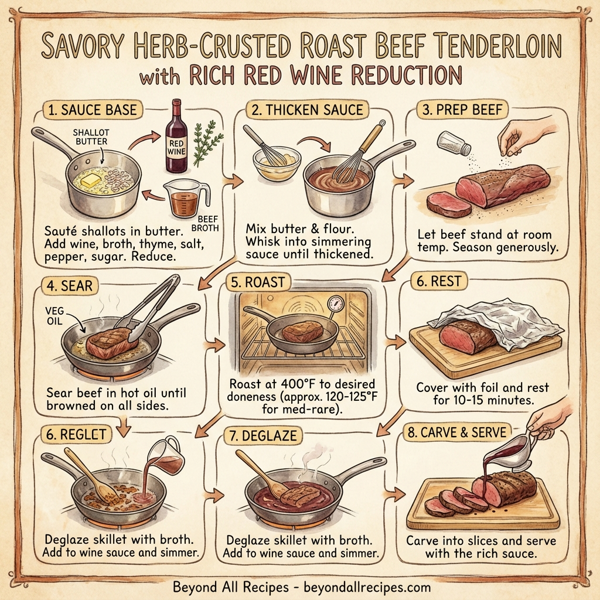
Begin by preparing the wine sauce. Melt 5 tablespoons of unsalted butter in a medium saucepan over medium-low heat. Add finely chopped shallots and sauté for 7 to 8 minutes, stirring occasionally until they are soft and translucent.
2
Pour in 1 1/4 cups of red wine, followed by 3 cups of beef broth, 6 fresh thyme sprigs, 1/4 teaspoon of kosher salt, 1/8 teaspoon of ground black pepper, and 1 teaspoon of sugar. Increase heat to bring the mixture to a boil, then reduce it to medium heat. Allow it to simmer for approximately 30 minutes, or until the liquid reduces by about half.
3
While the wine mixture reduces, prepare the flour-butter paste. In a small bowl, combine the remaining 3 tablespoons of softened butter with 2 tablespoons of all-purpose flour, mixing until a smooth paste forms.
4
Once the wine sauce has reduced, lower the heat and remove the thyme sprigs. Gradually whisk the flour-butter mixture into the simmering sauce, one teaspoon at a time, stirring continuously until the sauce thickens. Set aside or refrigerate up to 3 days if making ahead.
5
For the beef tenderloin, let the roast stand at room temperature for about 1 hour before cooking. Preheat your oven to 400°F and adjust the oven rack to the center position.
6
Season the beef generously with 1 teaspoon of kosher salt and 1/2 teaspoon of black pepper. Heat 2 tablespoons of vegetable oil in an oven-safe skillet over medium-high heat until shimmering. Sear the tenderloin, turning occasionally with tongs, until it is browned on all sides, approximately 10 minutes total.
7
Once seared, position the unbrowned side down in the skillet and transfer it to your preheated oven. Roast the beef until the internal temperature reaches 120°F-125°F for medium-rare, roughly 15 minutes depending on the size, or until it reaches your desired doneness (115°F-120°F for rare and 130°F-135°F for medium). Remember that the temperature will rise by about 5°F while resting.
8
Remove the roast from the oven and transfer it to a carving board. Loosely cover with aluminum foil and let it rest for 10-15 minutes to allow the juices to redistribute.
9
While the roasts rest, carefully discard excess fat from the skillet (be cautious, the handle will be hot!). Set the pan over medium heat on the stovetop, adding 1/4 cup of beef broth. Bring to a boil, scraping the bottom with a wooden spoon to release the brown bits. Incorporate this flavorful broth into the wine sauce, bringing it back to a simmer.
10
Finally, carve the beef tenderloin into 1/3-inch-thick slices and serve the slices with the rich red wine sauce drizzled atop or served on the side for guests to help themselves.
Nutrition Information
33g
Fat
8g
Carbs
35g
Protein
Frequently Asked Questions
Frequently Asked Questions
What is the primary dish of this recipe?
The primary dish is a Savory Herb-Crusted Roast Beef Tenderloin served with a Rich Red Wine Reduction sauce.
How many tablespoons of butter are required for this recipe?
The recipe requires 8 tablespoons of unsalted butter in total, divided between the sauce and the flour-butter paste.
How long should the shallots be sautéed?
Shallots should be sautéed for 7 to 8 minutes over medium-low heat until they are soft and translucent.
What ingredients are used for the red wine reduction base?
The base consists of red wine, beef broth, fresh thyme sprigs, kosher salt, ground black pepper, and sugar.
How long does it take for the wine sauce to reduce?
The wine mixture should simmer for approximately 30 minutes, or until the liquid reduces by about half.
How is the flour-butter paste prepared?
Combine 3 tablespoons of softened butter with 2 tablespoons of all-purpose flour in a small bowl and mix until smooth.
Can the red wine sauce be made in advance?
Yes, the red wine sauce can be prepared and refrigerated for up to 3 days ahead of time.
How long should the beef tenderloin rest at room temperature before cooking?
The roast should stand at room temperature for about 1 hour before you begin cooking.
What is the recommended oven temperature for roasting?
The oven should be preheated to 400 degrees Fahrenheit with the rack adjusted to the center position.
How should the beef be prepared before searing?
Season the beef generously with 1 teaspoon of kosher salt and 1/2 teaspoon of black pepper.
What type of pan should be used to sear the beef?
An oven-safe skillet should be used to sear the beef so it can be transferred directly to the oven.
How long does the searing process take?
The tenderloin should be seared on all sides for approximately 10 minutes total until browned.
What is the target internal temperature for medium-rare beef?
The target internal temperature for medium-rare is 120-125 degrees Fahrenheit.
What internal temperature should I aim for if I prefer rare beef?
For rare beef, aim for an internal temperature of 115-120 degrees Fahrenheit.
What is the target internal temperature for medium doneness?
For medium doneness, the internal temperature should reach 130-135 degrees Fahrenheit.
How much does the temperature rise after the beef is removed from the oven?
The internal temperature of the beef will typically rise by about 5 degrees Fahrenheit while resting.
Why must the beef rest after cooking?
Resting the beef for 10-15 minutes allows the juices to redistribute, ensuring a moist and flavorful result.
What should be done with the skillet after roasting the beef?
Discard excess fat and deglaze the skillet with 1/4 cup of beef broth to release the flavorful brown bits.
How should the beef tenderloin be sliced for serving?
The beef tenderloin should be carved into 1/3-inch-thick slices.
How many calories are in a serving of this dish?
Each serving contains approximately 496 calories.
What is the fat content of this recipe?
A serving contains 33 grams of fat.
How much protein is provided in one serving?
There are 35 grams of protein per serving.
How many grams of carbohydrates are in this meal?
The dish contains 8 grams of carbohydrates per serving.
What size beef tenderloin roast is recommended?
A 2 to 3 pound center-cut beef tenderloin roast is recommended for this recipe.
Which herbs are used to flavor the sauce?
Six fresh thyme sprigs are used to infuse the red wine reduction sauce.
Is any oil used in the preparation of the beef?
Yes, 2 tablespoons of vegetable oil are used to sear the beef tenderloin in the skillet.
What is the best way to incorporate the thickening paste into the sauce?
Gradually whisk the flour-butter mixture into the simmering sauce one teaspoon at a time until thickened.
When should the fresh thyme sprigs be removed?
Remove the thyme sprigs after the sauce has reduced and before you whisk in the thickening paste.
What makes this dish suitable for special occasions?
The combination of high-quality center-cut beef and a luxurious, chef-style red wine reduction makes it perfect for elegant dinners.
Is any sugar used in the sauce?
Yes, 1 teaspoon of sugar is added to the red wine reduction to balance the flavors.