Savory Artichoke and Tomato Asiago Focaccia
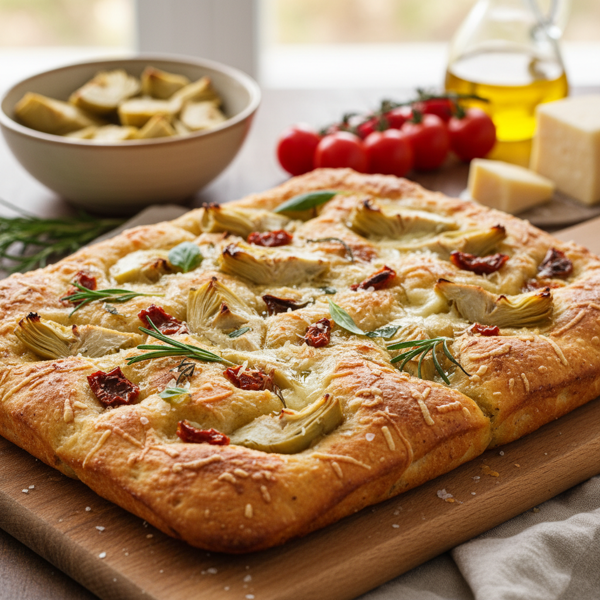
This Savory Artichoke and Tomato Asiago Focaccia is a delightful take on the classic Italian flatbread. Featuring a rich, buttery crust and a flavorful filling of artichoke hearts, sun-dried tomatoes, and grated Asiago cheese, this focaccia is perfect for sharing at gatherings or enjoying as a snack. The high moisture content makes this focaccia incredibly soft and airy, with a wonderfully chewy texture that pairs beautifully with the savory toppings. Don't let the dough's temperament discourage you; with patience and careful measuring, you'll create a deliciously satisfying bread that's sure to impress friends and family alike. Ideal for serving alongside soups, salads, or simply on its own, this focaccia can be personalized with your favorite herbs or spices.
N/A
Servings
N/A
Calories
9
Ingredients
Ingredients
all-purpose flour
2 1/4 cups (sifted)
milk
1 cup (scalded and cooled)
fast rising yeast
1/2 teaspoon (dry)
olive oil
2 tablespoons (divided)
salt
1 teaspoon (divided)
canned or jarred artichoke hearts
1/2 cup (rinsed and chopped)
sun-dried tomatoes
1/4 cup (chopped)
grated asiago cheese
1/4 cup (for filling and topping)
kosher salt
1 teaspoon
Instructions
1
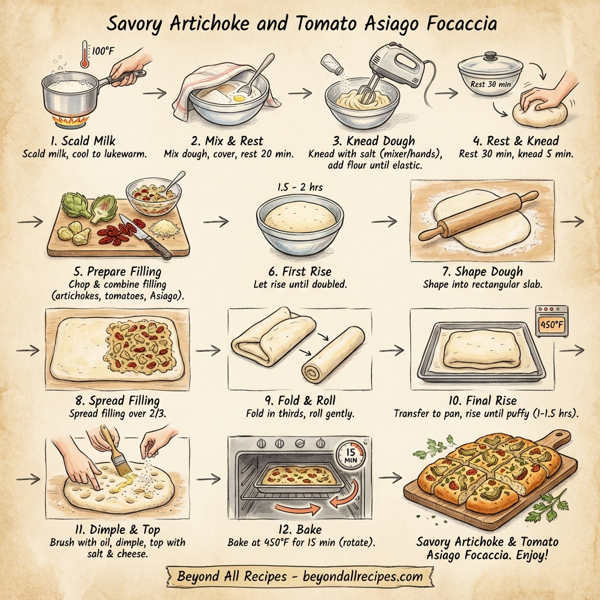
In a small saucepan, scald the milk over medium heat until bubbles form around the edges, then remove from heat and allow it to cool to lukewarm (around 100°F).
2
In a medium mixing bowl, sift the all-purpose flour and combine it with the fast-rising yeast, 1 tablespoon of olive oil, and the lukewarm milk. Mix until a rough dough begins to form, then cover the bowl with a clean kitchen towel and let it rest for 20 minutes.
3
Sprinkle the salt over the dough and use an electric mixer fitted with a dough hook to knead it on low-medium speed. Add flour gradually, as needed, until the dough is sticky yet elastic, pulling away from the sides of the bowl. If using your hands, knead the dough on a floured surface for about 10 minutes instead.
4
Cover the dough again and let it rest for 30 minutes. After resting, knead it for an additional 5 minutes; the dough should remain very sticky but should form a cohesive ball.
5
Rinse and drain the canned or jarred artichoke hearts, then finely chop them. In another bowl, combine the chopped artichokes, sun-dried tomatoes, and grated Asiago cheese. Set aside, allowing the tomatoes to soften slightly from the moisture.
6
After the initial rise, let the dough rise until it has doubled in size, which should take about 1.5 to 2 hours.
7
Once risen, scrape the dough onto a floured countertop. Gently shape it into a rectangular slab about 1/4 to 1/2 inch thick using a floured rolling pin.
8
Spread the artichoke and tomato mixture over 2/3 of the dough, ensuring it remains damp but not dripping.
9
Fold the dough into thirds like an envelope; bring the empty third over the middle, then fold the other side on top. Roll gently until the filling just begins to peek through the top.
10
Transfer the folded dough onto a cookie sheet lined with parchment paper or a silpat. Preheat your oven to 450°F and allow the dough to rise, loosely covered, for an additional 1 to 1.5 hours until puffy.
11
Once the dough has risen, brush it with olive oil and use your fingertips to create several small dimples in the surface.
12
Sprinkle with kosher salt and additional cheese, if desired.
13
Bake in the preheated oven for 15 minutes, rotating the pan after 10 to ensure even cooking.
14
Let the focaccia cool slightly before cutting it into squares. Serve warm and enjoy!
Nutrition Information
Frequently Asked Questions
Frequently Asked Questions
What is Savory Artichoke and Tomato Asiago Focaccia?
It is a delightful take on classic Italian flatbread featuring a rich, buttery crust filled with artichoke hearts, sun-dried tomatoes, and grated Asiago cheese.
What type of flour is best for this recipe?
The recipe calls for all-purpose flour, which helps create the soft and airy texture characteristic of this bread.
Why do I need to scald the milk?
Scalding the milk until bubbles form around the edges helps to break down proteins that can otherwise weaken the dough structure.
What temperature should the milk be when added to the yeast?
The milk should be allowed to cool to lukewarm, approximately 100°F, to ensure the yeast is activated without being killed.
How much yeast is required for this focaccia?
You should use 1/2 teaspoon of fast-rising dry yeast.
How long does the dough need to rest after the initial mixing?
After the initial mix of flour, yeast, olive oil, and milk, the dough should rest for 20 minutes.
Can I knead the dough by hand?
Yes, if you do not have an electric mixer, you can knead the dough on a floured surface for approximately 10 minutes.
What should the dough's consistency be like?
The dough should be very sticky but elastic enough to form a cohesive ball and pull away from the sides of the bowl.
How should I prepare the artichoke hearts?
The artichoke hearts should be rinsed, drained, and then finely chopped before being mixed with the other filling ingredients.
How long is the first rise for the dough?
The dough should rise until it has doubled in size, which typically takes between 1.5 to 2 hours.
How thick should I roll out the dough before adding the filling?
The dough should be shaped into a rectangular slab about 1/4 to 1/2 inch thick.
How do I incorporate the artichoke and tomato filling?
Spread the mixture over two-thirds of the dough, then fold the empty third over the middle and fold the other side on top, like an envelope.
What is the second rising time after the dough is shaped?
The folded dough should rise loosely covered for an additional 1 to 1.5 hours until it becomes puffy.
Why do I need to create dimples in the dough?
Creating dimples with your fingertips helps hold the olive oil and salt on the surface and prevents the bread from rising too much like a standard loaf.
What temperature should the oven be for baking?
The oven should be preheated to 450°F.
How long does the focaccia need to bake?
It takes approximately 15 minutes to bake, with a pan rotation at the 10-minute mark.
Should I rotate the pan during baking?
Yes, rotating the pan after 10 minutes ensures even cooking and browning.
What kind of cheese is used in this recipe?
Grated Asiago cheese is used both in the filling and as a topping.
Can I use parchment paper for baking?
Yes, you should transfer the dough onto a cookie sheet lined with parchment paper or a silpat.
What provides the savory flavor in the filling?
The combination of chopped artichoke hearts, sun-dried tomatoes, and Asiago cheese provides the rich savory flavor.
Is this dough supposed to be sticky?
Yes, the dough has a high moisture content and should remain very sticky throughout the process to ensure a soft and chewy texture.
How do I finish the top of the bread before baking?
Brush the risen dough with olive oil, create dimples, and sprinkle with kosher salt and extra cheese if desired.
How should the focaccia be served?
It is best served warm, cut into squares, either on its own or alongside soups and salads.
Can I personalize this recipe?
Yes, you can easily personalize the focaccia by adding your favorite herbs or spices.
What is the role of salt in this recipe?
Salt is used within the dough for flavor and structural development, and kosher salt is sprinkled on top for a savory finish.
How many tablespoons of olive oil are needed total?
The recipe uses 2 tablespoons of olive oil, which are divided between the dough and brushing the top.
How much sun-dried tomato should I use?
The recipe calls for 1/4 cup of chopped sun-dried tomatoes.
Does the recipe require sifted flour?
Yes, the all-purpose flour should be sifted before combining it with the yeast and milk.
Can I use canned artichokes?
Yes, you can use either canned or jarred artichoke hearts as long as they are rinsed and drained.
How many ingredients are in this recipe?
There are 9 ingredients: all-purpose flour, milk, yeast, olive oil, salt, artichoke hearts, sun-dried tomatoes, Asiago cheese, and kosher salt.