Portuguese Sweet Brioche Bread
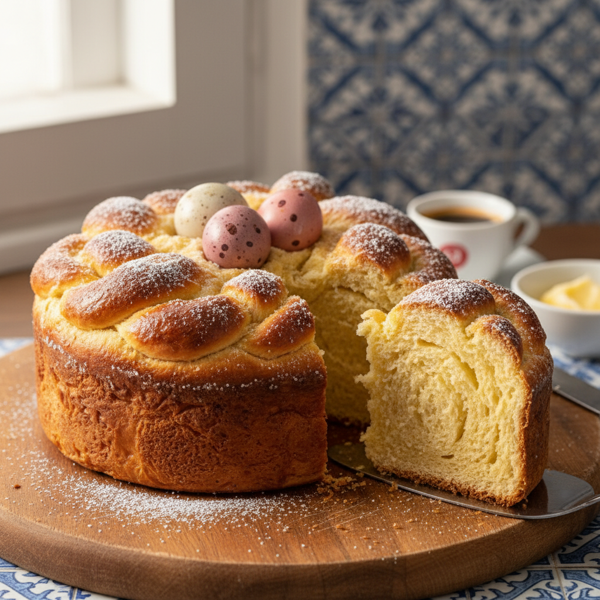
Experience the delightful taste of this Portuguese Sweet Brioche Bread, a rich and dense loaf that is perfect for accompanying savory stews, enhancing meat dishes, or simply enjoyed with a warm cup of tea or coffee. This traditional recipe yields four beautifully golden 9-inch breads that are soft on the inside and slightly crusty on the outside. Ideal for breakfast or as a snack, this bread is sure to be a favorite in any household. Enjoy the art of bread-making with this delightful recipe that brings a touch of Portugal to your kitchen!
N/A
Servings
N/A
Calories
10
Ingredients
Ingredients
granulated sugar
1 teaspoon (for activating yeast)
granulated sugar
3/4 cup (for the dough)
lukewarm water
1/2 cup (for activating yeast)
active dry yeast
1 package (or 1 tablespoon) (for fermentation)
eggs
6 (at room temperature)
salt
1 teaspoon (for flavor)
warm milk
1 cup (for the dough)
all-purpose flour
8 cups (for the dough)
butter
1/2 cup (melted and cooled)
butter
4 teaspoons (for brushing on top)
Instructions
1
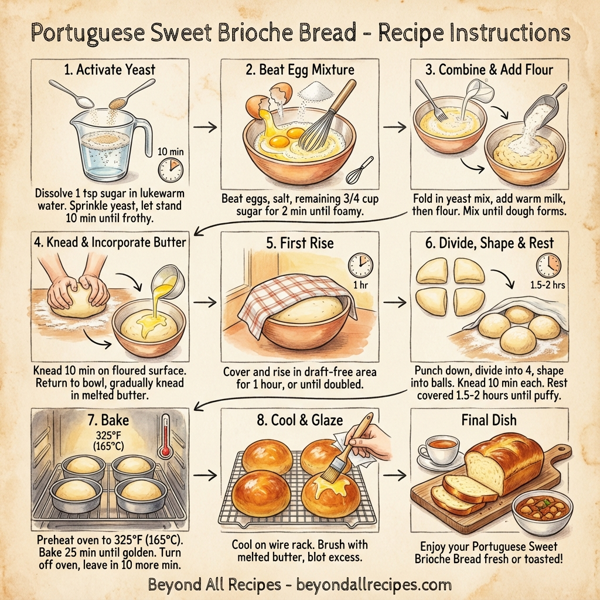
In a measuring cup, dissolve 1 teaspoon of sugar in lukewarm water. Sprinkle the yeast over the top and let it stand for about 10 minutes, or until it becomes frothy.
2
In a large mixing bowl, beat the eggs with the salt and the remaining 3/4 cup of sugar for 2 minutes until foamy and well combined.
3
Stir the frothy yeast mixture vigorously with a fork and then gently fold it into the egg mixture.
4
Add the warm milk to the mixture and gradually incorporate the flour, mixing until a dough begins to form.
5
Turn the dough onto a lightly floured surface and knead it for approximately 10 minutes until the dough becomes smooth and elastic.
6
Return the kneaded dough to a greased bowl and gradually pour in the melted butter, continuing to knead until all the butter is fully incorporated.
7
Cover the bowl with a clean kitchen towel and place it in a draft-free area to rise for 1 hour, or until it doubles in size.
8
Once risen, punch down the dough and turn it out onto a floured surface. Divide the dough into four equal portions and shape each into a ball.
9
Knead each dough ball for another 10 minutes until smooth and elastic. Cover the dough balls and let them rest on a floured surface for 1.5 to 2 hours, or until slightly puffy and crusty on the surface.
10
Preheat your oven to 325°F (165°C). Place the dough onto well-greased baking sheets or into 9-inch round pans.
11
Bake the breads in the preheated oven for about 25 minutes, or until the tops turn golden brown. To ensure even cooking, turn off the heat and leave the bread in the oven for an additional 10 minutes.
12
Once baked, transfer the breads to a wire rack to cool. Brush the tops with the remaining 1 teaspoon of melted butter, ensuring an even coat, and blot off any excess with paper towels.
13
Allow the breads to cool completely before serving. Enjoy fresh or toasted!
Nutrition Information
Frequently Asked Questions
Frequently Asked Questions
What is Portuguese Sweet Brioche Bread?
It is a rich, dense, and sweet loaf that is soft on the inside and slightly crusty on the outside, traditional to Portugal.
How many loaves does this recipe produce?
This recipe yields four 9-inch round breads.
How long should the yeast stand to become frothy?
The yeast should stand for about 10 minutes after being sprinkled over lukewarm water and sugar.
What temperature should the water be for the yeast?
The water should be lukewarm to properly activate the yeast without killing it.
How long should I beat the eggs and sugar?
Beat the eggs, salt, and 3/4 cup of sugar for 2 minutes until the mixture is foamy.
When do I add the warm milk to the dough?
Add the warm milk after folding the yeast mixture into the beaten egg mixture.
How long is the initial kneading process?
The dough should be kneaded for approximately 10 minutes until it becomes smooth and elastic.
When is the melted butter added to the dough?
The melted butter is kneaded into the dough after the initial 10-minute knead is complete.
How long should the dough rise the first time?
The dough should rise in a draft-free area for 1 hour, or until it has doubled in size.
How should the dough be divided after the first rise?
Once punched down, the dough should be divided into four equal portions and shaped into balls.
How long is the second kneading session?
Each of the four dough balls should be kneaded for an additional 10 minutes.
How long is the second rise?
The shaped dough balls should rest for 1.5 to 2 hours until they are slightly puffy.
What is the recommended oven temperature?
Preheat your oven to 325 degrees Fahrenheit (165 degrees Celsius).
What size pans are used for baking?
You can use 9-inch round pans or well-greased baking sheets.
How long does the bread bake?
The bread bakes for 25 minutes, followed by an additional 10 minutes in the oven with the heat turned off.
Why leave the bread in the oven after turning off the heat?
This ensures even cooking and helps achieve the desired crust texture.
When do I brush the bread with butter?
Brush the tops with melted butter once they have been transferred to a wire rack after baking.
How much total sugar is used in the recipe?
The recipe uses 3/4 cup plus 1 teaspoon of granulated sugar.
How many eggs are required?
The recipe requires 6 eggs at room temperature.
Can this bread be served with savory meals?
Yes, it is excellent for accompanying savory stews and enhancing meat dishes.
What type of flour is recommended?
The recipe calls for 8 cups of all-purpose flour.
What should the dough look like after the second rise?
It should be slightly puffy and have a crusty texture on the surface.
Is the butter added to the dough hot?
The butter should be melted but cooled before being incorporated into the dough.
How should the bread be cooled?
Transfer the breads to a wire rack to cool completely before serving.
What is the purpose of the 1 teaspoon of sugar in water?
It serves as food to help activate the yeast.
How many yeast packages are needed?
One package of active dry yeast, or approximately 1 tablespoon, is required.
Can I toast this bread?
Yes, it is delicious enjoyed both fresh and toasted.
What is the total amount of butter used?
The recipe uses 1/2 cup for the dough and 4 teaspoons for brushing the tops.
Is this bread suitable for breakfast?
Yes, it is ideal for breakfast or as a snack with coffee or tea.
What does 'punching down the dough' mean?
It is the process of gently pressing the risen dough to release air bubbles before shaping.