Perfectly Juicy Sous Vide Turkey with Savory Dressing and Homemade Stock

Elevate your holiday feast with this innovative sous vide turkey recipe, designed to ensure your bird is always juicy and flavorful. By separating the dark and white meat, you can fine-tune the cooking times for optimal tenderness. This recipe not only makes the turkey effortless to prepare, but it also allows you to create a delicious dressing infused with flavorful stock made from the turkey trimmings. Ideal for small gatherings, you can easily prepare half the turkey ahead of time and store the rest in the freezer for future use, making meal prep a breeze. Customize the seasoning to suit your taste with fresh herbs like rosemary, thyme, or sage. With minimal mess and impeccable results, this turkey will be the star of your table, not to mention the delightful homemade stock perfect for soups and gravies!
5
Servings
N/A
Calories
9
Ingredients
Ingredients
Whole turkey
1 (Fresh or fully thawed)
Dressing
To taste (Your favorite recipe)
Lemon
1 (Sliced)
Fresh rosemary
A few sprigs (Whole)
Thyme or sage
A few sprigs (Whole, leaves stripped if preferred)
Garlic
4 cloves (Crushed)
Olive oil or butter
2 tablespoons (Melted)
Salt
To taste (Kosher or sea salt)
Black pepper
To taste (Freshly ground)
Instructions
1
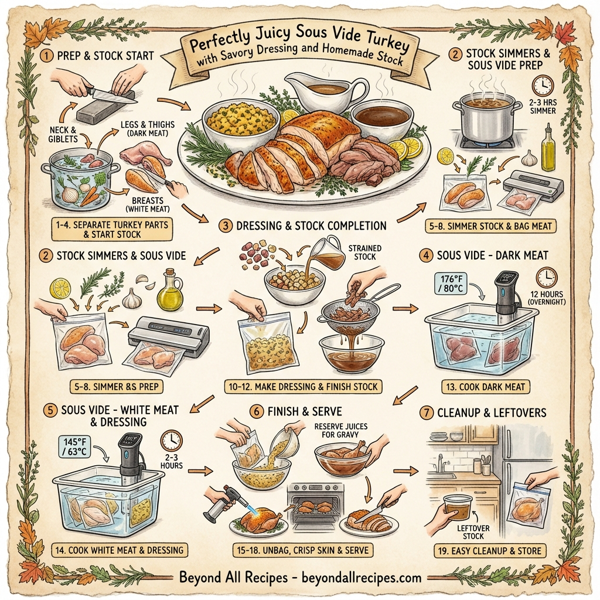
1. Start by sharpening your knife. Carefully remove the neck and giblets from the turkey cavity and set them aside for the stock pot.
2
2. Using your knife, detach the legs and thighs from the turkey, ensuring not to cut into the meat.
3
3. Remove the back of the turkey and place it into the stock pot along with the neck and giblets.
4
4. Carefully cut off each breast from the bone using a boning knife, placing the meat aside.
5
5. Place all trimmings and leftover parts in the stock pot, season generously with salt, pepper, and your choice of herbs, then cover with water.
6
6. Bring the stock to a boil, then reduce to a simmer and cook for 2-3 hours.
7
7. While the stock simmers, prepare the turkey for sous vide. In vacuum seal bags, place each breast and thigh, adding olive oil, a lemon slice, rosemary twigs, garlic, and thyme or your preferred herbs.
8
8. Vacuum seal the bags. If you don’t have a vacuum sealer, use freezer bags and press as much air out as possible before sealing.
9
9. Optionally, you may choose to add the wings to the stock pot or vacuum seal them separately for later use.
10
10. After your stock has simmered, remove all solids with tongs and set aside the turkey parts. Dice the giblets and mix them into your favorite dressing recipe, incorporating a cup of the strained stock for added flavor.
11
11. Seal the dressing in a vacuum bag or freezer bag, removing as much air as possible, and refrigerate it alongside the turkey.
12
12. Once your stock is complete, use the meat pulled from the bones to enrich the stock, discarding the bones.
13
13. Set your sous vide to 176°F (80°C) and immerse the dark meat for 12 hours (preferably overnight).
14
14. The next morning, adjust your sous vide to 145°F (63°C) and add the white meat and dressing. Cook for 2 to 3 hours, with 2.5 hours being ideal.
15
15. When ready to serve, remove the bags from the sous vide and place them in a large bowl. If you are serving immediately, pour the dressing into a separate bowl; otherwise, keep it in a safe oven-proof bowl to retain heat and develop a crust.
16
16. Empty the turkey into the bowl, reserving the juices for your gravy.
17
17. Decide whether to serve the turkey with or without skin. If serving with skin, either broil for 10-15 minutes or use a kitchen torch to achieve a beautiful golden-brown finish before slicing.
18
18. For skinless servings, remove the skin and cut the meat accordingly. Save the skin to crisp up later in a skillet for an amazing treat.
19
19. Enjoy a simplified cleanup, thanks to using the carcass for stock—almost nothing to clean up afterwards! If making ahead, reheat the turkey in a sous vide bath set to 146°F (63°C) for an hour before broiling to finish, if desired.
Nutrition Information
Frequently Asked Questions
Frequently Asked Questions
Why is sous vide a good method for cooking turkey?
Sous vide ensures the turkey is always juicy and flavorful by allowing you to separate dark and white meat to fine-tune cooking times for optimal tenderness.
What temperature should the dark meat be cooked at?
The dark meat (legs and thighs) should be cooked in the sous vide at 176°F (80°C).
How long does the dark meat need to cook in the sous vide?
The dark meat should be immersed for 12 hours, preferably overnight.
What temperature is used for the white meat?
The white meat (breasts) should be cooked at 145°F (63°C).
How long should the white meat cook?
The white meat should cook for 2 to 3 hours, with 2.5 hours being the ideal duration.
How do I make the homemade turkey stock?
Simmer the turkey neck, giblets, back, and trimmings with water, salt, pepper, and herbs for 2-3 hours.
What ingredients are added to the sous vide bags with the turkey?
Add olive oil or butter, a lemon slice, rosemary twigs, garlic, and thyme or sage to the bags.
Can I cook the dressing in the sous vide?
Yes, you can seal the dressing in a vacuum bag and cook it alongside the white meat for 2 to 3 hours.
How can I make the dressing more flavorful?
Incorporate diced cooked giblets and a cup of the strained homemade stock into your dressing recipe.
What should I do if I don't have a vacuum sealer?
You can use freezer bags and press as much air out as possible before sealing them manually.
How do I achieve a golden-brown finish on the turkey skin?
You can either broil the turkey for 10-15 minutes or use a kitchen torch to crisp the skin before serving.
Can this recipe be prepared ahead of time?
Yes, you can prepare half the turkey ahead of time and store the rest in the freezer for future use.
How do I reheat the turkey using sous vide?
Set your sous vide bath to 146°F (63°C) and reheat the turkey for one hour before finishing it under a broiler if desired.
What should I do with the juices left in the sous vide bags?
Reserve the juices to use as a base for making flavorful gravy.
Which turkey parts are used for the stock pot?
Use the neck, giblets, back, and any trimmings or leftover parts for the stock pot.
Is it necessary to remove the bones from the breasts?
Yes, the recipe calls for using a boning knife to carefully remove each breast from the bone before bagging.
What herbs are recommended for seasoning?
Fresh rosemary, thyme, and sage are recommended, but you can customize the seasoning to suit your taste.
How many servings does this recipe provide?
This recipe is designed to provide approximately 5 servings.
What should I do with the turkey wings?
You can either add the wings to the stock pot or vacuum seal them separately for later use.
Can I use butter instead of olive oil?
Yes, you can use either olive oil or melted butter in the vacuum seal bags.
How do I prep the garlic for the bags?
The garlic should be crushed before being added to the sous vide bags.
What is the benefit of making the stock from the carcass?
Using the carcass for stock enriches your recipes and simplifies cleanup because there is almost nothing to clean up afterward.
What should I do with the meat pulled from the bones after making stock?
Use the meat pulled from the bones to enrich the stock, then discard the bones.
How should the turkey be prepped before starting?
The turkey should be fresh or fully thawed, and you should start by sharpening your knife.
What happens if I don't want to serve the turkey with skin?
For skinless servings, remove the skin and cut the meat. You can save the skin to crisp up later in a skillet as a treat.
How do I store the dressing before cooking?
Seal the dressing in a vacuum bag or freezer bag and refrigerate it until you are ready to cook it with the white meat.
What kind of salt is best for this recipe?
Kosher or sea salt is recommended to taste.
Why is the dark meat cooked at a higher temperature than the white meat?
Dark meat contains more connective tissue and requires a higher temperature (176°F) and longer time to become tender compared to white meat.
How do I keep the dressing warm if I am not serving immediately?
Keep the dressing in a safe oven-proof bowl to retain heat and help it develop a crust.
Can I use ground pepper or does it have to be fresh?
Freshly ground black pepper is recommended for the best flavor.