Mediterranean Salt-Encrusted Fish
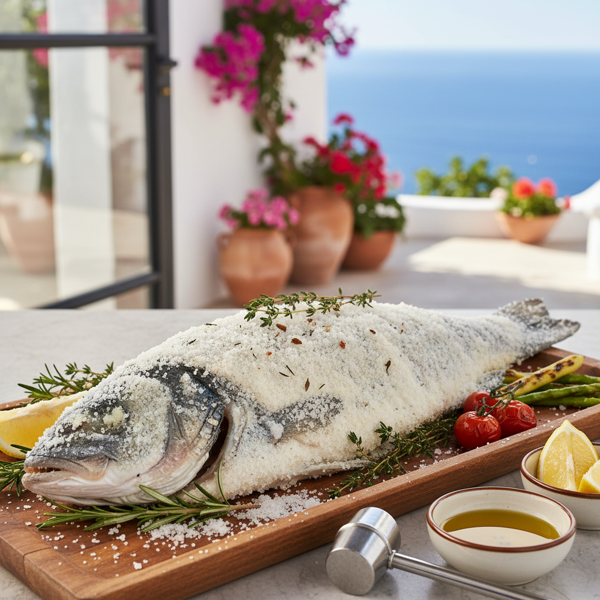
This Mediterranean-inspired salt-crusted fish is a feast for the senses, enveloping a whole white fish in a flavorful crust that enhances its natural flavors while keeping it moist and tender. The stuffing, rich with sun-dried tomatoes, olives, artichoke hearts, and zesty lemon, imparts an aromatic quality reminiscent of coastal Italian cuisine. Serve this dish to impress guests or for a sophisticated date night dinner.
2
Servings
400
Calories
12
Ingredients
Ingredients
egg whites
3
sea salt
2 cups
all-purpose flour
2 cups
Italian parsley
3 tablespoons (chopped and divided)
water
1/2 cup
fresh whole white fish
1 (2 1/2 lb)
sun-dried tomatoes
2 tablespoons (julienned)
kalamata olive
1 tablespoon (chopped)
artichoke hearts
2 tablespoons (chopped)
lemons
2 slices (sliced in half, plus more for garnish)
garlic
1 tablespoon (minced)
cracked black pepper
1/2 teaspoon
Instructions
1
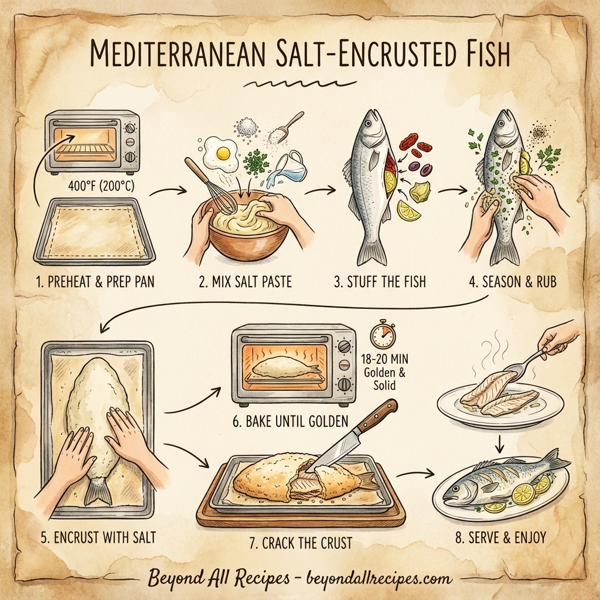
Preheat your oven to 400°F (200°C). Prepare a baking sheet by lining it with parchment paper, ensuring it extends an extra 3-inches around the fish to accommodate the crust.
2
In a mixing bowl, whisk together the egg whites, sea salt, flour, 2 tablespoons of chopped parsley, and 1/2 cup of water. Use your hands to mix into a thick pliable paste. This will form the crust that seals the fish and keeps it juicy.
3
Open the cavity of your fish and carefully stuff it with sun-dried tomatoes, chopped kalamata olives, artichoke hearts, and lemon slices, ensuring even distribution for maximum flavor.
4
Rub the exterior of the fish with the minced garlic. Sprinkle the remaining parsley and cracked black pepper over the fish.
5
Place the fish onto the prepared parchment. Cover the fish completely with the salt paste, using your hands to pat it firmly, ensuring there are no cracks. This will serve as a seal to cook the fish evenly.
6
Bake the fish in the preheated oven for 18-20 minutes, or until the crust is golden and solid. The crust acts like an oven-within-the-oven to evenly cook the fish.
7
Once baked, transfer the fish on the parchment to a serving platter. Break the crust open using the handle of a large knife. Remove the upper crust and gently slide a spoon under the top fillet of fish to lift it over the spine to another serving platter.
8
Flip the fish over and repeat on the other side to serve. Garnish with additional lemon slices if desired, and serve immediately for the best flavor.
Nutrition Information
5g
Fat
25g
Carbs
50g
Protein
2.5g
Fiber
4000mg
Sodium
Frequently Asked Questions
Frequently Asked Questions
What is Mediterranean Salt-Encrusted Fish?
It is a whole white fish stuffed with Mediterranean ingredients and encased in a salt and flour paste that seals in moisture while baking.
How many servings does this recipe provide?
This recipe is designed to provide 2 servings.
What kind of fish should I use for this recipe?
The recipe calls for one 2.5 lb fresh whole white fish.
How do I prepare the salt crust?
Mix 3 egg whites, 2 cups of sea salt, 2 cups of flour, 2 tablespoons of parsley, and 1/2 cup of water into a thick pliable paste.
What is the required oven temperature?
Preheat your oven to 400 degrees Fahrenheit or 200 degrees Celsius.
How long does the fish need to bake?
The fish should bake for 18 to 20 minutes until the crust is golden and solid.
Is the salt crust edible?
No, the salt crust serves as an oven-within-the-oven to cook the fish evenly and should be broken off and discarded before eating.
What ingredients are used to stuff the fish?
The cavity is stuffed with julienned sun-dried tomatoes, chopped kalamata olives, chopped artichoke hearts, and lemon slices.
How do I know when the fish is done?
The fish is ready when the salt crust has become golden brown and feels solid to the touch.
Can I use table salt instead of sea salt?
Sea salt is recommended for this recipe to achieve the correct texture and thickness for the crust paste.
Why are egg whites used in the crust?
Egg whites act as a binder for the salt and flour, creating a pliable paste that can be molded around the fish.
Is this recipe gluten-free?
No, the salt crust contains 2 cups of all-purpose flour.
How much sodium is in each serving?
Each serving contains 4000mg of sodium, though much of this remains in the discarded crust.
What tools are needed to open the salt crust?
You can use the handle of a large knife to break the crust open after baking.
Can I use fish fillets instead of a whole fish?
This recipe is specifically designed for a whole fish to maintain moisture and accommodate the stuffing cavity.
How should the fish be served?
Break the crust, remove the top fillet, then lift the spine to access and serve the bottom fillet.
Can the salt paste be made in advance?
It is best to mix the paste right before applying it to the fish so it remains pliable and moist.
What are the primary flavors of this dish?
The flavors are savory and aromatic, featuring garlic, lemon, sun-dried tomatoes, and kalamata olives.
Is this dish suitable for a dinner party?
Yes, it is described as a sophisticated meal perfect for impressing guests or for a special date night.
What are some suggested side dishes?
Light Mediterranean sides like roasted vegetables, a fresh green salad, or a lemon-herb couscous would pair well.
How many calories are in a serving?
There are 400 calories per serving.
How much protein does this recipe provide?
Each serving provides 50 grams of protein.
Can I substitute the Italian parsley with other herbs?
Yes, herbs like dill, thyme, or oregano could be used, though parsley provides a classic Mediterranean flavor.
What is the purpose of adding flour to the salt crust?
The flour helps create a more durable, airtight seal that effectively steams the fish inside.
Why is parchment paper required?
Parchment paper prevents the crust from sticking to the baking sheet and makes it easier to transfer the fish to a platter.
Do I need to scale the fish before cooking?
Yes, ensure the whole fish is cleaned, gutted, and scaled before you begin stuffing and encrusting it.
Where do I apply the garlic?
The minced garlic should be rubbed onto the exterior of the fish before the salt paste is applied.
How do I prevent the salt crust from cracking?
Use your hands to pat the paste firmly and ensure there are no visible cracks or gaps before baking.
What is the total carbohydrate count?
There are 25 grams of carbohydrates per serving.
Can I use lemon juice instead of lemon slices for the stuffing?
Lemon slices are preferred as they release moisture and aromatics slowly inside the cavity during the baking process.