Italian Sfogliatelle Pastries
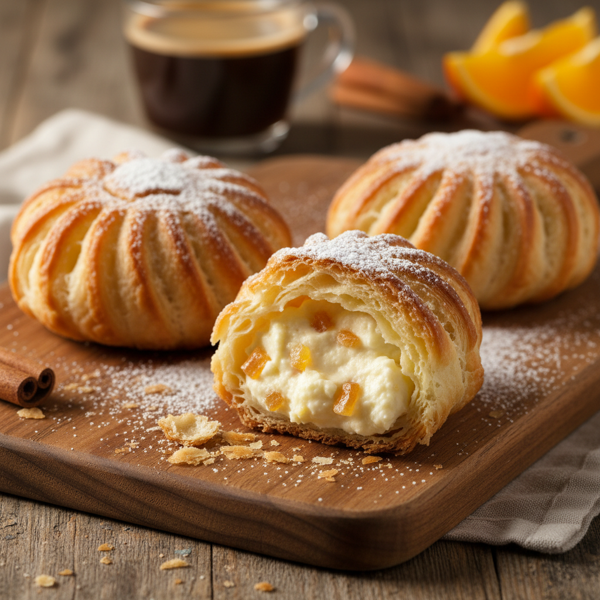
Dive into a traditional Italian delight with these exquisite Sfogliatelle pastries. Renowned for their crisp, flaky layers, these delightful treats are filled with a luscious ricotta cheese mixture delicately infused with candied citrus peels. Perfect for a special dessert or a delightful afternoon snack, Sfogliatelle captures the essence of Italian patisserie and will transport your taste buds to the streets of Naples. Each bite reveals a light crunch followed by a creamy filling, making it a beloved classic often featured in popular culture. Serve them dusted with confectioners' sugar for an elegant finish.
N/A
Servings
N/A
Calories
11
Ingredients
Ingredients
all-purpose flour
3 cups (sifted)
salt
1/2 teaspoon (sifted with flour)
shortening
3/4 cup (cut into small pieces for mixing)
melted shortening
1/2 cup (for brushing)
ricotta cheese
1 1/2 lbs (drained through cheesecloth until dry)
confectioners' sugar
8 tablespoons (for the filling and dusting)
minced candied orange and citron peel
3 tablespoons (to add flavor)
eggs
2 (beaten)
all-purpose flour
1 tablespoon (for the filling)
vanilla extract
1/2 teaspoon (for flavor)
egg white
1 (for sealing)
Instructions
1
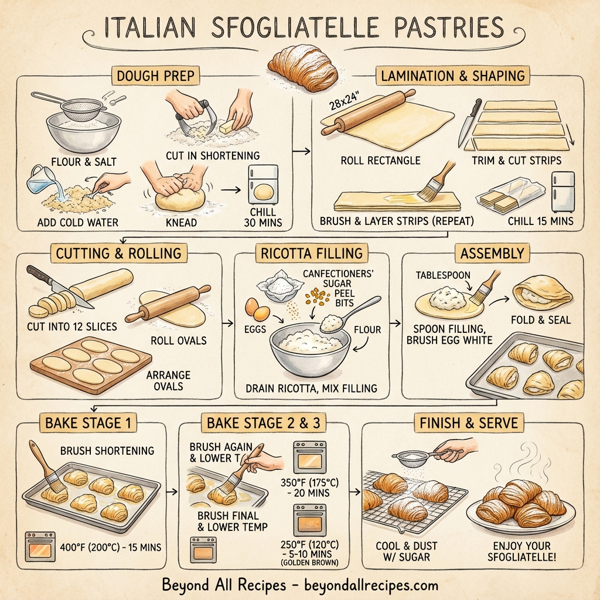
In a large mixing bowl, sift together the all-purpose flour and salt until well blended.
2
Add the shortening and use your fingers to cut it into the flour until the mixture resembles coarse crumbs.
3
Gradually add about 1/2 cup of cold water, stirring until the dough holds together but is not too soft or too tough, similar to egg noodle dough.
4
Knead the dough on a floured surface for several minutes until smooth and elastic.
5
Shape the dough into a ball, wrap it in plastic wrap, and refrigerate for 30 minutes to relax the dough.
6
On a lightly floured surface, roll the dough into a rectangle approximately 28 x 24 inches.
7
Trim the edges to create straight sides, then cut the dough into four strips measuring 28 x 6 inches.
8
Generously brush melted shortening over the first strip and layer it with the second strip, repeating this process until all four strips are layered with melted shortening in between each.
9
Wrap the layered dough in wax paper and refrigerate for 15 minutes.
10
Using a sharp knife, trim the ends to create even pieces, then cut the roll into 12 pieces, each about 1/2 inch thick.
11
Place the slices on a floured surface and sprinkle lightly with flour. Use a rolling pin to gently roll each slice into an oval shape, approximately 7 1/2 inches long.
12
Arrange the rolled ovals on a floured board, side by side, while you prepare the filling.
13
In a bowl, drain the ricotta cheese through cheesecloth until dry. Mix in the confectioners' sugar, minced candied orange and citron peel, eggs, flour, and vanilla until smooth.
14
Spoon a tablespoon or two of the ricotta filling onto the lower half of each oval. Moisten the edges with egg white and fold over the filling, sealing the edges tightly to create a shell.
15
Brush the tops of the pastries with melted shortening, then place them in a preheated oven at 400°F (200°C) for about 15 minutes.
16
After 15 minutes, quickly brush the pastries again with more melted shortening, and lower the oven temperature to 350°F (175°C). Bake for an additional 20 minutes.
17
Afterward, brush each pastry one final time with shortening, lower the oven temperature to 250°F (120°C), and bake for 5 to 10 more minutes until golden brown.
18
Remove from the oven and cool on a wire rack. Once cooled, dust generously with confectioners' sugar before serving.
Nutrition Information
Frequently Asked Questions
Frequently Asked Questions
What are Italian Sfogliatelle Pastries?
Sfogliatelle are traditional Italian pastries known for their crisp, flaky layers and a luscious ricotta cheese filling infused with candied citrus peels.
Where did Sfogliatelle originate?
Sfogliatelle is a classic Italian patisserie staple that captures the essence of the streets of Naples.
What are the main ingredients for the Sfogliatelle dough?
The dough is made from all-purpose flour, salt, shortening, and cold water.
How is the ricotta prepared for the filling?
The ricotta cheese must be drained through cheesecloth until it is completely dry before being mixed with other ingredients.
What flavorings are added to the ricotta filling?
The filling is flavored with minced candied orange and citron peel, vanilla extract, and confectioners' sugar.
How long should the dough rest in the refrigerator?
The dough should be refrigerated for 30 minutes to relax after the initial kneading process.
What size should the dough be rolled into?
The dough should be rolled into a large rectangle measuring approximately 28 by 24 inches.
How many strips is the dough rectangle cut into?
The dough is cut into four strips, each measuring approximately 28 by 6 inches.
What is used to layer the dough strips?
Melted shortening is generously brushed over each strip as they are layered on top of one another.
How many pastries does this recipe produce?
The recipe produces 12 individual pastries.
How thick should the sliced dough pieces be?
The layered dough roll should be cut into 12 pieces, each about 1/2 inch thick.
What is the final shape of the dough before filling?
Each slice is rolled into an oval shape approximately 7.5 inches long before the filling is added.
How much filling is used for each pastry?
Approximately one or two tablespoons of the ricotta filling is spooned onto the lower half of each dough oval.
What is used to seal the edges of the Sfogliatelle?
Egg white is used to moisten the edges before folding and sealing them tightly to create a shell.
What is the initial baking temperature?
The pastries begin baking in a preheated oven at 400°F (200°C) for the first 15 minutes.
What is the second baking temperature and duration?
The temperature is lowered to 350°F (175°C) for an additional 20 minutes of baking.
What is the final baking temperature?
The oven is lowered one last time to 250°F (120°C) for the final 5 to 10 minutes until the pastries are golden brown.
How often should you brush the pastries with shortening?
The pastries are brushed with melted shortening before entering the oven, after the first 15 minutes, and one final time before the last stage of baking.
How should Sfogliatelle be finished before serving?
Once cooled on a wire rack, they should be dusted generously with confectioners' sugar.
What is the texture of a Sfogliatelle pastry?
The pastry has a light crunch from its flaky layers followed by a creamy, luscious filling.
How many eggs are used in this recipe?
The recipe calls for two beaten eggs for the filling and one egg white for sealing the shells.
Is flour used in the ricotta filling?
Yes, one tablespoon of all-purpose flour is mixed into the filling to help achieve a smooth consistency.
What type of citrus peel is recommended?
The recipe uses a combination of minced candied orange and citron peel.
Should the dough be kneaded?
Yes, the dough should be kneaded on a floured surface for several minutes until it becomes smooth and elastic.
What is the purpose of sifting the flour?
Sifting the flour and salt together ensures they are well blended and free of lumps before mixing with shortening.
How long is the layered dough chilled before slicing?
The layered dough strips are wrapped in wax paper and refrigerated for 15 minutes before being cut into pieces.
What kind of sugar is used for the filling?
Confectioners' sugar is used in the filling and for the final dusting.
Can Sfogliatelle be eaten as a snack?
Yes, they are perfect for both a special dessert or a delightful afternoon snack.
Is shortening used in the dough itself?
Yes, 3/4 cup of shortening is cut into the flour until the mixture resembles coarse crumbs.
What is the total estimated baking time?
The total baking time is approximately 40 to 45 minutes across three different temperature settings.