Homemade Sourdough Starter and Artisan Bread
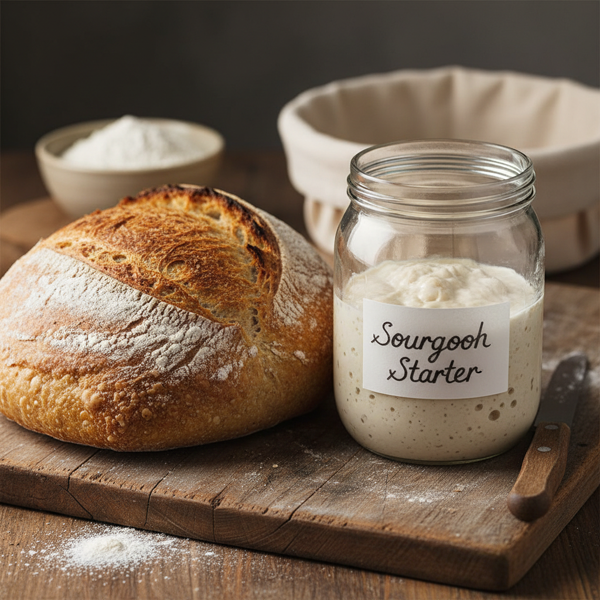
Embark on a delightful culinary journey with this comprehensive recipe for creating your own Homemade Sourdough Starter, followed by crafting a rustic Artisan Sourdough Bread. This process not only enhances your baking skills but also allows you to cultivate a living starter that will produce tangy, flavorful bread. Share this recipe with friends and family for a wholesome homemade experience!
N/A
Servings
100
Calories
6
Ingredients
Ingredients
All-purpose flour
9 ounces (Measured by weight)
Water
1 cup (Room temperature)
Bread flour
1/2 pound (Measured by weight)
Water
1/2 cup (Room temperature)
Table salt or kosher salt
1 teaspoon or 2 teaspoons (To taste)
Olive oil
1 tablespoon (For mixing into the dough)
Instructions
1
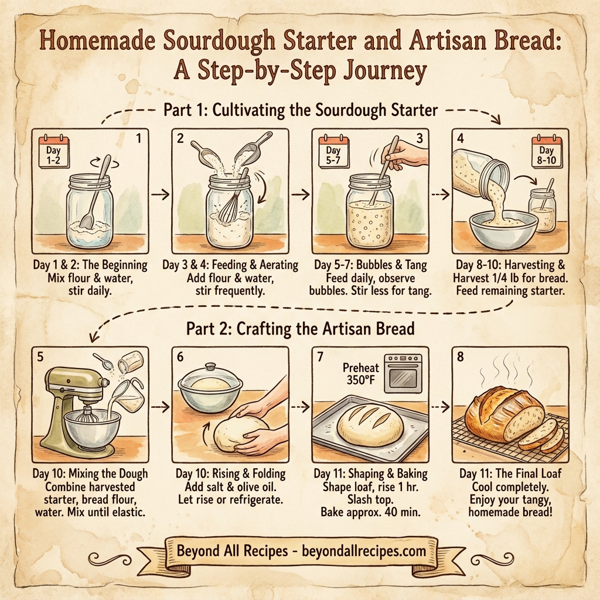
Day 1: In a pint jar, mix 1/2 ounce of all-purpose flour (about 1 tablespoon, packed) and 1 ounce of water (2 tablespoons). Cover the jar loosely with plastic wrap to prevent contaminants. Stir the mixture well several times throughout the day to encourage fermentation.
2
Day 2: Do not feed the starter today. Just give it a stir whenever you think of it to incorporate air.
3
Day 3: Add 1 ounce each of flour and water (2 tablespoons of each) to the jar. Stir the mixture thoroughly and continue to aerate it throughout the day by stirring occasionally.
4
Day 4: Add 1 ounce of flour and 1/2 ounce of water to the starter, achieving a 50/50 ratio of flour to water (100% hydration). Continue to stir frequently.
5
Day 5: Feed the starter again with 1 ounce of flour and 1 ounce of water (2 tablespoons of each). Stir occasionally throughout the day.
6
Day 6: Repeat the feeding by adding 1 ounce of flour and 1 ounce of water (2 tablespoons of each). You should start seeing bubbles forming in the mixture.
7
Day 7: Feed the starter with 1 ounce of flour and 1 ounce of water (2 tablespoons of each) and stir as necessary. To enhance the tanginess, stir less often to allow for the development of lactic acid.
8
Day 8: Continue the routine by adding another 1 ounce each of flour and water (2 tablespoons of each). Stir and observe the growth.
9
Day 9: If your starter is bubbling well, harvest 1/4 pound (4 ounces, or 1/2 cup) into a bowl. To this portion, add 2 tablespoons of flour and 1 tablespoon of water, stir, and cover. Feed the remaining starter in the jar with the usual 1 ounce each of flour and water.
10
Day 10: Feed your starter one more time with 1 ounce each of flour and water. For the bread: In the bowl of a stand mixer equipped with a dough hook, combine the prepared starter with 1/2 pound of bread flour and 1/2 cup of water. Mix on medium-low speed until the dough becomes elastic, about 5 minutes. Add 1 teaspoon of salt and 1 tablespoon of olive oil, mixing until just combined. Form the dough into a ball and place it in a lightly oiled bowl. Let it rise at room temperature for 2-3 hours or refrigerate overnight for more complex flavors.
11
Day 11: After rising, shape the dough into your desired loaf shape and let it rise for about 1 hour. Preheat the oven to 350°F (175°C). Before baking, slash the top of the loaf with a sharp knife to allow for expansion. Bake for approximately 40 minutes, or until the crust is golden brown and sounds hollow when tapped on the bottom. Allow the bread to cool completely on a wire rack before slicing.
Nutrition Information
1.5g
Fat
21g
Carbs
3g
Protein
0.8g
Fiber
Frequently Asked Questions
Frequently Asked Questions
What is the purpose of this sourdough recipe?
This recipe is a comprehensive guide to creating a homemade sourdough starter and crafting a rustic artisan sourdough bread.
How long does it take to create the sourdough starter?
The sourdough starter process takes approximately 10 days of feeding and stirring before it is ready for baking.
What are the initial ingredients for Day 1?
On Day 1, you need 1/2 ounce of all-purpose flour (about 1 tablespoon) and 1 ounce of water (2 tablespoons).
How should I cover the starter jar?
The jar should be covered loosely with plastic wrap to prevent contaminants while allowing gases to escape.
What is the instruction for Day 2?
On Day 2, do not feed the starter; simply stir it whenever you think of it to incorporate air.
How much flour and water is added on Day 3?
On Day 3, add 1 ounce of flour and 1 ounce of water (2 tablespoons of each) and stir thoroughly.
What is special about the feeding on Day 4?
On Day 4, you add 1 ounce of flour and 1/2 ounce of water to achieve a 100% hydration (50/50 ratio) starter.
What are the feeding requirements for Day 5 and Day 6?
On both days, feed the starter with 1 ounce of flour and 1 ounce of water (2 tablespoons of each).
When should I expect to see bubbles in the starter?
You should start seeing bubbles forming in the mixture by Day 6.
How can I make the sourdough starter more tangy?
To enhance the tanginess, stir the mixture less often on Day 7 to allow for the development of lactic acid.
What is the feeding routine for Day 8?
On Day 8, continue the routine by adding 1 ounce each of flour and water (2 tablespoons of each) and observe growth.
How much starter should be harvested on Day 9?
Harvest 1/4 pound (4 ounces or 1/2 cup) of the starter into a separate bowl.
What do I add to the harvested portion on Day 9?
Add 2 tablespoons of flour and 1 tablespoon of water to the harvested portion, then stir and cover.
What are the bread dough ingredients for Day 10?
Combine the prepared starter with 1/2 pound of bread flour, 1/2 cup of water, 1 teaspoon of salt, and 1 tablespoon of olive oil.
What equipment is recommended for mixing the bread dough?
A stand mixer equipped with a dough hook is recommended for mixing the dough.
How long should the dough be mixed in the stand mixer?
Mix on medium-low speed for about 5 minutes until the dough becomes elastic.
When should the salt and olive oil be added?
Add the salt and olive oil after the initial 5 minutes of mixing, then mix until just combined.
How long is the initial rise for the dough?
Let the dough rise at room temperature for 2-3 hours.
Can I refrigerate the dough for the first rise?
Yes, you can refrigerate the dough overnight to develop more complex flavors.
What is the rise time on Day 11?
After shaping the loaf, let it rise for about 1 hour.
At what temperature should the oven be set?
Preheat the oven to 350 degrees Fahrenheit (175 degrees Celsius).
Why should I slash the top of the loaf before baking?
Slashing the top with a sharp knife allows the bread to expand properly during the baking process.
How long does the bread need to bake?
The bread should bake for approximately 40 minutes.
How can I tell if the sourdough bread is fully cooked?
The bread is done when the crust is golden brown and it sounds hollow when tapped on the bottom.
What is the best way to cool the finished bread?
Allow the bread to cool completely on a wire rack before slicing.
What kind of flour is used for the starter?
All-purpose flour is used throughout the 10-day starter cultivation process.
What kind of flour is used for the bread itself?
Bread flour is used for the actual dough on Day 10 to provide better structure.
What type of salt should I use?
You can use either table salt or kosher salt according to your preference.
What is the water temperature for the recipe?
The water should be at room temperature for both the starter and the dough.
How much olive oil is required?
The recipe requires 1 tablespoon of olive oil for the dough mixture.