Homemade Grape Jelly from Frozen Concentrate
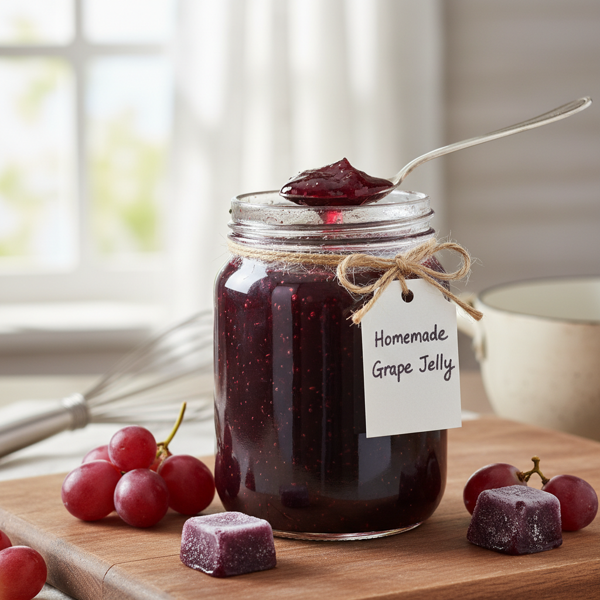
Indulge in the delightful taste of homemade grape jelly made from frozen concentrate! This recipe transforms simple ingredients into a deliciously sweet and smooth jelly that pairs perfectly with toast, biscuits, or even as a filling for desserts. Easy to prepare and perfect for sharing, this grape jelly not only preserves the rich flavor of grapes but also makes for great homemade gifts packed in jars. Enjoy the satisfaction of creating your own jelly with this straightforward method that yields seven 8-ounce jars – an ideal way to fill your pantry or spread joy to friends and family!
N/A
Servings
N/A
Calories
4
Ingredients
Ingredients
Grape Juice Concentrate
11.5 ounces (thawed)
Granulated Sugar
4.5 cups (measured)
Fruit Jell Pectin
1 package (1.75 ounces) (opened)
Water
3 cups (measured)
Instructions
1
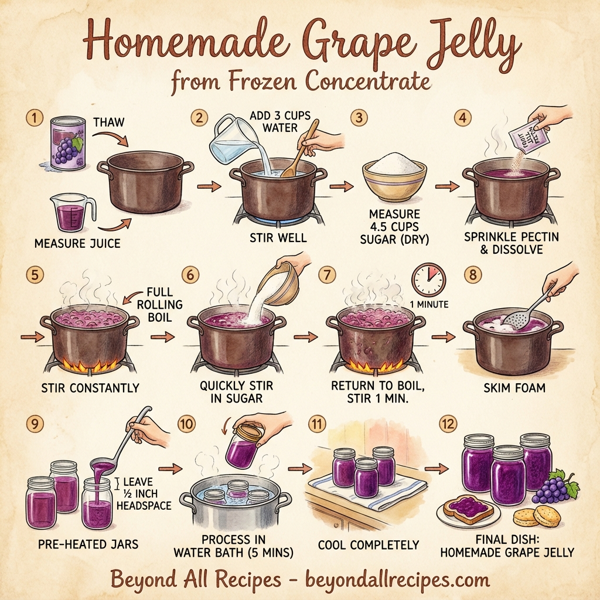
Begin by measuring the thawed grape juice concentrate into a large 6 to 8-quart saucepot.
2
Add 3 cups of water to the pot and stir well to combine.
3
In a separate bowl, measure out 4.5 cups of granulated sugar and set aside, keeping it dry.
4
Sprinkle the Fruit Jell pectin over the juice and water mixture, stirring continuously to dissolve the pectin thoroughly.
5
Place the pot on the stove over medium-high heat and bring the mixture to a full rolling boil, stirring constantly to prevent sticking.
6
Once boiling, quickly stir in the measured sugar, continuing to stir until fully dissolved.
7
Return the mixture to a full rolling boil that cannot be stirred down, and maintain this boil for exactly 1 minute while stirring constantly.
8
Once the time is up, remove the pot from the heat and use a spoon to skim off any foam that has formed on the surface.
9
Immediately ladle the hot jelly mixture into pre-heated glass jars, leaving about ½ inch of headspace at the top.
10
Seal the jars with sterilized lids and process them in a boiling water bath for 5 minutes to ensure proper sealing.
11
Carefully remove the jars from the bath and allow them to cool completely on a clean towel or drying rack before storing.
Nutrition Information
Frequently Asked Questions
Frequently Asked Questions
What is the primary base for this homemade grape jelly?
The primary base is an 11.5-ounce container of thawed grape juice concentrate.
How much water is added to the concentrate?
You should add 3 cups of water to the grape juice concentrate.
How much granulated sugar is required for this recipe?
The recipe requires 4.5 cups of granulated sugar.
What kind of pectin is used in this grape jelly recipe?
One 1.75-ounce package of Fruit Jell Pectin is used.
How many jars does this recipe produce?
This recipe yields approximately seven 8-ounce jars of jelly.
What size saucepot is recommended for cooking the jelly?
A large 6 to 8-quart saucepot is recommended.
How should the pectin be added to the juice mixture?
The pectin should be sprinkled over the juice and water mixture while stirring continuously to ensure it dissolves thoroughly.
At what heat setting should the jelly be cooked?
The mixture should be cooked over medium-high heat.
What is a 'full rolling boil' in jelly making?
A full rolling boil is a boil that continues to bubble vigorously even when the mixture is stirred.
How long should the mixture boil after adding the sugar?
Once it returns to a full rolling boil, it must be maintained for exactly 1 minute while stirring constantly.
Why is it necessary to stir the mixture constantly?
Constant stirring prevents the sugar and juice mixture from sticking or burning on the bottom of the pot.
What should I do with the foam that forms on the surface?
Once removed from heat, use a spoon to skim off any foam to ensure a clear jelly.
How much headspace should be left in the glass jars?
Leave about 1/2 inch of headspace at the top of each jar.
Should the jars be cold or hot when filling them with jelly?
The jelly should be ladled into pre-heated glass jars to prevent the glass from cracking.
How long do the jars need to be processed in a boiling water bath?
They should be processed in a boiling water bath for 5 minutes.
What type of lids should be used to seal the jars?
Sterilized lids should be used to ensure proper sealing and food safety.
How should the jars be cooled after the water bath?
Remove them carefully and let them cool completely on a clean towel or drying rack.
Can this jelly be used as a gift?
Yes, it is described as an ideal homemade gift when packed in jars.
What are the common uses for this grape jelly?
It pairs perfectly with toast and biscuits, and can also be used as a filling for desserts.
How many total ingredients are needed for this recipe?
There are 4 total ingredients: grape juice concentrate, sugar, pectin, and water.
What state should the grape juice concentrate be in when starting?
The concentrate should be thawed before measuring and mixing.
Is it okay to measure the sugar while the juice is heating?
It is best to measure the sugar into a separate bowl and set it aside before you begin heating the juice mixture.
Why is the water bath process important?
The water bath ensures the jars are properly sealed for long-term pantry storage.
What is the texture of the finished jelly?
The result is a deliciously sweet and smooth jelly.
How do you ensure the pectin is well mixed?
By stirring continuously while sprinkling it over the juice and water mixture.
Does this recipe include dietary information like calories or fat?
No, the provided data indicates that calories, fat, protein, and other nutritional values are not specified.
What is the recipe category?
While the category is blank in the data, it is tagged under grape jelly, homemade jelly, fruit preserves, and sweet spreads.
Can I stir down the boil after adding sugar?
No, the final boil should be a full rolling boil that cannot be stirred down.
Should the sugar be wet or dry when adding it?
The sugar should be measured and kept dry in a separate bowl until it is time to stir it into the boiling juice.
How should the juice concentrate be prepared?
It should be thawed from its frozen state before use.