Herman's Friendship Bread Starter
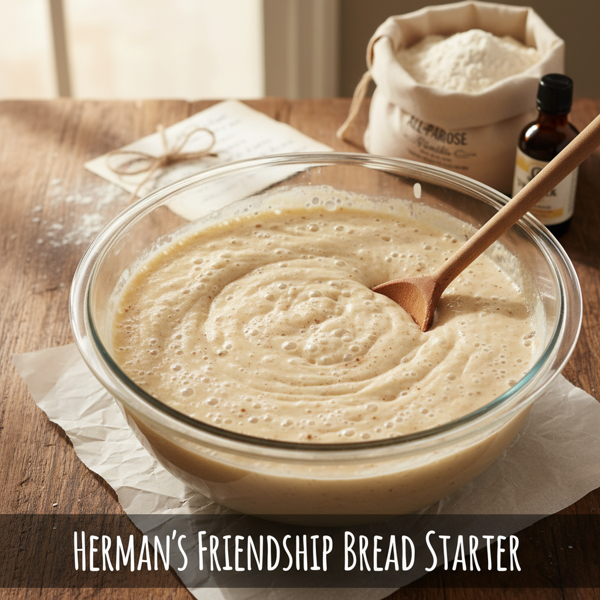
Herman's Friendship Bread Starter is a delightful blend that serves as the foundation for the popular Amish Friendship Bread. This unique starter is not only easy to make but also encourages sharing and connection with friends and family. The process lasts 10 days, resulting in a bubbly, flavorful starter that can be transformed into a delicious bread, perfect for gifting or enjoying at home. Keep this recipe on hand for an endless cycle of baking and bonding!
4
Servings
N/A
Calories
5
Ingredients
Ingredients
Active dry yeast
1 (1/4 ounce) package (None)
Warm water
1/4 cup ((110°F/45°C))
All-purpose flour
3 cups (divided)
White sugar
3 cups (divided)
Milk
3 cups (None)
Instructions
1
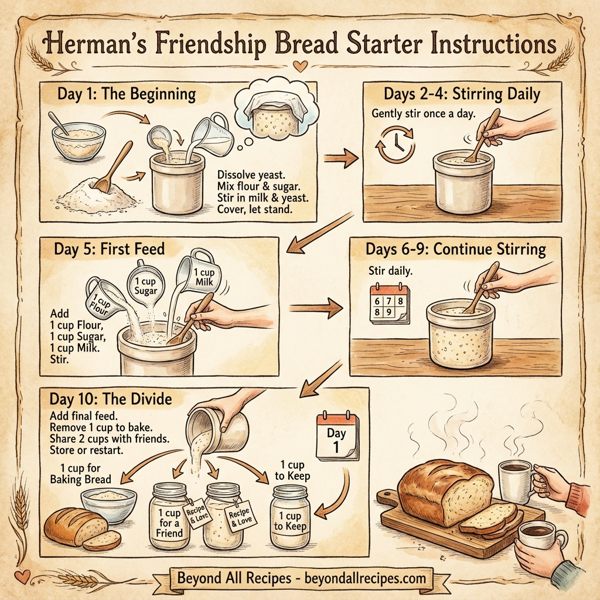
In a small bowl, dissolve the active dry yeast in the warm water. Let it stand for approximately 10 minutes until it becomes frothy.
2
In a 2-quart glass, plastic, or ceramic container, combine 1 cup of flour and 1 cup of sugar. Mix thoroughly to avoid lumps.
3
Slowly stir in 1 cup of milk and the dissolved yeast mixture into the flour-sugar mix until fully combined.
4
Cover the container loosely with a towel or plastic wrap and let it stand at room temperature until bubbly; this marks the beginning of Day 1 of the 10-day cycle.
5
On Days 2 through 4, gently stir the starter once a day with a spoon.
6
On Day 5, add 1 cup of flour, 1 cup of sugar, and 1 cup of milk to the mixture. Stir until well incorporated.
7
From Days 6 to 9, continue to stir the starter daily.
8
On Day 10, add another 1 cup of flour, 1 cup of sugar, and 1 cup of milk, stirring thoroughly to combine.
9
Remove 1 cup of the starter to make your first batch of Amish Friendship Bread.
10
Share 2 cups of the starter with friends, along with this recipe and a favorite Amish Bread recipe.
11
Store the remaining 1 cup of starter in the refrigerator or begin the 10-day process over again from Day 2.
Nutrition Information
Frequently Asked Questions
Frequently Asked Questions
What is Herman's Friendship Bread Starter?
It is a fermented foundation used to make Amish Friendship Bread, designed to be nurtured over 10 days and shared with others.
How long does the starter process take?
The entire process for this starter lasts 10 days.
What type of yeast is required for this recipe?
You need one 1/4 ounce package of active dry yeast.
What temperature should the water be for the yeast?
The water should be warm, approximately 110°F or 45°C.
What kind of container should I use for the starter?
Use a 2-quart container made of glass, plastic, or ceramic.
How many cups of flour are needed in total?
The recipe requires a total of 3 cups of all-purpose flour, added in divided portions.
How many cups of sugar are used in the process?
You will use a total of 3 cups of white sugar, added in stages.
How much milk is needed for the 10-day cycle?
A total of 3 cups of milk are used throughout the 10-day process.
What happens on Day 1 of the cycle?
You dissolve the yeast and mix it with 1 cup of flour, 1 cup of sugar, and 1 cup of milk to begin the fermentation.
What should I do on Days 2, 3, and 4?
During these days, you simply stir the starter gently once a day with a spoon.
When is the first feeding of the starter?
The first feeding occurs on Day 5, where you add 1 cup each of flour, sugar, and milk.
What is the routine for Days 6 through 9?
You must continue to stir the starter once daily from Day 6 until Day 9.
What ingredients are added on Day 10?
On Day 10, add the final 1 cup of flour, 1 cup of sugar, and 1 cup of milk.
How much starter should I use for my first batch of bread?
Remove exactly 1 cup of the starter to bake your first batch of Amish Friendship Bread.
How much of the starter should I give away?
The recipe suggests sharing 2 cups of the starter with friends.
What should I do with the remaining 1 cup of starter?
You can store it in the refrigerator or restart the 10-day cycle from Day 2.
Should I cover the container tightly?
No, the container should be covered loosely with a towel or plastic wrap to allow it to breathe.
How do I know the yeast is ready to be mixed in?
The yeast should stand in warm water for about 10 minutes until it becomes frothy.
Where should the starter be kept during the 10 days?
It should stand at room temperature throughout the fermentation process.
Can I use metal bowls or utensils?
The recipe recommends glass, plastic, or ceramic containers; metal is generally avoided in fermented starters.
What are the total servings produced by this recipe?
The recipe produces 4 cups of starter, which counts as 4 servings of the base.
Is there a specific flour type mentioned?
Yes, the recipe specifies using all-purpose flour.
What are the main tags associated with this recipe?
Common tags include starter, friendship bread, yeast bread, baking, and giftable.
Does the recipe provide nutritional information like calories or fat?
No, the nutritional data for this specific starter recipe is not provided.
How should I share the starter with friends?
Give them 2 cups of the starter along with a copy of the starter recipe and a recipe for the bread itself.
What category does this recipe fall under?
This recipe is categorized under Yeast Breads.
What is the purpose of the 10-day cycle?
The 10-day cycle allows the starter to ferment properly, developing a bubbly texture and flavor.
What should the starter look like at the start of Day 1?
After mixing and sitting at room temperature, it should appear bubbly.
How many ingredients are in this recipe?
There are 5 ingredients: yeast, water, flour, sugar, and milk.
Can I restart the process immediately after Day 10?
Yes, you can begin the 10-day process over again starting from Day 2 using your kept cup of starter.