Herb-Crusted Slow-Roasted Pork
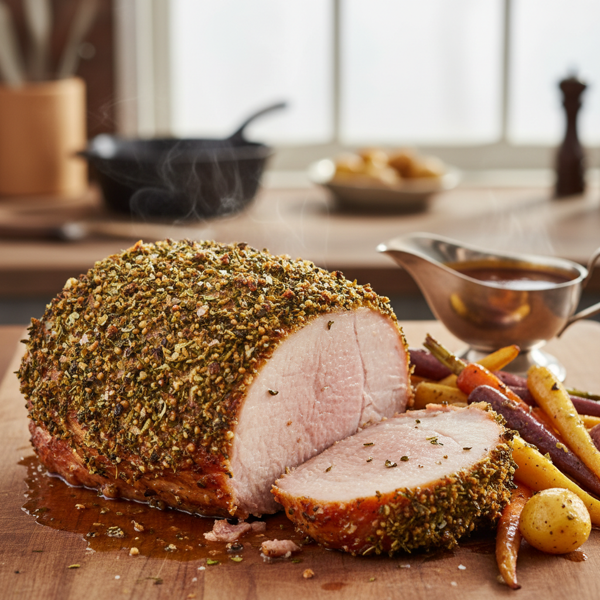
Transform your dinner with this Herb-Crusted Slow-Roasted Pork, bound to impress both family and friends. This succulent dish features a savory blend of fresh sage and rosemary complemented by aromatic garlic and a hint of fennel. As it roasts for six hours at a low temperature, the herbs form a delectable crust while the interior remains incredibly moist and tender. The intoxicating aroma that fills your kitchen will have everyone eagerly awaiting dinner. Serve it with your favorite sides for a comforting meal that highlights the rich flavors of slow cooking.
6
Servings
N/A
Calories
10
Ingredients

Ingredients
Fresh sage
2 tablespoons (finely chopped)
Fresh rosemary
2 tablespoons (finely chopped)
Garlic
10 cloves (peeled)
Fennel seed
1 1/2 tablespoons (whole)
Coarse salt
1 1/2 tablespoons (none)
Cracked black pepper
1 tablespoon (none)
Dry white wine
1 tablespoon (none)
Olive oil
1 tablespoon (none)
Boneless Boston pork roast
6 lbs (not tied, trimmed)
Kitchen twine
as needed (none)
Instructions
1
Preheat the oven to 275°F (135°C).
2
In a food processor, combine the finely chopped sage, rosemary, garlic, fennel seeds, coarse salt, and cracked black pepper. Blend until a thick paste forms.
3
While the motor is running, gradually pour in the dry white wine and olive oil, continuing to blend until all ingredients are well-combined.
4
If necessary, trim the fat from the top of the pork roast, leaving a thin layer about 1/8 inch thick for moisture and flavor.
5
Using a small, sharp knife, make three small incisions, each about 1 inch long and 1 inch deep, on all sides of the pork. Fill each incision with approximately 1 teaspoon of the herb paste.
6
Spread the remaining herb paste over the pork, focusing particularly on the side that has been boned. Tie the roast securely with kitchen twine at 2-inch intervals to maintain its shape during cooking.
7
Place the pork, fat side up, in a sturdy roasting pan and roast it in the middle of the preheated oven for 6 hours, or until the internal temperature reaches 190°F (88°C).
8
After roasting, transfer the pork to a cutting board and let it stand for 15 minutes to allow the juices to redistribute.
9
Carefully remove the kitchen twine. Slice the roast into thick slices using an electric knife or a sharp chef's knife for a clean cut.
Nutrition Information
Frequently Asked Questions
Frequently Asked Questions
What is the name of this recipe?
The recipe is for Herb-Crusted Slow-Roasted Pork.
What is the recommended oven temperature for roasting the pork?
The oven should be preheated to 275°F (135°C).
How long does the pork roast need to cook?
The pork roast should be cooked for 6 hours.
What internal temperature should the pork reach?
The internal temperature should reach 190°F (88°C).
What herbs are used in the crust?
The crust uses fresh sage and fresh rosemary.
How many garlic cloves are required for the recipe?
The recipe calls for 10 cloves of peeled garlic.
What type of pork roast is used?
The recipe uses a 6 lb boneless Boston pork roast.
How much fennel seed is needed?
You will need 1 1/2 tablespoons of whole fennel seeds.
What liquids are blended into the herb paste?
Dry white wine and olive oil are added to the herb paste.
How thick should the fat layer be on the pork roast?
Trim the fat to a thin layer about 1/8 inch thick.
How deep should the incisions in the pork be?
The incisions should be about 1 inch long and 1 inch deep.
How many incisions should be made in the pork?
Make three small incisions on all sides of the pork roast.
How much herb paste goes into each incision?
Fill each incision with approximately 1 teaspoon of the herb paste.
How should the roast be tied?
Tie the roast securely with kitchen twine at 2-inch intervals.
Which side should face up during roasting?
Place the pork fat side up in the roasting pan.
Where should the roasting pan be placed in the oven?
The pan should be placed in the middle of the preheated oven.
How long should the pork rest after roasting?
The pork should stand for 15 minutes before slicing.
What tools are recommended for slicing the pork?
An electric knife or a sharp chef's knife is recommended for clean slices.
How many servings does this recipe yield?
This recipe yields 6 servings.
What type of salt is best for the herb rub?
Coarse salt is recommended for the herb paste.
How do you prepare the sage and rosemary?
The fresh sage and rosemary should be finely chopped.
What is the purpose of the kitchen twine?
The twine helps maintain the roast's shape during the long cooking process.
What equipment is used to create the herb paste?
A food processor is used to blend the herbs, garlic, and spices into a thick paste.
What kind of pepper should be used?
The recipe specifies 1 tablespoon of cracked black pepper.
When should the white wine and olive oil be added to the paste?
Gradually pour them in while the motor of the food processor is running.
Which side of the roast should get the most herb paste?
Focus particularly on the side that has been boned when spreading the remaining paste.
Should the pork be tied before or after adding the herb paste?
The pork should be tied after applying the herb paste to the surface.
What type of pan is suggested for this recipe?
A sturdy roasting pan is suggested for the 6-hour roasting time.
Is the Boston pork roast trimmed before cooking?
Yes, if necessary, trim the fat to leave only a thin layer.
Why is the pork rested before slicing?
Resting allow the juices to redistribute, ensuring the meat remains moist.