Grandma's Fluffy Holiday Rolls
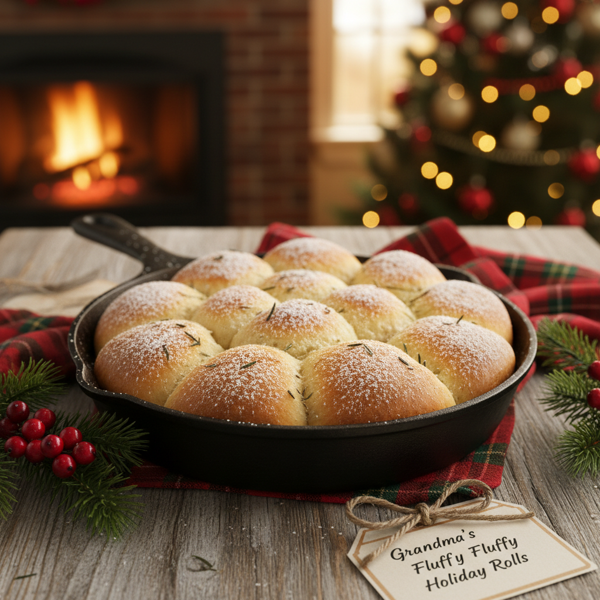
These fluffy holiday rolls are a cherished family favorite that grace our dinner tables each Thanksgiving and Christmas. Passed down through generations, this recipe from my grandmother’s collection captures the warmth and love of home-cooked meals. The rolls are soft, buttery, and perfect for sopping up gravy or enjoying with a spread of sweet butter. Ideal for large gatherings or intimate family dinners, these rolls will become a staple at your holiday celebrations.
50
Servings
60
Calories
8
Ingredients
Ingredients
Yeast
2 (1/4 ounce) packages (active dry yeast)
Lukewarm water
1/2 cup
Lukewarm milk
1 1/2 cups
Sugar
1/2 cup
Salt
2 teaspoons
Eggs
2 (beaten)
Shortening
1/2 cup (softened)
All-purpose flour
6 - 6 1/2 cups (divided)
Instructions
1
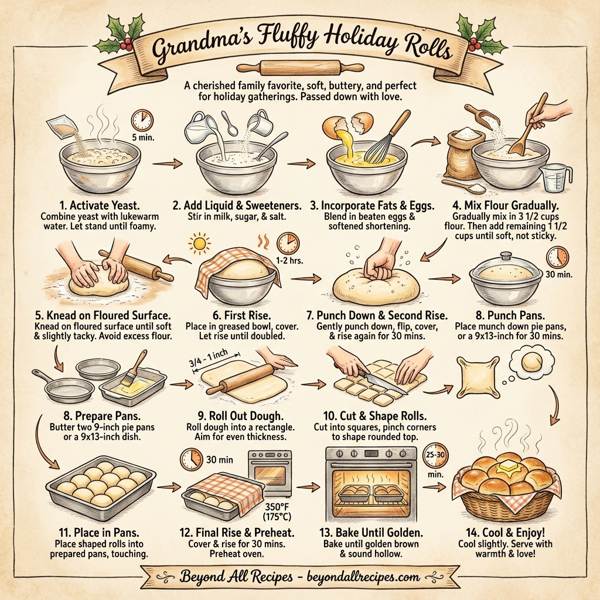
In a large mixing bowl, combine the yeast with 1/2 cup of lukewarm water and let it stand for about 5 minutes until foamy. This activates the yeast.
2
Add the lukewarm milk, sugar, and salt to the yeast mixture. Stir until well combined.
3
Next, incorporate the beaten eggs and softened shortening into the mixture. Blend until smooth.
4
Gradually mix in 3 1/2 cups of flour until thoroughly combined, then add another 1 1/2 cups of flour gradually, mixing until the dough is soft yet not overly sticky.
5
On a floured surface, place 1 cup of flour. Transfer the dough onto the flour and knead, incorporating any remaining flour until the dough is soft and slightly tacky. Avoid adding excess flour, or the rolls may turn dense.
6
Clean the mixing bowl and grease it with shortening. Place the dough back into the bowl, cover it with a towel, and allow it to rise in a warm area for 1 to 2 hours or until doubled in size.
7
Once risen, gently punch down the dough to release air and flip it over. Cover again and let rise for an additional 30 minutes.
8
Prepare your baking pans by buttering two 9-inch pie pans or a 9x13-inch baking dish.
9
Roll out the dough on a lightly floured surface into a rectangle about 3/4 to 1 inch thick. Don’t worry about the shape; just aim for an even thickness.
10
Cut the rolled dough into squares measuring 1-1 1/2 inches. For each square, pinch the dough’s corners together to shape a rounded top. You can visualize this as making a bubble with gum – pinch the ends to form a round shape.
11
Place the shaped dough balls into the prepared pans, ensuring they are touching each other.
12
Cover the pans with a towel and let the rolls rise for another 30 minutes. Preheat your oven to 350°F (175°C).
13
Bake the rolls for about 25-30 minutes or until the tops are golden brown and they sound hollow when tapped.
14
Remove from the oven and allow to cool slightly before serving. Enjoy the warmth and love with your family!
Nutrition Information
3.2g
Fat
8.4g
Carbs
0.6g
Protein
Frequently Asked Questions
Frequently Asked Questions
What is the origin of Grandma's Fluffy Holiday Rolls?
This is a cherished family recipe passed down through generations from the creator's grandmother's collection.
What holidays are these rolls typically served for?
These rolls are traditionally served during Thanksgiving and Christmas holiday dinners.
What type of yeast is required for this recipe?
The recipe calls for 2 packages (1/4 ounce each) of active dry yeast.
How do you activate the yeast?
Combine the yeast with 1/2 cup of lukewarm water and let it stand for about 5 minutes until it becomes foamy.
What temperature should the milk and water be?
Both the milk and water should be lukewarm to ensure the yeast activates properly without being killed by high heat.
How much sugar is included in the dough?
The recipe uses 1/2 cup of sugar to provide a slight sweetness to the rolls.
When should the eggs be added to the mixture?
Beaten eggs should be incorporated into the mixture after the yeast, milk, sugar, and salt are combined.
What type of fat is used in Grandma's Fluffy Holiday Rolls?
The recipe uses 1/2 cup of softened shortening for a tender and fluffy texture.
How much flour is needed in total?
The recipe requires between 6 and 6 1/2 cups of all-purpose flour in total, added in stages.
How do you begin mixing the flour?
Start by gradually mixing in 3 1/2 cups of flour until thoroughly combined.
When is the second batch of flour added?
After the first 3 1/2 cups, add another 1 1/2 cups of flour gradually until the dough is soft.
How much flour is used for the kneading process?
Approximately 1 cup of flour is placed on a surface for kneading the dough.
What should the dough feel like after kneading?
The dough should be soft and slightly tacky, but not overly sticky.
Why shouldn't I add too much flour?
Adding excess flour can make the rolls turn out dense instead of fluffy.
How should the bowl be prepared for the first rise?
The mixing bowl should be cleaned and greased with shortening before placing the dough back inside.
How long is the first rise period?
The dough should rise in a warm area for 1 to 2 hours or until it has doubled in size.
What do you do after the first rise?
Gently punch down the dough to release air, flip it over, and let it rise again.
How long is the second rise?
The second rise, after punching down the dough, lasts for 30 minutes.
What type of pans can be used for baking?
You can use two buttered 9-inch pie pans or one 9x13-inch baking dish.
How thick should the dough be rolled out?
Roll the dough into a rectangle that is approximately 3/4 to 1 inch thick.
How are the rolls shaped?
Cut the dough into 1 to 1 1/2 inch squares and pinch the corners together to form a rounded top.
How should the rolls be placed in the pan?
Place the shaped dough balls in the pan so that they are touching each other.
Is there a third rise?
Yes, once shaped in the pans, the rolls should rise for a final 30 minutes before baking.
What is the required oven temperature?
Preheat the oven to 350 degrees Fahrenheit (175 degrees Celsius).
How long do the rolls take to bake?
The rolls bake for about 25 to 30 minutes until golden brown.
How can you tell if the rolls are done?
The rolls are done when the tops are golden brown and they sound hollow when tapped.
How many servings does this recipe make?
This recipe yields approximately 50 individual rolls.
What is the calorie count per roll?
Each roll contains approximately 60 calories.
How much fat and carbohydrates are in each roll?
Each serving has 3.2 grams of fat and 8.4 grams of carbohydrates.
What are the best ways to serve these rolls?
They are perfect for sopping up gravy or enjoying with a spread of sweet butter.