Gourmet Hard Rolls for Bratwurst
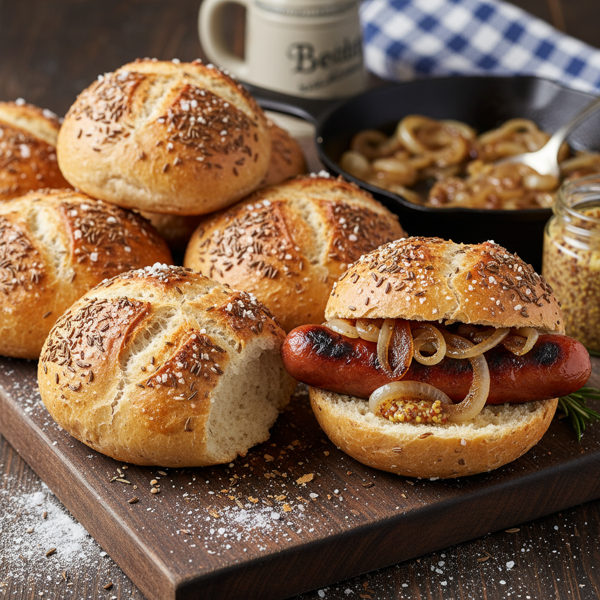
These Gourmet Hard Rolls are the perfect accompaniment for bratwurst, elevating any outdoor barbecue or dinner gathering. Inspired by traditional German Brochen and New York-style hard rolls, these buns are crusty on the outside while remaining soft and airy on the inside. With a simple blend of unbleached flour, instant yeast, and a touch of butter, these rolls celebrate authentic flavors that pair beautifully with savory sausages. Shape them as you prefer—omit the egg wash for a classic Brochen presentation or apply the wash for a shiny finish reminiscent of New York bakery rolls. Enjoy them fresh and warm, right out of the oven, and delight your friends and family with this delectable homemade treat.
N/A
Servings
500
Calories
7
Ingredients
Ingredients
Unbleached All-Purpose Flour
500 g (4 cups)
Water
313 g (11 ounces)
Salt
10 g (1 2/3 teaspoons table salt)
Instant Yeast
3 g (1 teaspoon)
Sugar
5 g (1 teaspoon)
Butter
10 g (2 teaspoons, softened)
Egg
1 (beaten with 1 teaspoon water for optional wash)
Instructions
1
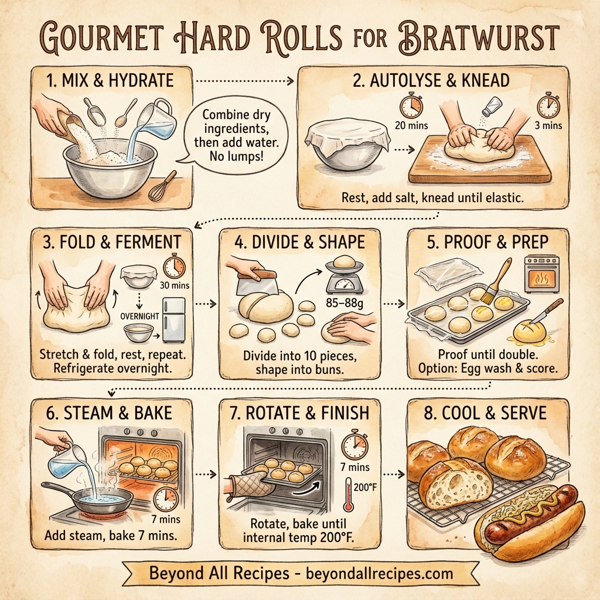
In a large mixing bowl, combine the flour, sugar, and instant yeast. Mix well to ensure even distribution.
2
Gradually add the water to the dry ingredients, stirring until all the flour is hydrated and there are no lumps.
3
Cover the bowl with a clean cloth or plastic wrap and let the dough rest for 20 minutes to allow for autolyse.
4
Sprinkle the salt over the rested dough, then transfer the dough to a lightly floured countertop. Knead for 3 minutes until the dough is uniform and slightly elastic. Cover and allow to rest for 10 minutes.
5
Perform a stretch and fold technique by folding the dough letter-style (top to bottom, then side to side). Cover and let rest for 30 minutes.
6
Repeat the stretch and fold method once more, then cover the dough and place it in the refrigerator overnight.
7
The next morning, check the dough; if it hasn't doubled in volume, let it sit at room temperature until it rises adequately.
8
Divide the dough into 10 pieces, weighing between 85 to 88 grams each. Shape the pieces into round buns or your desired form.
9
Preheat the oven to 450°F (230°C). Place a pan for steaming at the bottom of the oven and allow it to heat up.
10
Cover the shaped dough with oiled plastic wrap and let them proof until they have expanded to 1.5 to 2 times their original volume.
11
Optionally, brush the tops of the rolls with the egg wash for a glossy finish, and make a single score down the center of each roll.
12
Once the rolls are ready, carefully pour 1 cup of hot water into the steam pan to create steam, being cautious not to splash.
13
Immediately place the rolls in the oven and bake for 7 minutes. Rotate the pan and bake for an additional 7 minutes, or until the internal temperature reaches 200°F (93°C).
14
Remove the rolls from the oven and let them cool slightly on a wire rack before serving.
Nutrition Information
4 g
Fat
93 g
Carbs
16 g
Protein
3 g
Fiber
Frequently Asked Questions
Frequently Asked Questions
What are Gourmet Hard Rolls for Bratwurst?
These are homemade rolls featuring a crusty exterior and a soft, airy interior, designed specifically to accompany savory sausages like bratwurst. They are inspired by traditional German Brochen and New York-style hard rolls.
How many rolls does this recipe make?
This recipe makes 10 individual rolls, with each dough piece weighing between 85 and 88 grams.
What type of flour is best for these hard rolls?
The recipe calls for 500 grams (approximately 4 cups) of unbleached all-purpose flour.
How much yeast is required?
You will need 3 grams of instant yeast, which is roughly 1 teaspoon.
What is the purpose of the 20-minute autolyse step?
The autolyse step allows the flour to fully hydrate and the gluten to begin forming naturally before salt and intensive kneading are introduced.
Why does the dough need to be refrigerated overnight?
Cold fermentation in the refrigerator overnight helps develop a more complex flavor and improves the final texture of the crumb.
What is the stretch and fold technique used in this recipe?
It is a method where the dough is folded letter-style (top to bottom, then side to side) to build strength and elasticity without heavy kneading.
At what temperature should the oven be preheated?
The oven should be preheated to 450°F (230°C).
How do I create steam in the oven for a crusty finish?
Place a pan at the bottom of the oven during preheating, then carefully pour 1 cup of hot water into it just before you start baking the rolls.
How long do the rolls need to bake?
The rolls bake for a total of 14 minutes: 7 minutes initially, then rotate the pan and bake for another 7 minutes.
What should the internal temperature of the rolls be when done?
The rolls are fully baked when they reach an internal temperature of 200°F (93°C).
How do I achieve a shiny, bakery-style finish?
Brush the tops of the shaped rolls with an egg wash (one egg beaten with a teaspoon of water) before placing them in the oven.
Can I make these rolls without an egg wash?
Yes, omitting the egg wash will give you a classic, matte German Brochen presentation.
How much water is used in the dough?
The dough uses 313 grams of water, which is approximately 11 ounces.
Is there sugar in these rolls?
Yes, the recipe uses 5 grams (1 teaspoon) of sugar to help with yeast activity and browning.
What amount of butter is required?
The recipe calls for 10 grams (2 teaspoons) of softened butter.
How much salt is in the recipe?
There are 10 grams of salt, which is about 1 2/3 teaspoons of table salt.
How much do the rolls proof before baking?
They should proof until they have expanded to 1.5 to 2 times their original volume.
Should I score the rolls?
Yes, make a single score down the center of each roll before putting them in the oven.
How many calories are in these rolls?
Each serving contains approximately 500 calories.
What is the protein content of these rolls?
Each serving provides 16 grams of protein.
What is the carbohydrate content?
Each serving contains 93 grams of carbohydrates.
How much fat is in one roll?
Each serving has 4 grams of fat.
Does this recipe contain fiber?
Yes, each serving contains 3 grams of dietary fiber.
What are the total number of ingredients needed?
There are 7 ingredients: flour, water, salt, instant yeast, sugar, butter, and an optional egg.
Can I use active dry yeast instead of instant?
While the recipe specifies instant yeast, you can use active dry yeast if you activate it in warm water first, though rising times may vary.
What happens if the dough hasn't doubled in the morning?
If it hasn't doubled after the overnight cold ferment, let it sit at room temperature until it rises adequately before shaping.
How should the rolls cool?
Remove them from the oven and let them cool slightly on a wire rack to prevent the bottoms from getting soggy.
Are these rolls suitable for barbecues?
Absolutely, their crusty exterior makes them the perfect hearty accompaniment for grilled sausages and barbecue sides.
How long is the initial kneading process?
The dough should be kneaded for about 3 minutes until it is uniform and slightly elastic.