Golden Swedish Saffron Buns - Festive Lussekatter
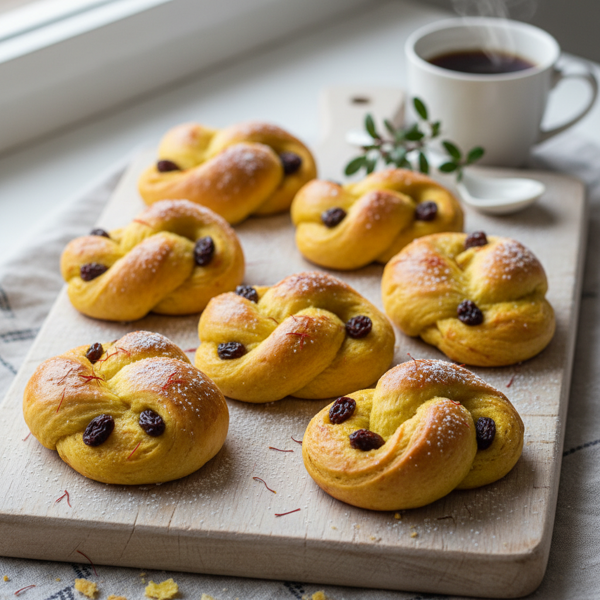
Celebrate the charming Swedish tradition of 'Lucia' Day with these exquisite saffron-flavored buns, a delightful nod to the Italian Saint Lucia. Known as 'Lussekatter' in Sweden, these buns symbolize warmth and light during the dark winter months. Often shaped like mythical 'Lucia cats,' these buns have been gracing Swedish holiday tables for centuries, reflecting both ancient Christmas festivities and contemporary culinary delights. Each bite offers a fragrant embrace of saffron and the subtle sweetness of raisins, ensuring that these buns are as memorable as they are delicious.
24
Servings
175
Calories
9
Ingredients

Ingredients
milk
300 ml (warm to 37°C)
saffron
1 g (to be mixed with milk and butter)
baker's yeast
50 g (finely divided)
sugar
150 g (to be mixed in dough)
butter or margarine
125 g (melted)
all-purpose flour
700 g (to be mixed in dough)
egg
1 (beaten)
salt
pinch (to enhance flavor)
raisins
to taste (for decoration)
Instructions
1
In a pan, melt the butter or margarine gently, then add the milk and saffron.
2
Continue to warm the mixture until it reaches 37°C (100°F). A thermometer is recommended for accuracy.
3
Pour this warm saffron milk over the finely crumbled yeast in a large mixing bowl.
4
Add the sugar, all-purpose flour, and a pinch of salt to the bowl, ensuring all ingredients are at room temperature (21-23°C or 72-75°F).
5
Mix everything together until a smooth, elastic dough forms.
6
Cover the dough with a clean cloth and allow it to rise in a warm place for approximately 30 minutes or until it doubles in size.
7
Once risen, knead the dough lightly and divide it into 25-30 equal pieces.
8
Roll each piece into a ball and let them rest under a cloth for a few minutes.
9
Shape each dough ball into a string about 15-20 cm long, then twist it into a classic 'S' or double 'S' shape, bringing the ends together.
10
Decorate each bun with raisins, pressing them gently into the dough.
11
Cover the shaped buns with a cloth and allow them to rise for an additional 40 minutes.
12
In a small bowl, beat the egg with a pinch of salt and brush this egg wash over the buns for a shiny finish.
13
Preheat your oven to 250°C (475°F) and bake the buns for 5-10 minutes, or until they achieve a rich golden-brown hue.
Nutrition Information
5.8 g
Fat
28 g
Carbs
3.3 g
Protein
Frequently Asked Questions
Frequently Asked Questions
What are Golden Swedish Saffron Buns?
Also known as Lussekatter, these are traditional Swedish saffron-flavored buns often baked for Lucia Day to symbolize warmth and light.
What is the significance of the 'S' shape?
The 'S' shape is traditional for these buns, which are often called 'Lucia cats' and have been a part of Swedish holiday tables for centuries.
What is the ideal temperature for the milk and butter mixture?
The mixture should be warmed to 37°C (100°F) before being added to the yeast.
How much saffron is required for this recipe?
This recipe calls for 1 gram of saffron to achieve its signature fragrance and golden color.
How long does the dough need to rise initially?
The dough should rise in a warm place for approximately 30 minutes or until it doubles in size.
What is the second rising time for the buns?
After shaping, the buns should be covered and allowed to rise for an additional 40 minutes.
What oven temperature is used for baking Lussekatter?
The oven should be preheated to a high temperature of 250°C (475°F).
How many buns does this recipe yield?
The recipe is designed to produce approximately 24 to 30 buns depending on the size of the pieces.
How long do the saffron buns need to bake?
They bake very quickly, usually taking only 5 to 10 minutes until they are golden-brown.
What is used for the egg wash?
A beaten egg mixed with a pinch of salt is brushed over the buns to give them a shiny finish.
What type of yeast is used in this recipe?
The recipe calls for 50 grams of baker's yeast, which should be finely crumbled.
How many calories are in one saffron bun?
Each serving contains approximately 175 calories.
How much flour is needed for the dough?
The recipe requires 700 grams of all-purpose flour.
What is the fat content per serving?
Each bun contains about 5.8 grams of fat.
Can I use margarine instead of butter?
Yes, the recipe specifies that either 125 grams of butter or margarine can be used.
How much sugar is included in the dough?
The recipe uses 150 grams of sugar for a subtle sweetness.
What are the buns decorated with?
Raisins are pressed into the dough to decorate each end of the 'S' shape.
What is the protein content of a Lussekatter bun?
Each bun provides approximately 3.3 grams of protein.
What is the carbohydrate count per serving?
There are 28 grams of carbohydrates in each serving.
Is a thermometer necessary for this recipe?
A thermometer is highly recommended to ensure the milk reaches exactly 37°C for optimal yeast activation.
What room temperature is best for the ingredients?
Ingredients like flour and sugar should ideally be at a room temperature of 21-23°C (72-75°F).
How long should the dough strings be when shaping?
Each piece of dough should be rolled into a string about 15-20 cm long before twisting into an 'S'.
Do these buns contain salt?
Yes, a pinch of salt is added to the dough to enhance the flavor.
How do you ensure the dough is the right consistency?
Mix the ingredients until a smooth and elastic dough forms.
Should the dough rest after being divided?
Yes, after dividing the dough into 25-30 pieces, let them rest under a cloth for a few minutes.
When is Lucia Day celebrated?
Lucia Day is a traditional Swedish celebration occurring in December.
Are raisins added before or after baking?
Raisins are pressed into the dough after the buns are shaped but before the second rise and baking.
What color should the buns be when finished?
They should achieve a rich golden-brown hue.
How much milk is used in the recipe?
The recipe uses 300 ml of milk.
Can these buns be part of a festive table?
Absolutely, they have been gracing Swedish holiday tables for centuries as a symbol of winter light.