Festive Epiphany King Cake
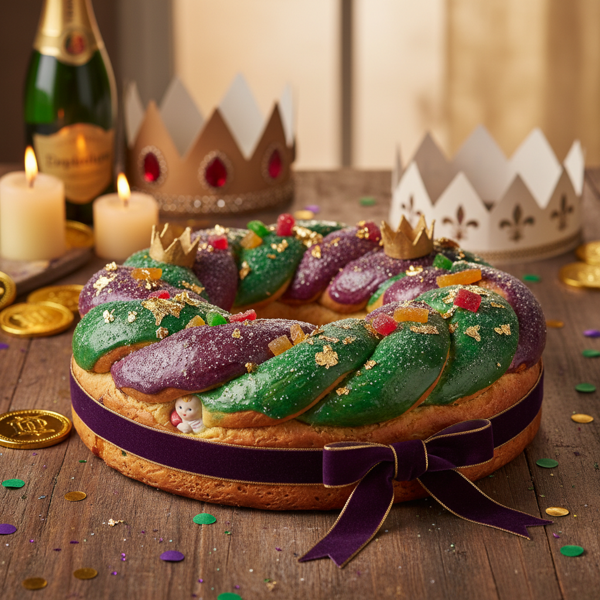
Celebrate the joyous occasion of Epiphany with this traditional New Orleans King Cake, a beloved treat that marks the arrival of the Wise Men. Traditionally enjoyed during Twelfth Night parties, this decadent cake is made with a rich, buttery Danish dough, enveloping delicious flavors of nutmeg and cinnamon. Enhanced with a vibrant frosting and festive colored sugars, it represents the spirit of Mardi Gras with its royal purple (justice), deep green (faith), and bright gold (power) hues. Every slice holds the fun tradition of hiding a tiny figurine inside, bringing good luck to the finder and encouraging them to host the next celebration. Perfect for gatherings, this King Cake not only delights your palate but also embodies the sense of community and joy that comes with celebrating together.
10
Servings
N/A
Calories
22
Ingredients
Ingredients
water
1/2 cup (heated to 110-115 degrees F)
active dry yeast
2 packages
sugar
1/2 cup
sugar
1 teaspoon
flour
3 1/2-4 1/2 cups (unsifted)
nutmeg
1 teaspoon
salt
2 teaspoons
lemon zest
1 teaspoon
warm milk
1/2 cup
egg yolks
5
butter
1/2-1 cup (softened and cut into slices)
softened butter
2 tablespoons
milk
1 tablespoon
egg
1 (slightly beaten with milk)
cinnamon
1 teaspoon
green food coloring paste
as needed
purple food coloring paste
as needed
yellow food coloring paste
as needed
sugar
12 tablespoons
confectioners' sugar
3 cups
lemon juice
1/4 cup
water
3-6 tablespoons
Instructions
1
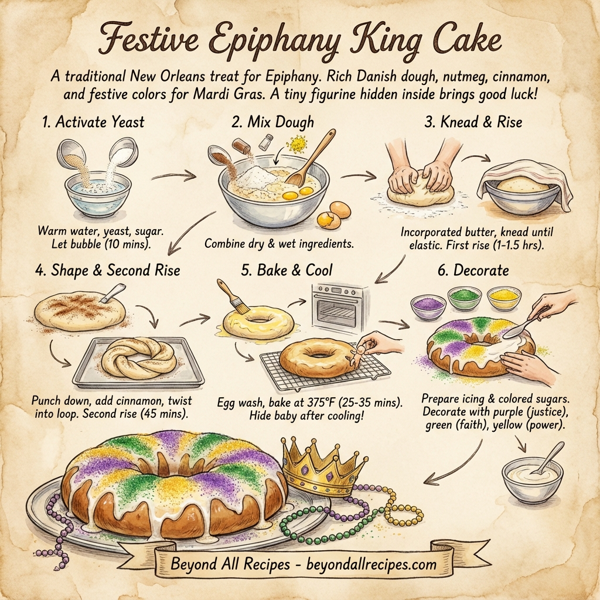
Begin by pouring 1/2 cup of warm water into a small shallow bowl. Sprinkle the active dry yeast and 2 teaspoons of sugar on top of the water. Allow the mixture to rest for 3 minutes before mixing thoroughly.
2
Set the bowl in a warm area for approximately 10 minutes until the yeast bubbles and nearly doubles in volume.
3
In a large mixing bowl, sift together 3 1/2 cups of flour, remaining 1/2 cup of sugar, nutmeg, and salt. Stir in the lemon zest.
4
Create a well in the center of the dry mixture and pour in the activated yeast mixture along with the warm milk.
5
Add the egg yolks and gradually mix in the dry ingredients using a wooden spoon until the mixture is smooth.
6
Incorporate 8 tablespoons of softened butter incrementally and continue to beat for about 2 minutes, or until the dough forms a medium-soft ball.
7
Transfer the dough to a lightly floured surface and begin kneading it as you add more flour (up to 1 cup), one tablespoon at a time, until the dough is no longer sticky.
8
Continue to knead for an additional 10 minutes until the dough is shiny and elastic.
9
Butter the interior of a large bowl with 1 tablespoon of softened butter and place the dough inside, turning it to coat the surface.
10
Cover the bowl with a thick kitchen towel and set it in a draft-free area for 1 to 1.5 hours until the dough has doubled in size.
11
Grease a large baking sheet with 1 tablespoon of butter and set it aside.
12
Once the dough has risen, punch it down with your fist and sprinkle the cinnamon on top. Shape the dough into a cylinder and twist it into a loop on the baking sheet, pinching the ends to form a circle.
13
Cover the dough with the towel and let it rise again in a draft-free environment for about 45 minutes.
14
Preheat the oven to 375°F (190°C). Brush the top and sides of the cake with the egg wash and bake for 25 to 35 minutes until golden brown.
15
Let the cake cool on a wire rack. If desired, hide a plastic baby inside the cake at this time.
16
To prepare the colored sugars, place a dot of green, purple, and yellow food coloring paste in your palm and mix with 2 tablespoons of sugar, rubbing until combined. Set aside on wax paper and wash your hands.
17
For the icing, mix confectioners' sugar, lemon juice, and 3 tablespoons of water until smooth. Adjust with additional water as needed.
18
Spread the icing over the cooled cake and immediately decorate with the colored sugars in alternating rows of green, purple, and yellow.
Nutrition Information
Frequently Asked Questions
Frequently Asked Questions
What is a Festive Epiphany King Cake?
The Festive Epiphany King Cake is a traditional New Orleans dessert made with a rich, buttery Danish dough flavored with nutmeg and cinnamon, typically served during Twelfth Night and Mardi Gras celebrations.
What do the colors on the King Cake represent?
The traditional colors are purple, green, and gold. Purple represents justice, green represents faith, and gold represents power.
What is the tradition of the hidden figurine?
A tiny plastic baby or figurine is hidden inside the cake. The person who finds it is said to have good luck and is traditionally responsible for hosting the next celebration or buying the next King Cake.
At what temperature should the water be for the yeast?
The water should be heated to between 110 and 115 degrees F to properly activate the active dry yeast.
How long should I let the yeast mixture sit?
After sprinkling the yeast and sugar on the water, let it rest for 3 minutes, then mix and set in a warm area for about 10 minutes until it bubbles and doubles in volume.
How many egg yolks are needed for this recipe?
This recipe requires 5 egg yolks to create the rich, golden dough.
What kind of dough is used for a King Cake?
This recipe uses a buttery Danish-style dough that is kneaded until shiny and elastic.
How long is the first rising period for the dough?
The dough should rise in a buttered bowl in a draft-free area for 1 to 1.5 hours until it has doubled in size.
How long is the second rising period?
After shaping the dough into a loop, it should rise a second time for approximately 45 minutes.
How do I shape the King Cake?
Shape the dough into a cylinder, then twist it into a loop and pinch the ends together to form a continuous circle.
What temperature should the oven be set to?
The oven should be preheated to 375 degrees F (190 degrees C).
How long does the King Cake take to bake?
The cake typically bakes for 25 to 35 minutes until it reaches a golden brown color.
When should I add the plastic baby?
The plastic baby should be hidden inside the cake after it has been baked and allowed to cool on a wire rack.
How do I make the colored sugars?
Mix a dot of food coloring paste with 2 tablespoons of sugar in your palm and rub until the color is evenly distributed.
What are the ingredients for the icing?
The icing is made from 3 cups of confectioners' sugar, 1/4 cup of lemon juice, and 3 to 6 tablespoons of water.
How many servings does this recipe provide?
This recipe makes approximately 10 servings.
What should I do if the icing is too thick?
You can adjust the consistency of the icing by adding additional water, one tablespoon at a time, until smooth.
Is there lemon in the dough?
Yes, 1 teaspoon of lemon zest is stirred into the flour mixture to add a bright flavor to the dough.
What is the purpose of the egg wash?
Brushing the top and sides with an egg wash (egg beaten with milk) before baking helps the cake achieve a beautiful golden brown finish.
How much butter is needed for the dough itself?
The recipe calls for 1/2 to 1 cup of softened butter to be incorporated into the dough incrementally.
How much flour is used in total?
The recipe uses between 3 1/2 and 4 1/2 cups of flour, starting with 3 1/2 cups and adding more during the kneading process.
What spices are included in the recipe?
The cake is flavored with 1 teaspoon of nutmeg in the dough and 1 teaspoon of cinnamon sprinkled on top before shaping.
Can I use food coloring liquid instead of paste?
While the recipe specifies paste for more vibrant colors, liquid coloring can be used, though it may require more sugar to maintain a dry consistency.
How do I know the dough has been kneaded enough?
The dough is ready when it is shiny, elastic, and no longer sticks to your hands or the surface.
What is the significance of the 12 tablespoons of sugar listed?
The 12 tablespoons are divided into three portions (4 tablespoons each) to be mixed with the three different food colors for decoration.
When do I apply the colored sugars?
Spread the icing over the cooled cake and immediately decorate with the sugars so they stick to the wet icing.
Why do I need to punch down the dough?
Punching down the dough after the first rise releases air bubbles and allows for better texture and flavor development during the second rise.
Is the milk in the dough warm or cold?
The recipe specifies using 1/2 cup of warm milk to help maintain the temperature needed for the yeast to work.
Can the cake be eaten immediately?
Yes, once the icing has been applied and the sugars are set, the cake is ready to be served and enjoyed.
What should I do if the yeast does not bubble?
If the yeast does not bubble after 10 minutes, it may be expired or the water was too hot/cold; you should start over with fresh yeast and regulated water temperature.