Creative Sushi Rolls: A Fun and Flavorful DIY Experience

Making sushi at home can be an exhilarating culinary adventure, and with this easy-to-follow guide, you'll be able to create delicious sushi rolls that will impress your family and friends. This tutorial empowers you to unleash your creativity by choosing from a variety of vegetables, fishes, and sauces to craft your perfect sushi roll. From traditional ingredients like cucumbers and avocado to unique additions like tempura shrimp, smoked salmon, or tempura vegetables, the possibilities are endless. Additionally, we'll share tips for rolling techniques, presentation ideas, and suggestions for complementary sauces and condiments. Get ready to roll up your sleeves and dive into the delightful world of sushi making!
N/A
Servings
N/A
Calories
11
Ingredients
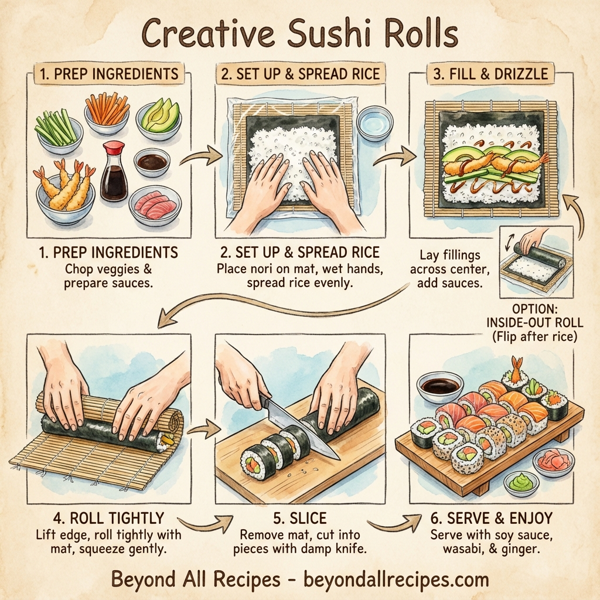
Ingredients
Nori sheet
1 sheet (To be used as the base for sushi.)
Sushi rice
1 cup (Prepared and seasoned; ready to spread.)
Vegetables
Your choice (Cut into long thin strips (e.g., cucumber, carrots, avocado).)
Fish
Your choice (Raw or tempura; sliced or prepared as desired.)
Spicy mayonnaise
To taste (For drizzling over ingredients.)
Masago (smelt roe)
Optional (For topping.)
Toasted sesame seeds
Optional (For garnishing.)
Soy sauce
Optional (For dipping.)
Wasabi
Optional (For serving.)
Pickled ginger
Optional (For serving.)
Eel sauce
Optional (Drizzle over sushi before serving.)
Instructions
1
Prepare any sauces you'll be using in advance so they are ready to go.
2
Chop your vegetables into thin strips, approximately 1/4 inch wide, using your favorite selections such as cucumbers (seeds removed), carrots, avocados, and green onions.
3
If using Tempura Shrimp, position two large shrimp end to end on your roll. For Tempura Soft Shelled Crab, lay one crab with claws extending from each end of the roll.
4
For rolls topped with raw fish (like a Rainbow Roll), slice the fish into pieces about 1/4 inch thick and 1 inch wide. For fish inside the rolls, cut them into smaller chunks.
5
To begin rolling with the rice on the inside, set a sushi mat on your work surface and cover it with a layer of plastic wrap.
6
Place a nori sheet, shiny side down, on the plastic wrap. Wet your hands to prevent the rice from sticking, then grab approximately 3/4 to 1 cup of prepared sushi rice and spread it evenly on the nori sheet, leaving about 1 inch at the top edge without rice.
7
Press the rice gently to adhere it to the nori while keeping the layer even. Lay your chosen ingredients horizontally across the center of the rice, then drizzle any sauces on top.
8
For inside-out rolls, after laying the rice on the nori, carefully flip the nori over onto the plastic wrap before adding the ingredients.
9
For rolls with fish on top, lay the fish pieces lengthwise, overlapping slightly across the roll.
10
To roll your sushi, lift the edge of the nori closest to you, encapsulating the ingredients. Using the mat, roll it tightly away from you to form a cylinder. Squeeze gently to secure the roll without crushing it.
11
Once rolled, remove the mat. Using a damp, sharp knife, cut the sushi roll into 1 1/2 inch pieces, re-moistening the knife after each cut to achieve clean slices.
12
Serve your beautifully plated sushi with optional soy sauce, wasabi, pickled ginger, and eel sauce, if desired.
Nutrition Information
Frequently Asked Questions
Frequently Asked Questions
What is the main benefit of making sushi at home?
Making sushi at home allows for a fun, creative DIY experience where you can choose your own vegetables, fish, and sauces.
What vegetables are recommended for these sushi rolls?
Recommended vegetables include cucumbers, carrots, avocados, and green onions.
How should I prepare the vegetables?
Vegetables should be chopped into thin strips, approximately 1/4 inch wide.
Do I need to remove seeds from cucumbers?
Yes, it is recommended to remove the seeds from cucumbers before slicing them into strips.
How do I incorporate Tempura Shrimp into a roll?
Position two large tempura shrimp end to end on your roll.
How do I add Tempura Soft Shelled Crab to sushi?
Lay one crab with the claws extending from each end of the roll.
How should fish be sliced for a Rainbow Roll?
Slice the fish into pieces about 1/4 inch thick and 1 inch wide for topping the roll.
How do I prepare fish that goes inside the sushi roll?
Fish intended for the inside of the roll should be cut into smaller chunks.
What equipment is needed for rolling sushi?
You will need a sushi mat (makisu) and plastic wrap to cover it.
Why should I cover the sushi mat with plastic wrap?
Covering the mat with plastic wrap prevents the rice and nori from sticking to the bamboo.
Which side of the nori sheet should face down?
Place the nori sheet on the mat with the shiny side facing down.
How much sushi rice is used per roll?
Use approximately 3/4 to 1 cup of prepared sushi rice per roll.
How do I stop sushi rice from sticking to my hands?
Wet your hands with water before handling the sushi rice to prevent sticking.
How do I spread the rice on the nori?
Spread the rice evenly over the nori, leaving about 1 inch of empty space at the top edge.
Where should I place the fillings?
Lay your chosen ingredients horizontally across the center of the rice.
What is an inside-out sushi roll?
An inside-out roll (uramakai) is a roll where the rice is on the outside and the nori is on the inside.
How do I prepare an inside-out roll?
After spreading the rice on the nori, carefully flip the nori over onto the plastic wrap before adding your ingredients.
How do I arrange fish on top of a sushi roll?
Lay the fish pieces lengthwise across the roll, overlapping them slightly.
How do I roll the sushi?
Lift the edge of the nori closest to you, encapsulate the ingredients, and use the mat to roll it tightly away from you.
How do I ensure the sushi roll stays together?
Squeeze the roll gently with the mat to secure the shape without crushing the ingredients.
What is the best way to cut a sushi roll?
Use a damp, sharp knife to cut the roll into 1 1/2 inch pieces, re-moistening the knife between every cut.
Why is it important to wet the knife while cutting?
A damp knife prevents the rice from sticking to the blade, ensuring clean, sharp slices.
What dipping sauces are suggested?
Soy sauce and eel sauce are traditional options for dipping or drizzling.
What condiments are usually served with sushi?
Wasabi and pickled ginger are standard condiments served alongside sushi rolls.
Can I make vegetarian sushi with this guide?
Yes, you can use a variety of vegetables or tempura vegetables to create delicious vegetarian rolls.
What are some unique ingredient ideas?
You can use smoked salmon, tempura shrimp, or masago (smelt roe) for unique flavors.
When should I prepare my sauces?
It is best to prepare all sauces in advance so they are ready when the rolls are assembled.
What is Masago?
Masago is smelt roe, which can be used as an optional topping for added texture and flavor.
How can I garnish my sushi rolls?
Toasted sesame seeds and spicy mayonnaise are excellent choices for garnishing.
How thick should the finished sushi slices be?
The roll should be cut into pieces approximately 1 1/2 inches thick.