Creamy Butternut Squash Risotto with Sage and Toasted Hazelnuts

Indulge in this luxurious and flavorful risotto that marries sweet roasted butternut squash with the earthy notes of fresh sage and the delightful crunch of toasted hazelnuts. This recipe is not only a comforting meal that's perfect for a chilly evening, but it's also stunning enough to impress at dinner parties. The creamy texture of arborio rice, combined with a splash of white wine and fresh Parmesan, elevates this dish into a gourmet experience. For a nut variation, substitute toasted blanched almonds for the hazelnuts if you prefer a different flavor profile. Delight your taste buds and warm your heart with this seasonal dish!
6
Servings
N/A
Calories
11
Ingredients
Ingredients
Vegetable stock or canned broth
5 1/2 cups (heated till simmering)
Unsalted butter
2 tablespoons (melted)
Onion
1 large (chopped)
Butternut squash
1 (peeled and cubed)
Fresh sage
5 teaspoons (chopped, or 1 teaspoon dried)
Arborio rice
1 1/2 cups (uncooked)
Dry white wine
1/2 cup (none)
Parmesan cheese
1/3 cup (freshly grated)
Hazelnuts
4 tablespoons (peeled, toasted and coarsely chopped)
Fresh ground pepper
1 1/2 teaspoons (none)
Salt
to taste (none)
Instructions
1
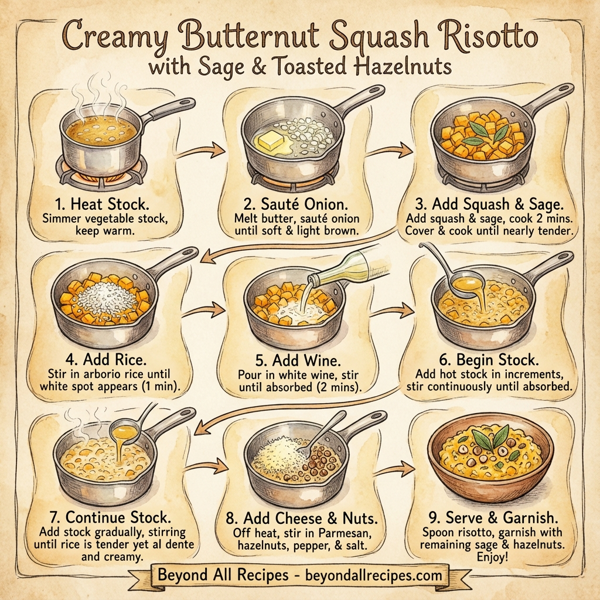
1. In a small saucepan, heat the vegetable stock over high heat until it reaches a simmer. Once simmering, reduce the heat to low to keep it hot throughout the cooking process.
2
2. In a medium heavy-bottomed saucepan, melt the unsalted butter over low heat. Add the chopped onion and sauté, stirring frequently, until the onion becomes soft and light brown—approximately 10 minutes.
3
3. Incorporate the cubed butternut squash and 4 teaspoons of fresh sage (or all the dried sage) into the pan. Continue to sauté for an additional 2 minutes. Cover the saucepan and allow the squash to cook until it is nearly tender, about 6 minutes.
4
4. Remove the lid and add the arborio rice, stirring continuously until a white spot appears at the center of the rice grains, roughly 1 minute.
5
5. Pour in the dry white wine and stir until it is completely absorbed, which should take about 2 minutes.
6
6. Begin adding the hot vegetable stock, starting with 3/4 cup. Adjust the heat as necessary to maintain a gentle simmer, allowing the stock to be absorbed slowly. Stir consistently until the liquid is fully absorbed.
7
7. Continue adding the broth in increments of 3/4 cup for the first 10 minutes as the rice cooks. Once the rice begins to soften, switch to adding broth in 1/2 cup increments. Stir nearly constantly until the rice is just tender but still slightly al dente at the center, resulting in a creamy consistency—this should take an additional 10 minutes.
8
8. Once the rice is cooked, remove the saucepan from heat and stir in the freshly grated Parmesan cheese, 3 tablespoons of the chopped hazelnuts, ground pepper, and salt to taste. Mix thoroughly to combine.
9
9. To serve, spoon the risotto into bowls or onto plates. Garnish with the remaining tablespoon of sage and the remaining chopped hazelnuts for a lovely presentation.
Nutrition Information
Frequently Asked Questions
Frequently Asked Questions
What are the main ingredients in this risotto?
The main ingredients are arborio rice, butternut squash, fresh sage, toasted hazelnuts, and Parmesan cheese.
What kind of rice is required for this recipe?
You should use 1 1/2 cups of uncooked arborio rice to ensure a creamy texture.
Can I use dried sage instead of fresh?
Yes, you can substitute the 5 teaspoons of fresh sage with 1 teaspoon of dried sage.
How many servings does this recipe yield?
This recipe makes approximately 6 servings.
What is the best way to prepare the hazelnuts?
The hazelnuts should be peeled, toasted, and then coarsely chopped before being added to the dish.
Can I substitute the hazelnuts with another nut?
Yes, toasted blanched almonds can be used as a delicious alternative if you prefer a different flavor profile.
What type of wine should be used in the risotto?
A dry white wine is recommended to add the proper acidity and depth to the dish.
Is this recipe vegetarian-friendly?
Yes, this risotto is vegetarian as it uses vegetable stock and contains no meat products.
How much vegetable stock is needed?
You will need approximately 5 1/2 cups of vegetable stock or canned broth.
Why must the vegetable stock be kept simmering?
Keeping the stock hot ensures that the temperature of the rice doesn't drop when liquid is added, allowing for even cooking.
How do I know when the onions are ready?
Sauté the onions until they become soft and light brown, which typically takes about 10 minutes.
How do I prepare the butternut squash?
The butternut squash should be peeled and cut into small cubes for even distribution and cooking.
What does the term 'al dente' mean for this recipe?
It means the rice is cooked until it is just tender but still has a slight firmness or 'bite' at the center.
How long should I sauté the rice before adding wine?
Stir the arborio rice for about 1 minute until a white spot appears at the center of the grains.
Why is the stock added in small increments?
Adding stock slowly and stirring allows the rice to release its starch, which creates the signature creamy risotto texture.
What role does Parmesan cheese play in the dish?
Freshly grated Parmesan cheese adds saltiness, savory depth, and helps thicken the risotto for a luxurious finish.
How do I garnish the final dish?
Garnish with the remaining tablespoon of chopped sage and the remaining toasted hazelnuts.
Can I use salted butter instead of unsalted?
You can, but you should adjust the amount of additional salt you add at the end to avoid over-salting.
Is it necessary to stir the risotto constantly?
Yes, stirring nearly constantly is vital to developing the creamy consistency that defines a good risotto.
How long does it take to cook the squash?
The squash is sautéed for 2 minutes and then covered and cooked for about 6 minutes until nearly tender.
What size saucepan is best for this recipe?
A medium heavy-bottomed saucepan is ideal as it provides even heat distribution for the rice.
Can I make this recipe in advance?
Risotto is best served immediately, as the texture becomes thick and the rice continues to absorb liquid as it sits.
What should I do if the rice is still hard but I am out of stock?
You can use a little bit of warm water to finish the cooking process if you run out of stock.
Is this recipe gluten-free?
Arborio rice is naturally gluten-free, so as long as your vegetable stock is certified gluten-free, the dish is safe.
How much sage is used in the initial cooking phase?
Use 4 teaspoons of fresh sage (or all of the dried sage) when sautéing the squash.
How much total time is required for adding the broth?
The total broth addition and stirring process takes approximately 20 minutes.
Can I use a different type of cheese?
While Parmesan is traditional, you could use Grana Padano or Pecorino Romano for a similar effect.
Is this dish suitable for dinner parties?
Yes, the description notes it is stunning enough to impress at dinner parties and offers a gourmet experience.
What is the first step of the recipe?
The first step is to heat the vegetable stock in a small saucepan until it reaches a simmer.
How much black pepper is recommended?
The recipe calls for 1 1/2 teaspoons of fresh ground pepper, added at the end of the cooking process.