Coriander and Honey Infusion Jelly

Savor the unique and aromatic taste of Coriander and Honey Infusion Jelly, a delightful blend that captures the essence of fresh coriander intertwined with the natural sweetness of honey. This jelly is perfect for spreading on fresh bread, pairing with cheese, or even drizzling over desserts. As the weather cools down, this recipe from 'Preserving the Harvest' invites you to explore a creative way to preserve the summer's bounty. With a delicate balance of flavor and a beautiful golden hue, this jelly is an ideal addition to your pantry that will surely impress your family and friends.
N/A
Servings
N/A
Calories
6
Ingredients
Ingredients
water
3 cups (Boiled)
coriander seed
1/3 cup (Bruised with the back of a spoon)
sugar
3 cups (Granulated)
fresh lemon juice
1/4 cup (Strained)
mild honey
1/4 cup (Liquid)
dry pectin
1 (1 3/4 ounce) package (Powdered)
Instructions
1
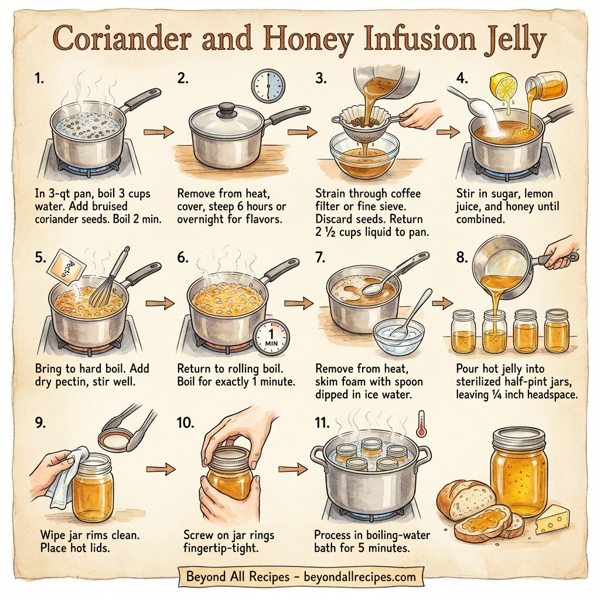
In a 3-quart saucepan, bring 3 cups of water to a boil. Add the bruised coriander seeds and let it boil for 2 minutes.
2
Remove the saucepan from heat, cover, and let the infusion steep for 6 hours or overnight to allow the flavors to develop.
3
Strain the infusion through a coffee filter or fine mesh sieve, discarding the coriander seeds. Return 2 1/2 cups of the liquid back to the saucepan.
4
Stir in the sugar, strained lemon juice, and honey until well combined.
5
Bring the mixture to a hard boil over medium-high heat. Once boiling, add the dry pectin and stir well.
6
Allow the mixture to return to a rolling boil and continue boiling for exactly 1 minute, using a timer for accuracy.
7
Remove the pan from heat and skim off any foam from the surface using a metal spoon dipped in ice water for effective foaming.
8
Carefully pour the hot jelly into four sterilized half-pint jars, leaving about 1/4 inch of headspace at the top.
9
Wipe the rims of each jar with a clean, damp cloth to ensure a good seal. Place the hot lids on each jar according to the manufacturer's instructions.
10
Screw on the jar rings fingertip-tight to secure the lids.
11
Process the jars in a boiling-water bath for 5 minutes, adjusting for altitude if necessary to ensure proper sealing.
Nutrition Information
Frequently Asked Questions
Frequently Asked Questions
What is Coriander and Honey Infusion Jelly?
It is a unique, aromatic jelly that blends the essence of fresh coriander seeds with the natural sweetness of mild honey.
What are the primary flavors of this jelly?
The jelly features a delicate balance of citrusy coriander notes and the rich, golden sweetness of honey.
How many jars does this recipe produce?
This recipe makes approximately four half-pint jars of jelly.
What type of coriander is used in this recipe?
The recipe calls for 1/3 cup of coriander seeds that have been bruised with the back of a spoon.
How long should the coriander seeds steep?
The infusion should steep for at least 6 hours or overnight to fully develop the flavor.
Why is it necessary to bruise the coriander seeds?
Bruising the seeds helps release their essential oils and aromatic compounds into the water during the boiling and steeping process.
What kind of honey is recommended?
A mild, liquid honey is recommended to ensure it complements rather than overpowers the coriander flavor.
Is fresh lemon juice required?
Yes, 1/4 cup of strained fresh lemon juice is used to provide necessary acidity for the pectin to set.
What type of pectin should I use?
You should use one 1.75-ounce package of dry powdered pectin.
How much liquid do I need after straining the seeds?
You need to return exactly 2 1/2 cups of the strained coriander infusion to the saucepan.
How long does the mixture need to boil after adding pectin?
Once it reaches a rolling boil, it must boil for exactly 1 minute for the pectin to activate correctly.
How do I effectively remove foam from the jelly?
Use a metal spoon dipped in ice water to skim any foam from the surface before jarring.
What is the recommended headspace for the jars?
Leave about 1/4 inch of headspace at the top of each jar to allow for a proper vacuum seal.
How long should the jars be processed in a water bath?
The jars should be processed in a boiling-water bath for 5 minutes.
Do I need to adjust processing time for altitude?
Yes, you should adjust the boiling-water bath time based on your local altitude to ensure safety.
Can I use ground coriander instead of seeds?
It is not recommended, as ground coriander will make the jelly cloudy and change the texture significantly.
What should I serve with Coriander and Honey Infusion Jelly?
It is excellent on fresh bread, paired with various cheeses, or drizzled over desserts.
How should I strain the infusion?
Use a coffee filter or a very fine mesh sieve to ensure all seed particles are removed for a clear jelly.
What size saucepan is needed?
A 3-quart saucepan is ideal for boiling the infusion and the jelly mixture.
Why is wiping the jar rims important?
Wiping the rims with a damp cloth removes any residue that could prevent the lids from sealing properly.
What kind of sugar is best for this recipe?
Standard granulated white sugar is best for achieving the correct set and clear color.
How do I know the jelly has reached a rolling boil?
A rolling boil is one that cannot be stirred down and continues to bubble vigorously while being stirred.
Can I substitute the honey?
While you can use different honey types, a mild honey is preferred to maintain the intended flavor balance.
Should the jars be sterilized before use?
Yes, use sterilized half-pint jars to ensure the preservation process is successful.
How tight should the jar rings be?
Screw the rings on fingertip-tight; do not over-tighten them before processing.
What color is the finished jelly?
The finished jelly has a beautiful, clear golden hue.
Is this recipe suitable for long-term storage?
Yes, when processed correctly in a water bath, this jelly is shelf-stable in a cool, dark pantry.
Can I use bottled lemon juice?
While fresh is recommended for flavor, bottled lemon juice can be used as it has a consistent acidity level.
What if I have more than 2 1/2 cups of liquid after steeping?
Only use the 2 1/2 cups specified in the recipe to ensure the pectin-to-liquid ratio is correct for setting.
Why must the lids be hot before application?
Heating the lids softens the sealing compound, which helps create a more reliable airtight seal.