Coconut Rice Appams
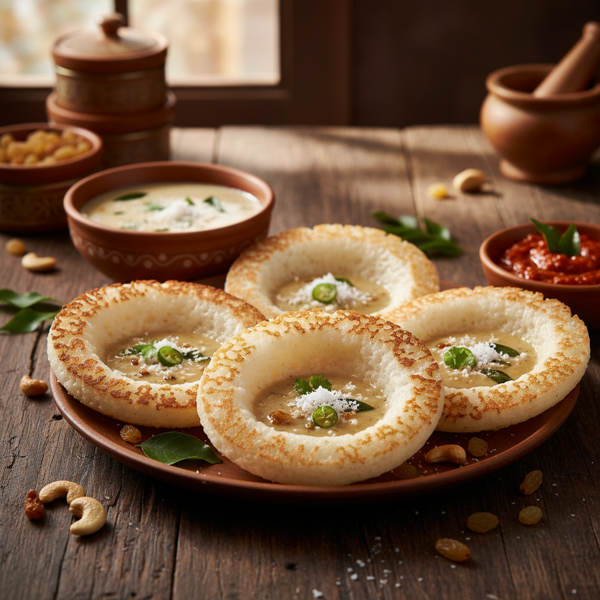
Coconut Rice Appams are delightful, leavened pancakes made from a fragrant blend of rice and freshly grated coconut. Originating from the southern regions of India, they boast a unique texture with a spongy center and delicate lacey edges. Perfect for breakfast, these appams are traditionally paired with sweet coconut milk infused with cardamom or savory stews, offering a tantalizing contrast in flavors. This simplified version — inspired by my dear neighbor, Sagar Aunty — retains the authentic taste and charm, making it easy for anyone to recreate these delicious pancakes at home.
8
Servings
N/A
Calories
7
Ingredients
Ingredients
Rice (raw)
2 glasses (Soaked for 3-4 hours)
Coconut (medium)
1/2 (Scraped)
Cooked rice
1 cup (Pre-cooked)
Milk
1 glass (Boiling hot)
Sugar
2-3 teaspoons (To taste)
Salt
To taste (Regular salt)
Baking soda or dry active yeast
1 pinch or 1/4 teaspoon (Optional for leavening)
Instructions
1
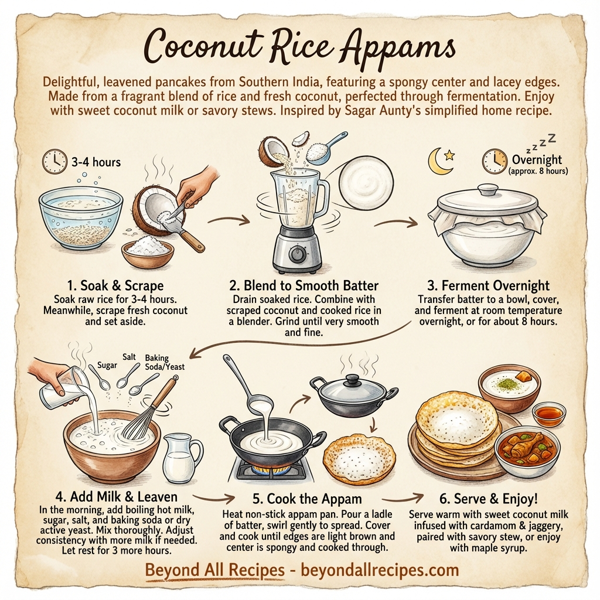
Begin by soaking the raw rice in water for 3-4 hours to soften.
2
While the rice is soaking, scrape the fresh coconut and set it aside.
3
Once the rice has soaked, drain it and combine it with the scraped coconut and cooked rice in a blender. Grind until the mixture is very smooth and fine.
4
Transfer the blended mixture into a bowl, cover it, and let it ferment at room temperature overnight, or for about 8 hours.
5
In the morning, about 3 hours before you want to cook the appams, add 1 glass of boiling hot milk to the fermented batter. Stir in the sugar, salt, and either the baking soda or dry active yeast, mixing thoroughly. Adjust with more milk if necessary to achieve a pourable consistency.
6
Cover the batter again and let it rest for an additional 3 hours.
7
Heat a non-stick wok or appam pan over medium heat.
8
Pour a ladle full of batter into the hot pan, swirling gently to spread it into a circle about 6-8 inches in diameter.
9
Cover the pan and cook for several minutes until the edges turn light brown and the top is no longer moist, with a spongy texture. The edges will become lacey, while the center remains thick and fluffy.
10
Serve warm with coconut milk sweetened with jaggery and cardamom, paired with chicken or mutton stew, or simply enjoy with maple syrup.
Nutrition Information
Frequently Asked Questions
Frequently Asked Questions
What are Coconut Rice Appams?
Coconut Rice Appams are traditional leavened pancakes from Southern India made with a blend of rice and freshly grated coconut, featuring a spongy center and delicate lacey edges.
How long should I soak the raw rice?
The raw rice should be soaked in water for 3 to 4 hours to ensure it is soft enough for grinding.
Why is cooked rice added to the batter?
Adding a cup of cooked rice to the blender helps create the signature soft and spongy texture in the center of the appam.
How long does the fermentation process take?
The initial fermentation should take place overnight at room temperature, or for approximately 8 hours.
What should I do on the morning of cooking?
About 3 hours before cooking, you should add boiling hot milk, sugar, salt, and your leavening agent to the fermented batter.
Can I use yeast instead of baking soda?
Yes, you can use either a pinch of baking soda or 1/4 teaspoon of dry active yeast as a leavening agent.
How long should the batter rest after adding milk?
The batter needs an additional resting period of 3 hours after the milk and leavening agents are incorporated.
What type of pan is best for cooking appams?
A non-stick wok or a specific appam pan (appachatti) is ideal for achieving the correct shape and texture.
How do I get the lacey edges?
Pour a ladle of batter into the hot pan and gently swirl it to spread the batter into a circle; the thin batter on the sides will become lacey.
Do I need to cover the pan while cooking?
Yes, covering the pan is essential to steam the center while the edges crisp up.
How do I know when the appam is done?
The appam is ready when the edges turn light brown and the top is no longer moist but feels spongy.
Is this recipe gluten-free?
Yes, based on the ingredients provided, this recipe is naturally gluten-free.
Is this recipe vegan?
This specific recipe uses dairy milk, but it can be made vegan by substituting the milk with coconut milk or another plant-based milk.
What is the recommended serving size?
This recipe is designed to yield approximately 8 servings.
What are traditional accompaniments for appams?
Appams are traditionally served with sweet coconut milk infused with cardamom, or savory chicken or mutton stews.
Can I use maple syrup with appams?
Yes, for a modern twist, appams can be enjoyed with maple syrup.
How much coconut is required?
The recipe calls for half of a medium-sized fresh coconut, scraped.
What consistency should the batter be?
The batter should be a pourable consistency; you can adjust this by adding more milk if the mixture is too thick.
Who inspired this version of the recipe?
This simplified version of the recipe was inspired by the creator's neighbor, Sagar Aunty.
What temperature should I cook them at?
Appams should be cooked over medium heat to ensure the bottom doesn't burn before the center is cooked.
Can I use store-bought coconut flakes?
While fresh scraped coconut is traditional for the best flavor, you can use unsweetened shredded coconut if fresh is unavailable.
How many ingredients are in this recipe?
There are 7 main ingredients: raw rice, coconut, cooked rice, milk, sugar, salt, and a leavening agent.
Is sugar necessary in the batter?
A small amount of sugar (2-3 teaspoons) is added to the batter to enhance the flavor and aid in fermentation.
Can I skip the overnight fermentation?
For the authentic texture and slightly tangy flavor, overnight fermentation is highly recommended.
What should I do if the batter doesn't rise?
Ensure your yeast is active and that the environment is warm enough for fermentation to occur.
Can I make these ahead of time?
Appams are best enjoyed warm and fresh, but the batter can be prepared in advance.
How do I achieve the 'spongy center'?
The combination of cooked rice in the batter and covering the pan while cooking creates the thick, fluffy center.
Why is boiling milk used?
Boiling hot milk helps to further soften the fermented rice particles and creates a smooth, pourable batter texture.
Can I use brown rice?
Traditional appams use raw white rice for the best color and texture, but brown rice can be used with adjustments to soaking time.
What if I don't have an appam pan?
A small non-stick wok or a small curved frying pan can serve as a suitable substitute.