Classic German Kastenweissbrot (Crispy White Loaf Bread)
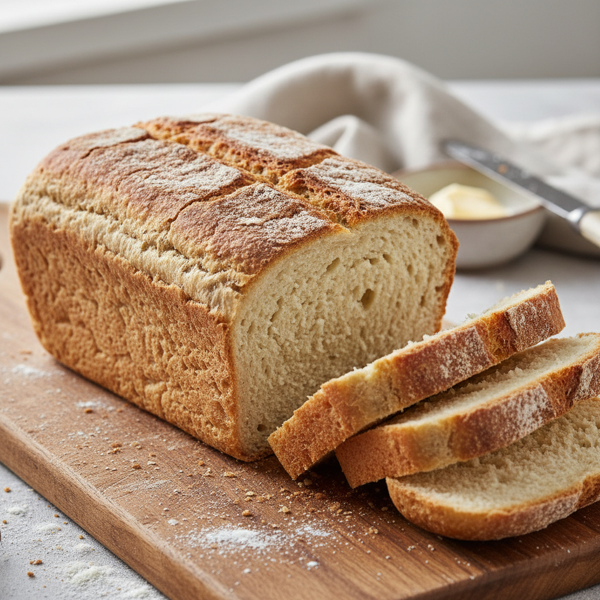
This Classic German Kastenweissbrot, or White Loaf Bread, is a cherished recipe I discovered in a delightful German cookbook, 'Brot Backen,' while living in Germany. It became a staple in my diet as I would enjoy this freshly baked bread from the local bakery weekly. The bread has a soft and tender crumb, while the crispy crust gives it a delightful texture. This recipe aims to recreate that authentic bakery experience in your home kitchen, complete with tips to achieve a beautifully golden crust. The addition of a light spritz of water before baking will help mimic that traditional crispiness you would find at a bakery. Perfect for sandwiches, toast, or simply slathering with butter, this Kastenweissbrot is sure to become a family favorite.
N/A
Servings
160
Calories
9
Ingredients
Ingredients
all-purpose flour
500 g (measured)
active dry yeast
4 1/2 teaspoons (sprinkled over lukewarm milk)
granulated sugar
1 teaspoon (added to yeast mixture)
salt
1 teaspoon (mixed into wet ingredients)
large eggs
2 (beaten and added to wet mixture)
egg yolk
1 (beaten and added to wet mixture)
lukewarm milk
100 ml (measured for yeast activation)
crème fraîche or sour cream
150 g (added to wet mixture)
breadcrumbs
for dusting (sprinkled in loaf pan)
Instructions
1
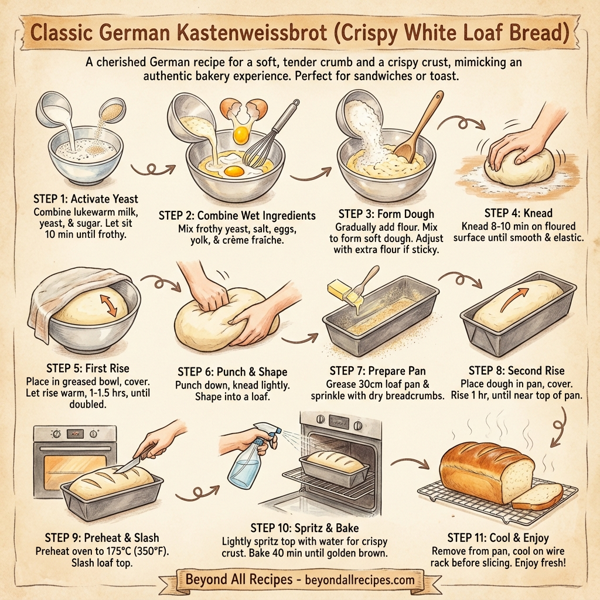
Start by measuring out the lukewarm milk (about 100 ml). Sprinkle the active dry yeast and granulated sugar on top. Allow it to sit for about 10 minutes until the mixture becomes frothy. If it does not froth, your yeast may be inactive; in that case, try again with fresh yeast or a different lukewarm milk.
2
In a large mixing bowl, combine the frothy yeast mixture with salt, whole eggs, egg yolk, and crème fraîche (or sour cream). Mix well until combined.
3
Gradually add the all-purpose flour (approximately 500 g) to the wet ingredients. Mix until a soft dough forms. If the dough feels too wet or sticky, add a little extra flour as needed, depending on the humidity.
4
Flour a clean work surface and transfer the dough onto it. Knead the dough for about 8-10 minutes until it is smooth and elastic, creating a nice round ball.
5
Place the kneaded dough into a greased bowl, turning it over so it's coated with grease. Cover the bowl with a damp clean towel or plastic wrap that has been sprayed with nonstick spray. Let the dough rise in a warm area until it has doubled in size, about 1 to 1.5 hours.
6
Once the dough has risen, punch it down gently to expel the air, and knead it lightly on a floured surface for a minute.
7
Prepare a 30 cm long loaf pan by greasing it well and sprinkling dry breadcrumbs throughout the pan to prevent sticking.
8
Shape the dough into a loaf and place it into the prepared pan, then even out the top with your hands to smooth it.
9
Cover the loaf pan again and let the dough rise for an additional hour until it has risen to about the top of the pan.
10
Preheat your oven to 175°C (350°F).
11
Once the dough has finished its second rise, use a sharp knife to make slashes at 1 cm intervals along the top of the loaf.
12
For a crispy crust, spritz the top of the dough lightly with water. You can use a spray bottle for this.
13
Bake the loaf on the second rack of your oven for approximately 40 minutes, or until the crust is golden brown and the loaf sounds hollow when tapped on the bottom.
14
Remove the loaf from the pan and allow it to cool on a wire rack before slicing. Enjoy your homemade Kastenweissbrot fresh!
Nutrition Information
3.6g
Fat
29g
Carbs
4.3g
Protein
0.6g
Fiber
Frequently Asked Questions
Frequently Asked Questions
What is Classic German Kastenweissbrot?
It is a traditional German white loaf bread characterized by a soft, tender crumb and a delightfully crispy crust.
What does the name Kastenweissbrot signify?
In German, 'Kasten' refers to the box-shaped loaf pan it is baked in, and 'weissbrot' translates to white bread.
How do I activate the yeast for this recipe?
Measure 100 ml of lukewarm milk and sprinkle 4 1/2 teaspoons of active dry yeast and 1 teaspoon of granulated sugar on top, letting it sit for 10 minutes until frothy.
What should I do if my yeast mixture doesn't froth?
If the mixture does not froth, the yeast may be inactive, and you should start over with fresh yeast and lukewarm milk.
What wet ingredients are mixed with the yeast?
The frothy yeast is combined with 1 teaspoon of salt, 2 large eggs, 1 egg yolk, and 150 grams of crème fraîche or sour cream.
How much flour is required for this bread?
The recipe calls for approximately 500 grams of all-purpose flour, added gradually until a soft dough forms.
How long should the dough be kneaded?
The dough should be kneaded for 8-10 minutes on a floured surface until it becomes smooth and elastic.
How do I know when the first rise is complete?
The first rise is complete when the dough has doubled in size, which typically takes between 1 to 1.5 hours in a warm area.
Why do I need to punch down the dough?
Punching the dough down gently after the first rise helps expel excess air before the final shaping.
How do I prepare the loaf pan to prevent sticking?
Grease a 30 cm loaf pan thoroughly and then sprinkle dry breadcrumbs throughout the pan.
What size loaf pan is recommended?
This recipe is designed for a loaf pan that is 30 centimeters in length.
How long is the second rise?
The second rise should last about one hour, or until the dough has risen to the top of the loaf pan.
What temperature should the oven be set to?
Preheat your oven to 175°C or 350°F before baking.
How do I prepare the top of the loaf before baking?
Use a sharp knife to make slashes at 1 cm intervals along the top and spritz it lightly with water for a crispy crust.
How long does the Kastenweissbrot need to bake?
The bread should bake on the second rack of the oven for approximately 40 minutes.
How can I tell if the bread is fully baked?
The bread is done when the crust is golden brown and the loaf sounds hollow when you tap it on the bottom.
Is it necessary to let the bread cool before slicing?
Yes, you should remove the loaf from the pan and let it cool completely on a wire rack to ensure the best texture when slicing.
Can I use sour cream if I don't have crème fraîche?
Yes, sour cream is a perfectly acceptable substitute for crème fraîche in this recipe.
How many calories are in a serving of this bread?
Each serving contains approximately 160 calories.
What is the fat content per serving?
There is approximately 3.6 grams of fat in each serving.
How much protein does this bread provide?
This bread provides about 4.3 grams of protein per serving.
What are the total carbohydrates per serving?
Each serving contains 29 grams of carbohydrates.
What tags are associated with this recipe?
Tags for this recipe include bread, german bread, artisan bread, yeast bread, and baking.
What type of yeast is used in this recipe?
The recipe specifies using active dry yeast.
How much milk is used in the dough?
The recipe requires 100 ml of lukewarm milk.
What is the role of breadcrumbs in the pan?
Breadcrumbs are used to dust the greased pan, which helps prevent the bread from sticking and adds a traditional texture.
How many eggs are required?
The recipe uses 2 large whole eggs and 1 additional egg yolk.
Is there any sugar in the bread dough?
Yes, 1 teaspoon of granulated sugar is used to help activate the yeast.
What is the best way to enjoy Kastenweissbrot?
It is excellent for sandwiches, toast, or simply served fresh with butter.
How many grams of flour should I start with?
You should start with 500 grams of all-purpose flour.