Calabrian Heritage Easter Bread

Celebrate Easter with this traditional Calabrian Easter Bread inspired by Grandma Rose's timeless recipe from 1947. With a delightful blend of citrus flavors from fresh oranges and lemons, this bread is not only perfect as a festive centerpiece but also works wonders as toast or a delightful French toast dish. The delicate sweet aroma fills your kitchen with nostalgia, while its soft, slightly sticky texture ensures each bite melts in your mouth. As it bakes, consider braiding the dough and topping it with sugar cubes for an authentic Italian bakery touch. This bread is wonderful served warm with a dab of fresh butter paired with a steaming cup of coffee, making it an absolute must-have for Easter gatherings.
80
Servings
N/A
Calories
9
Ingredients
Ingredients
Whole Milk
1 quart (scalded and cooled to room temperature)
Large Eggs
12 (beaten)
Oranges
2 (juice and zest)
Lemons
2 (juice and zest)
Granulated Sugar
4 cups (none)
Butter
2 cups (softened to room temperature)
Salt
3/4 tablespoon (none)
Fresh Bakery Yeast
1/4 lb (dissolved in milk)
All-Purpose Flour
8-12 cups (sifted, added gradually to form a soft dough)
Instructions
1
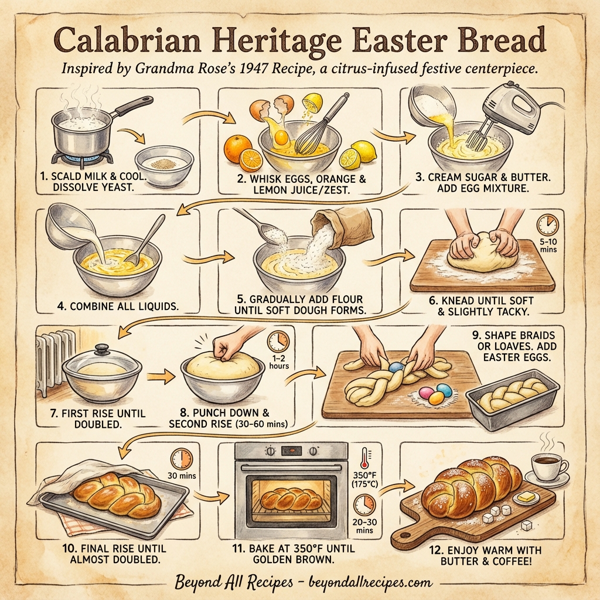
In a large saucepan, scald the quart of whole milk over medium heat. Once it reaches a boil, remove it from heat and allow it to cool to room temperature. Stir in the fresh bakery yeast, allowing it to dissolve fully.
2
In a separate mixing bowl, whisk together the eggs, fresh orange juice, and zest as well as the lemon juice and zest until well combined.
3
In another bowl, cream the granulated sugar and room temperature butter until light and fluffy. This should take about 5-7 minutes.
4
Gradually add the egg mixture to the butter and sugar mixture, beating well to combine thoroughly.
5
Once the milk and yeast mixture has cooled, mix it into the combined egg, sugar, and butter mixture, stirring until fully incorporated.
6
Gradually add sifted flour, mixing until a soft but not sticky dough forms. You may need between 8 to 12 cups of flour, depending on humidity and moisture content of the fruits.
7
Turn the dough out onto a lightly floured surface and knead for 5-10 minutes until it is soft and slightly tacky but does not stick to the surface.
8
Place the kneaded dough in a greased bowl, cover it with a clean cloth, and allow it to rise in a warm place until it doubles in size, about 1-2 hours.
9
Once the dough has risen, punch it down and let it rise a second time for another 30-60 minutes.
10
After the second rise, shape the dough into braids or place in greased loaf pans. If braiding, feel free to add dyed or raw eggs as an Easter touch.
11
Let the shaped dough rise until almost doubled, about 30 minutes.
12
Preheat the oven to 350°F (175°C) and bake for approximately 20-30 minutes or until the tops of the loaves are golden brown and the bread sounds hollow when tapped.
Nutrition Information
Frequently Asked Questions
Frequently Asked Questions
What is Calabrian Heritage Easter Bread?
It is a traditional festive Italian bread inspired by a 1947 recipe, featuring citrus flavors and a soft, slightly sticky texture.
Who inspired this specific recipe?
The recipe is inspired by Grandma Rose's timeless recipe from 1947.
How many servings does this recipe make?
This recipe yields approximately 80 servings.
What citrus fruits are used in the bread?
The bread uses the juice and zest of two fresh oranges and two fresh lemons.
How many eggs are required for this bread?
The recipe calls for 12 large eggs, which should be beaten before mixing.
What type of milk is used and how is it prepared?
The recipe uses 1 quart of whole milk that must be scalded and then cooled to room temperature.
What kind of yeast is recommended for this recipe?
The recipe specifically calls for 1/4 lb of fresh bakery yeast.
How much butter is needed for the dough?
You will need 2 cups of butter, softened to room temperature.
How much sugar is included in the recipe?
The bread requires 4 cups of granulated sugar.
What is the range for the amount of flour used?
The recipe uses between 8 to 12 cups of sifted all-purpose flour.
Why does the amount of flour vary?
The amount of flour needed depends on the humidity and the moisture content of the fresh fruits used.
How long should you cream the butter and sugar?
The butter and sugar should be creamed together for about 5-7 minutes until light and fluffy.
How long do you need to knead the dough?
The dough should be kneaded for 5-10 minutes until it is soft and slightly tacky.
How long is the first rise for the dough?
The dough should rise in a warm place for 1-2 hours until it doubles in size.
How long is the second rise?
After punching down the dough, it should rise a second time for 30-60 minutes.
What is the duration of the final rise after shaping?
The shaped dough should rise for about 30 minutes until almost doubled.
At what temperature should the bread be baked?
The oven should be preheated to 350°F (175°C).
How long does the baking process take?
The bread typically bakes for approximately 20-30 minutes.
How do you determine if the bread is fully cooked?
The bread is done when the tops are golden brown and it sounds hollow when tapped.
What shapes are recommended for this Easter bread?
The dough can be shaped into braids or placed into greased loaf pans.
How can I add a traditional Easter touch to the braids?
You can add dyed or raw eggs to the braids before baking as a festive touch.
What topping can be added for an authentic bakery look?
Topping the braids with sugar cubes provides an authentic Italian bakery touch.
What is the expected texture of the dough?
The dough should be soft and slightly tacky but should not stick to the surface while kneading.
Can this bread be used for other dishes?
Yes, it works wonderfully as toast or as a base for French toast.
How should the bread be served for the best experience?
It is best served warm with a dab of fresh butter and a cup of coffee.
Should the flour be sifted before adding?
Yes, the flour should be sifted and added gradually to form the soft dough.
What is the aroma of the bread?
The bread has a delicate sweet and citrusy aroma that fills the kitchen.
Is there salt in this recipe?
Yes, the recipe includes 3/4 tablespoon of salt.
Where does this heritage recipe come from?
The recipe originates from Calabria, Italy.
Is the finished bread soft?
Yes, it has a soft, melt-in-your-mouth texture when baked correctly.