Award-Winning Dill Pickles
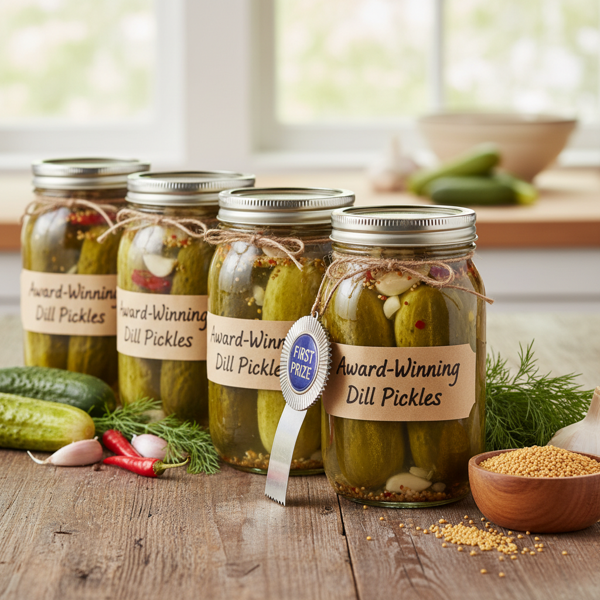
These Award-Winning Dill Pickles are a cherished family recipe passed down from a dear friend. After devouring nearly a quart on a visit, I was inspired to steal this recipe and create the ultimate dill pickle experience. Over the years, I've perfected this method, and it was validated when my pickles won a blue ribbon at the County Fair, along with the coveted 'Best of Show' and canning award. Filled with crunchy cucumbers and aromatic dill, these pickles make a perfect snack, condiment, or salad addition. Whether you are a seasoned canner or a beginner, follow along and impress your friends and family with these fantastic pickles that will bring a taste of the fair right to your kitchen!
32
Servings
5
Calories
7
Ingredients
Ingredients
Wide-mouth quart jars
7 (Cleaned and heated)
Fresh dill
To taste (Dill heads with several inches of stems, shaken free of bugs)
Cucumbers
To taste (Washed and scrubbed thoroughly)
Garlic cloves
1 or more (Peeled)
Water
8 1/2 cups (As needed for brine)
White vinegar
2 1/4 cups (As needed for brine)
Pickling salt
1/2 cup (As needed for brine)
Instructions
1
Prepare all ingredients and equipment before starting the canning process.
2
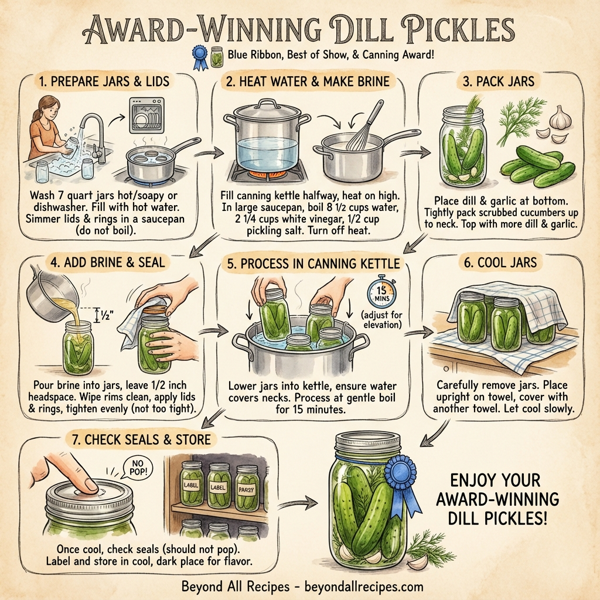
Wash 7 quart jars thoroughly with hot, soapy water (or place them in the dishwasher for sanitation). Rinse and fill each jar with hot water to keep them warm while you work. Set aside.
3
Fill a canning kettle halfway with the hottest tap water, set it on the burner over high heat to warm up.
4
In a medium saucepan, combine the lids and rings. Cover with water and bring to a simmer (do not boil). This will soften the sealing compound for a better seal.
5
In a large saucepan, combine 8 1/2 cups water, 2 1/4 cups white vinegar, and 1/2 cup pickling salt. Bring to a boil, then turn off the heat and set aside.
6
To fill the jars, place a generous layer of fresh dill at the bottom of each jar, followed by a single garlic clove (add more cloves if desired). Pack the washed and scrubbed cucumbers tightly into each jar up to the neck, layering if necessary. For an attractive presentation, use uniform sizes where possible and pack tightly.
7
Top each jar with a few tiny dill sprigs and additional garlic if desired.
8
Carefully pour the prepared brine into each jar, leaving a half-inch of headspace.
9
Wipe the rims of the jars with a clean cloth to ensure a proper seal, then place the lids and rings on each jar, tightening evenly but not overly tight.
10
Lower the jars into the canning kettle, ensuring the water covers the jars up to their necks.
11
Bring the water to a gentle boil and process the jars for about 15 minutes, adjusting the time based on your elevation if necessary.
12
Carefully remove the jars and place them upright on a clean dish towel on the counter. Cover them with another dish towel to allow them to cool slowly.
13
Once the jars are cool, check the seals by pressing down in the center of each lid; it should not pop back. If sealed, label each jar and store in a cool, dark place for optimal flavor.
Nutrition Information
0g
Fat
1g
Carbs
0g
Protein
0g
Fiber
Frequently Asked Questions
Frequently Asked Questions
What awards has this dill pickle recipe won?
This recipe won a blue ribbon at the County Fair, along with the 'Best of Show' and canning award.
How many jars does this recipe yield?
The recipe is designed to fill 7 wide-mouth quart jars.
What type of salt is used for these pickles?
The recipe requires 1/2 cup of pickling salt.
How much vinegar is needed for the brine?
You will need 2 1/4 cups of white vinegar.
What kind of dill should I use?
Use fresh dill heads with several inches of stems, ensuring they are shaken free of bugs.
How do I prepare the jars for canning?
Wash the jars in hot, soapy water or a dishwasher, then fill each jar with hot water to keep them warm until use.
What is the ratio of water to vinegar in the brine?
The brine uses 8 1/2 cups of water and 2 1/4 cups of white vinegar.
How much garlic should be added to each jar?
Add a single peeled garlic clove to the bottom and more on top if desired.
How long do the jars need to process in the canning kettle?
The jars should be processed in a gentle boil for about 15 minutes, adjusted for elevation.
What is the recommended headspace for the jars?
Leave a half-inch of headspace when pouring the brine into the jars.
How do I prepare the lids and rings?
Place them in a saucepan, cover with water, and bring to a simmer to soften the sealing compound, but do not boil.
How should I pack the cucumbers in the jars?
Pack the washed and scrubbed cucumbers tightly into each jar up to the neck, using uniform sizes for a better presentation.
How can I tell if the jars have sealed properly?
Once cool, press the center of the lid; if it does not pop back, the jar is properly sealed.
What is the best way to cool the jars after processing?
Place them upright on a clean dish towel and cover them with another towel to let them cool slowly.
Where should the pickles be stored?
Store the sealed and labeled jars in a cool, dark place for optimal flavor.
How many calories are in one serving?
Each serving contains approximately 5 calories.
Is this recipe suitable for beginners?
Yes, the instructions are designed for both seasoned canners and beginners to achieve professional results.
Why should I wipe the rims of the jars?
Wiping the rims with a clean cloth ensures there is no residue that could prevent a proper seal.
Can I add extra garlic to the recipe?
Yes, you can add more than the recommended one clove per jar if you prefer a stronger garlic flavor.
What is the serving size for this recipe?
The recipe yields approximately 32 servings.
How should the dill be layered in the jar?
Place a generous layer of fresh dill at the bottom and top each jar with a few tiny dill sprigs after packing the cucumbers.
Should the cucumbers be scrubbed?
Yes, the recipe specifies that the cucumbers should be washed and scrubbed thoroughly before packing.
What type of jars are recommended?
The recipe specifically calls for wide-mouth quart jars.
Does this recipe contain any fat or protein?
The nutritional information indicates 0g of fat and 0g of protein per serving.
What is the carbohydrate count per serving?
There is approximately 1g of carbohydrates per serving.
How much water is needed for the canning kettle?
Fill the canning kettle halfway with the hottest tap water before heating.
How tight should the rings be placed on the jars?
Tighten the rings evenly but do not make them overly tight.
What is the first step of the process?
The first step is to prepare all ingredients and equipment before starting the actual canning.
Can I use any size cucumber?
While any size works, using uniform sizes provides a more attractive presentation.
What should I do after the jars have cooled and sealed?
Label each jar and move them to a cool, dark storage location.