Artisanal Fresh Pasta Made with KitchenAid
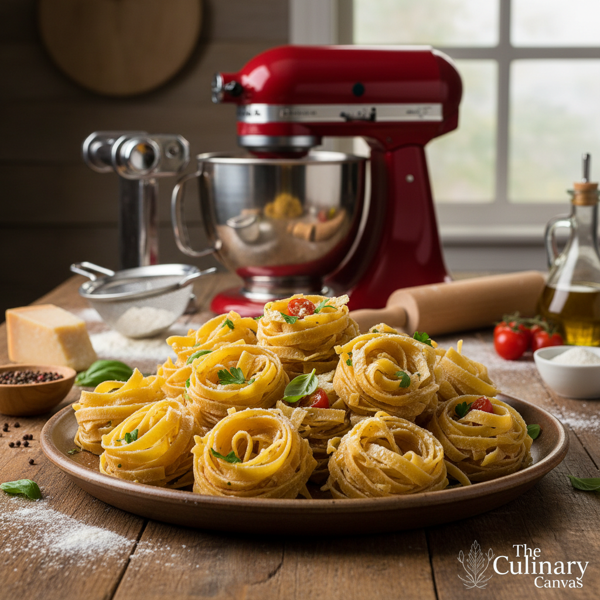
Discover the joy of creating your own fresh pasta with this foolproof recipe inspired by Chef Andrea Apuzzo of Andrea's Restaurant in New Orleans. Whether you're preparing a delightful spaghetti dish, elegant ravioli, or comforting lasagna, this versatile pasta will elevate any meal with its rich texture and authentic flavor. This recipe yields a generous 1.5 pounds of pasta, perfect for sharing with family and friends. With only a few simple ingredients and a KitchenAid mixer, you can enjoy the satisfaction of homemade pasta like a culinary pro. Just remember, the key to perfect pasta lies in the kneading—your hands will work their magic on this dough to yield a beautiful result. Get ready to impress your loved ones at the dinner table!
N/A
Servings
225
Calories
6
Ingredients
Ingredients
Semolina flour
2 cups (not required)
All-purpose flour
2 cups (Not required; bread flour can also be used for higher gluten.)
Large eggs
2 (well beaten)
Extra virgin olive oil
1 tablespoon (not required)
Salt
1/2 teaspoon (not required)
Cold water
1 cup (not required)
Instructions
1
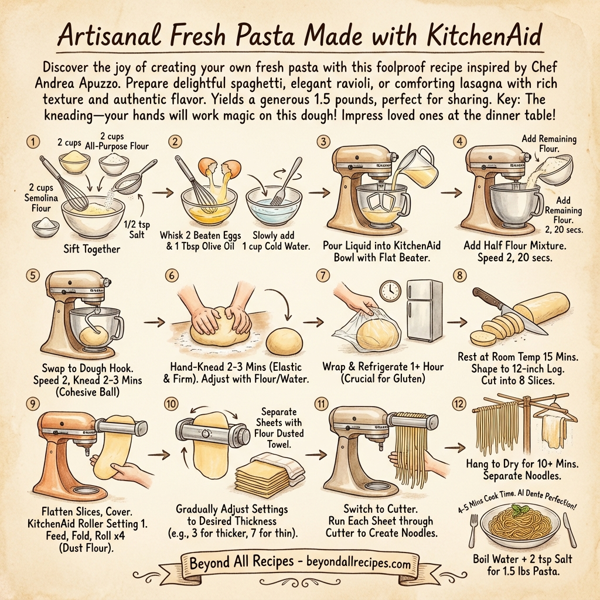
In a large mixing bowl, combine 2 cups of semolina flour, 2 cups of all-purpose flour, and 1/2 teaspoon of salt. Use a fork to mix well and then sift the mixture into another bowl. Set aside.
2
In a separate bowl, whisk together 2 large beaten eggs and 1 tablespoon of extra virgin olive oil until well combined.
3
Slowly add 1 cup of cold water to the egg and olive oil mixture, stirring with a fork until blended.
4
Pour the liquid mixture into the bowl of your KitchenAid mixer fitted with the flat beater attachment.
5
Add half of the sifted flour mixture into the mixer bowl. Turn the mixer to speed 2 and mix for 20 seconds. Then, add the remaining flour mixture and continue mixing for another 20 seconds.
6
Swap the flat beater for the dough hook and set the mixer to speed 2. Knead the dough for 2 to 3 minutes until a cohesive dough ball forms.
7
Remove the dough from the mixer and hand-knead for an additional 2 to 3 minutes. The dough should be elastic and firm, not soft or sticky. Adjust consistency by adding flour or water as needed.
8
Wrap the dough in plastic wrap and refrigerate for at least 1 hour. This resting period is crucial for the gluten structure.
9
After chilling, let the dough rest at room temperature for 15 minutes. Shape it into a 12-inch log and cut it into 8 slices.
10
Flatten each slice slightly, spacing them out, and cover with plastic wrap to prevent drying.
11
Using the KitchenAid pasta roller attachment, set it to the widest setting (1). Feed one piece of dough through the rollers on speed 2. Fold it in half and roll it out again. Repeat this process 3 more times, dusting with flour as needed to prevent sticking.
12
Gradually adjust the roller setting, passing the dough through each level until you reach your desired thickness. Use settings 3 for thicker noodles, 4 for standard pasta, and 7 or 8 for very thin pasta.
13
Once the desired thickness is achieved, separate the sheets using a towel or plastic wrap dusted with flour.
14
Switch to the pasta cutter attachment of your choice. Run each sheet of dough through the cutter to create noodles. Avoid cutting too short for easier handling.
15
Hang the freshly cut pasta on a pasta rack or floured hangers to dry for at least 10 minutes. Separate the noodles to prevent clumping during drying.
16
To store, dry the pasta for several hours and place in airtight bags for later use.
17
To cook, boil water and add 2 teaspoons of salt for the 1.5 pounds of pasta. Fresh pasta cooks quickly—about 4 to 5 minutes—so keep an eye on it as it cooks for al dente perfection.
Nutrition Information
1.25g
Fat
48g
Carbs
7.5g
Protein
1.5g
Fiber
Frequently Asked Questions
Frequently Asked Questions
What are the main types of flour used in this recipe?
The recipe uses 2 cups of semolina flour and 2 cups of all-purpose flour.
Can I substitute the all-purpose flour with something else?
Yes, you can use bread flour instead of all-purpose flour for a higher gluten content.
How many eggs are required for the Artisanal Fresh Pasta?
The recipe calls for 2 large beaten eggs.
What kind of oil should be used?
Use 1 tablespoon of extra virgin olive oil.
Is the water used in the recipe hot or cold?
You should use 1 cup of cold water.
How much salt is added to the dough?
The recipe requires 1/2 teaspoon of salt.
How much pasta does this recipe yield?
This recipe yields approximately 1.5 pounds of fresh pasta.
Who is the chef that inspired this recipe?
This recipe is inspired by Chef Andrea Apuzzo of Andrea's Restaurant in New Orleans.
Which KitchenAid attachment is used for the initial mixing?
The flat beater attachment is used for the initial mixing process.
What speed setting should the KitchenAid be on for mixing?
The mixer should be set to speed 2.
How long do you mix the first half of the flour?
Mix the first half of the flour for 20 seconds on speed 2.
When do you switch to the dough hook?
Switch to the dough hook after adding the second half of the flour mixture.
How long should the KitchenAid knead the dough with the hook?
Knead the dough with the hook for 2 to 3 minutes until a cohesive dough ball forms.
Is hand-kneading necessary?
Yes, you should hand-knead the dough for an additional 2 to 3 minutes after removing it from the mixer.
What should the consistency of the finished dough be?
The dough should be elastic and firm, not soft or sticky.
How long must the dough rest in the refrigerator?
The dough should be wrapped in plastic and refrigerated for at least 1 hour.
Why is the refrigeration period important?
The resting period is crucial for the development of the gluten structure.
How long should the dough sit at room temperature after chilling?
Let the dough rest at room temperature for 15 minutes before shaping.
How many pieces should the dough log be cut into?
Shape the dough into a 12-inch log and cut it into 8 equal slices.
What is the starting setting for the KitchenAid pasta roller?
Start with the widest setting, which is setting 1.
How many times should the dough be rolled on the first setting?
Feed the dough through, fold it in half, and repeat the process 3 more times.
Which roller setting is best for standard pasta?
Setting 4 is recommended for standard thickness pasta.
What setting should be used for very thin pasta?
Use settings 7 or 8 for very thin pasta sheets.
How do you prevent the pasta from sticking during the rolling process?
Dust the dough and equipment with flour as needed to prevent sticking.
How long should the cut pasta dry before cooking?
Hang the pasta to dry for at least 10 minutes.
How long does fresh pasta take to cook?
Fresh pasta cooks very quickly, usually in about 4 to 5 minutes.
How much salt should be added to the boiling water for cooking?
Add 2 teaspoons of salt to the boiling water for 1.5 pounds of pasta.
What is the best way to store fresh pasta for later?
Dry the pasta for several hours and then place it in airtight bags.
Can I use this recipe for ravioli?
Yes, this versatile dough is perfect for spaghetti, ravioli, or lasagna.
How many grams of protein are in a serving of this pasta?
There are approximately 7.5g of protein per serving.