Artisan Rustic Sourdough Bread

Experience the heartwarming aroma and flavor of freshly baked Artisan Rustic Sourdough Bread, a delightful addition to any meal. This recipe makes use of a trusty KitchenAid mixer to handle the mixing and kneading, allowing you to effortlessly create two golden loaves or a batch of dinner rolls. The resultant bread boasts a beautifully crispy crust that encases a soft, airy interior, perfect for sandwiches or as an accompaniment to soups and stews. With just a little patience during the rising times, you'll be rewarded with homemade bread that rivals any bakery. Share it with family, or keep it all to yourself; either way, it's sure to impress and satisfy the taste buds!
20
Servings
N/A
Calories
9
Ingredients
Ingredients
Dry active yeast
4 1/2 teaspoons (Use 2 packages of dry yeast.)
Warm water
1 1/4 cups (Heat to 105-110 degrees F.)
Sourdough starter
1 cup (At room temperature.)
Splenda granular
1/4 cup
Kosher salt
3/4 tablespoon
Eggs
2 (Beaten.)
Sunflower oil
1/4 cup (Plus additional for brushing.)
Unbleached flour
4-5 cups (Divided.)
Melted butter
As needed (For brushing.)
Instructions
1
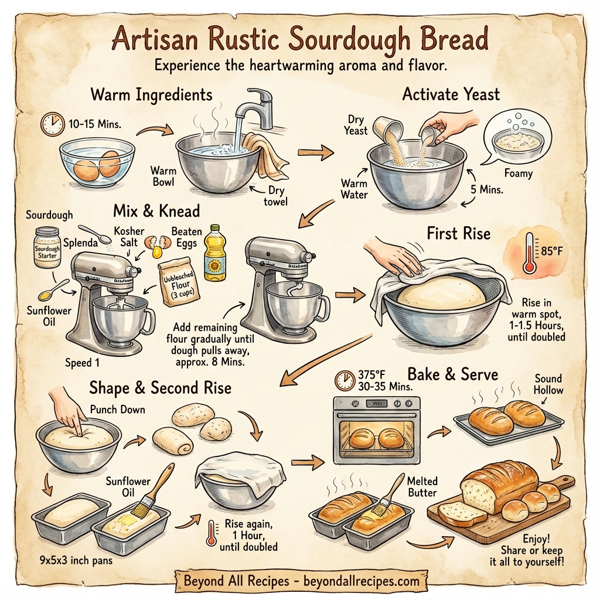
Begin by placing the eggs in a bowl of warm water for about 10-15 minutes to warm them up.
2
Preheat your KitchenAid (KA) bowl by filling it with hot water, quickly dumping it out, and then towel-drying it to ensure it's warm.
3
In the warmed KA mixing bowl, dissolve the dry yeast in the warm water. Allow it to stand for about 5 minutes until it becomes foamy.
4
On speed 1, add the sourdough starter, Splenda, kosher salt, beaten eggs, sunflower oil, and 3 cups of the unbleached flour to the active yeast mixture.
5
Gradually add the remaining flour (up to 2 additional cups) until the dough starts to pull away from the sides of the mixing bowl, which should take approximately 8 minutes of mixing.
6
Once mixed, transfer the dough to a well-greased bowl, turning it to ensure the top is greased. Cover it and let it rise in a warm, draft-free spot at around 85 degrees F for 1 to 1.5 hours, or until it doubles in size.
7
After rising, punch down the dough to remove excess air, then divide it in half to shape each portion into a loaf or dinner rolls.
8
Place the shaped loaves into greased 9x5x3 inch loaf pans. Lightly brush the tops with sunflower oil to help with the crust.
9
Cover the loaves again and allow them to rise in a warm, draft-free environment for about 1 hour, or until they have doubled in size.
10
Preheat the oven to 375 degrees F. Bake the loaves for 30-35 minutes, or until they sound hollow when tapped on the bottom. Remove from pans and brush with melted butter before serving.
Nutrition Information
Frequently Asked Questions
Frequently Asked Questions
What is Artisan Rustic Sourdough Bread?
It is a homemade bread recipe featuring a crispy crust and soft, airy interior, designed to be easily made using a KitchenAid mixer.
How many servings does this recipe yield?
This recipe yields approximately 20 servings.
What equipment is recommended for kneading the dough?
A KitchenAid mixer is recommended to handle the mixing and kneading process efficiently.
How should I prepare the eggs for this recipe?
The eggs should be placed in a bowl of warm water for 10 to 15 minutes to warm up before being beaten and added to the mixture.
Why should I preheat the mixing bowl?
Preheating the bowl with hot water ensures it is warm, which helps the yeast activate and the dough rise properly.
How much yeast is required?
The recipe calls for 4 1/2 teaspoons of dry active yeast, which is equivalent to 2 packages.
What is the ideal temperature for the water?
The water used to dissolve the yeast should be heated to between 105 and 110 degrees F.
How long should the yeast stand in water?
The yeast should stand in the warm water for about 5 minutes until it becomes foamy.
What state should the sourdough starter be in?
The sourdough starter should be at room temperature before being added to the mix.
What sweetener is used in this sourdough?
This recipe uses 1/4 cup of Splenda granular as a sweetener.
What type of salt is best for this recipe?
The recipe specifically calls for 3/4 tablespoon of kosher salt.
What kind of oil should I use?
Sunflower oil is used both in the dough and for brushing the tops of the loaves.
What type of flour is recommended?
Unbleached flour is recommended, with a total amount ranging from 4 to 5 cups.
At what speed should I mix the initial ingredients?
You should use speed 1 on your mixer to combine the initial ingredients.
How much flour is added in the first mixing step?
Initially, 3 cups of the unbleached flour are added to the yeast mixture.
How long does the mixing and kneading process take?
It takes approximately 8 minutes of mixing until the dough starts to pull away from the sides of the bowl.
What is the ideal temperature for the first rise?
The dough should rise in a warm, draft-free spot at around 85 degrees F.
How long is the first rising period?
The first rise takes between 1 and 1.5 hours, or until the dough doubles in size.
What should I do after the first rise?
You should punch down the dough to remove excess air and then divide it into two portions.
What size loaf pans are needed?
The recipe requires two greased 9x5x3 inch loaf pans.
Can I make rolls instead of loaves?
Yes, the dough can be divided and shaped into dinner rolls instead of two loaves.
What should I do before the second rise?
Lightly brush the tops of the shaped loaves with sunflower oil to help develop the crust.
How long is the second rising period?
The second rise takes about 1 hour, or until the loaves have doubled in size.
What temperature should the oven be set to?
The oven should be preheated and set to 375 degrees F.
How long does the bread take to bake?
The loaves should bake for 30 to 35 minutes.
How can I tell if the bread is finished baking?
The bread is done when the loaves sound hollow when tapped on the bottom.
What is the final step after removing the bread from the oven?
Remove the bread from the pans and brush the tops with melted butter before serving.
What is the texture of the finished bread?
The bread features a beautifully crispy crust with a soft, airy interior.
What are good serving suggestions for this bread?
It is perfect for sandwiches or as a side for hearty soups and stews.
Is this recipe considered easy?
Yes, it is tagged as an easy and rustic recipe that uses a mixer to simplify the process.