Artisan Ciabatta Bread
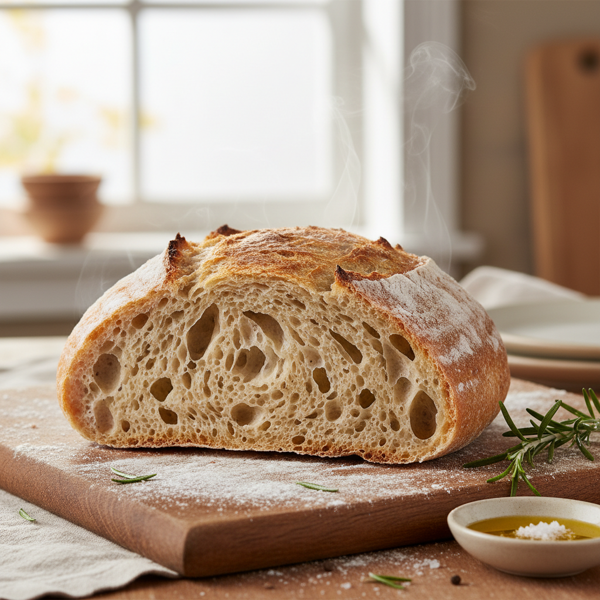
This Artisan Ciabatta Bread is a delightful Italian specialty characterized by its crispy crust and airy, chewy interior. Perfect for sopping up sauces, making exquisite sandwiches, or enjoying on its own, this bread is sure to impress your family and friends. Made with simple ingredients, the long fermentation process and high hydration create the unique open crumb structure associated with authentic ciabatta. With a little patience and care, you can recreate this classic bread in your own kitchen, filling your home with the irresistible aroma of freshly baked bread.
N/A
Servings
N/A
Calories
6
Ingredients
Ingredients
unbleached all-purpose flour
4.5 (cups)
salt
2 (teaspoons)
active dry yeast
2 (teaspoons)
warm water
2 (cups at 110 degrees Fahrenheit)
olive oil
as needed (for greasing the bowl)
cornmeal
as needed (for the sliding pan)
Instructions
1
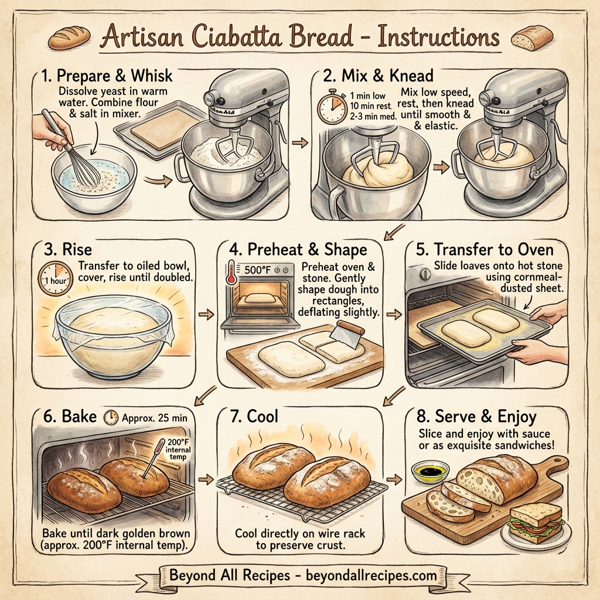
Prepare your workspace by ensuring you have a baking stone or two jelly roll pans that fit side by side in the oven. Additionally, keep a cookie sheet with no sides or a piece of stiff cardboard handy for sliding the loaves into the oven.
2
In the bowl of an electric mixer, combine the unbleached all-purpose flour and salt, mixing well.
3
In a separate bowl, gently whisk the active dry yeast into the warm water (about 110 degrees Fahrenheit) until dissolved. Pour this yeast mixture into the flour mixture.
4
Attach the paddle attachment to your mixer and mix on the lowest speed for 1 minute until combined. Allow the dough to rest for 10 minutes.
5
Increase the speed to medium and beat the dough for an additional 2 to 3 minutes, or until it becomes smooth and elastic.
6
Lightly oil a 3-quart bowl, then transfer your dough into the bowl, turning it over so the top is also coated in oil.
7
Press plastic wrap directly against the surface of the dough and let it rise at room temperature until it has doubled in size, around 1 hour.
8
About 30 minutes before baking, place your baking stone on the middle rack of your oven and preheat to 500 degrees Fahrenheit. If you are using jelly roll pans, invert them side by side on the middle rack and preheat to the same temperature.
9
To shape the loaves, transfer the dough onto a lightly floured work surface, taking care to deflate it as little as possible. Pat the dough into an 8-inch square and cut it in half to create two rectangles.
10
Sprinkle cornmeal on your cookie sheet or cardboard. Position one rectangle of dough at the far end of the sheet, gently stretching it as needed.
11
Quickly open the oven and slide the loaf onto the baking stone or an inverted jelly roll pan, pulling the cookie sheet or cardboard away swiftly.
12
Repeat the process with the second piece of dough.
13
Bake the loaves until they are a dark golden brown and have reached an internal temperature of about 200 degrees Fahrenheit, which should take roughly 25 minutes.
14
Allow the bread to cool directly on a wire rack to preserve its crust.
15
To serve, cut the loaf into thick vertical slices for a meal or split horizontally for delectable sandwiches.
Nutrition Information
Frequently Asked Questions
Frequently Asked Questions
What is Artisan Ciabatta Bread?
Artisan Ciabatta Bread is a classic Italian specialty known for its crispy crust and airy, chewy interior.
What are the main characteristics of ciabatta?
It is characterized by a high hydration level, an open crumb structure, and a rustic appearance.
What ingredients are needed for this ciabatta recipe?
You will need unbleached all-purpose flour, salt, active dry yeast, warm water, olive oil, and cornmeal.
What type of flour is recommended?
The recipe specifies using unbleached all-purpose flour for the best results.
How much yeast is used in this recipe?
The recipe requires 2 teaspoons of active dry yeast.
What should the water temperature be for the yeast?
The water should be warm, approximately 110 degrees Fahrenheit, to properly activate the yeast.
How long does the dough need to rest after the first mix?
After the initial 1-minute mix, the dough should rest for 10 minutes.
What mixer attachment should I use?
Use the paddle attachment on your electric mixer for this recipe.
How long should I beat the dough on medium speed?
Beat the dough for 2 to 3 minutes until it becomes smooth and elastic.
Why do I need to oil the bowl for the dough?
Oiling the bowl prevents the dough from sticking as it rises and makes it easier to remove.
How long is the fermentation or rising period?
The dough should rise at room temperature for about 1 hour, or until it has doubled in size.
What temperature should the oven be for baking ciabatta?
The oven should be preheated to 500 degrees Fahrenheit.
When should I start preheating the oven?
Begin preheating the oven and your baking stone about 30 minutes before you are ready to bake.
What can I use if I do not have a baking stone?
You can use two jelly roll pans inverted side by side on the middle rack of the oven.
How do I shape the ciabatta loaves?
Pat the dough into an 8-inch square on a floured surface and cut it in half to form two rectangles.
Why is cornmeal used on the cookie sheet?
Cornmeal acts as a lubricant to help the dough slide easily off the sheet and onto the baking stone.
How do I transfer the dough into the oven?
Use a cookie sheet without sides or a piece of stiff cardboard to slide the dough onto the preheated stone.
How many loaves does this recipe make?
This recipe makes two rectangular loaves of ciabatta bread.
How long does the bread take to bake?
The loaves typically bake for about 25 minutes until they are a dark golden brown.
What is the target internal temperature for the bread?
The bread is fully baked when it reaches an internal temperature of approximately 200 degrees Fahrenheit.
Why must the bread cool on a wire rack?
Cooling on a wire rack allows air to circulate, which keeps the crust crispy and prevents the bottom from becoming soggy.
How should I slice the ciabatta for sandwiches?
For sandwiches, it is best to split the loaf horizontally.
How should I slice the bread to serve with a meal?
Cut the loaf into thick vertical slices for serving alongside a meal.
What creates the open crumb structure in ciabatta?
The open crumb is created by a combination of high hydration and a long fermentation process.
Can I use bleached flour?
While you can, unbleached flour is preferred for artisan breads as it provides a better structure and flavor.
Is it necessary to deflate the dough during shaping?
No, you should take care to deflate the dough as little as possible to preserve the air bubbles for the open crumb.
What is the purpose of salt in this recipe?
Salt provides flavor and helps control the rate of yeast fermentation.
Does the dough need to be covered during the rise?
Yes, press plastic wrap directly against the surface of the dough while it rises.
Can this bread be frozen?
Yes, ciabatta freezes well. Wrap it tightly and thaw at room temperature, then reheat in the oven to restore the crust.
What are some common uses for ciabatta?
It is excellent for dipping in sauces, making panini, or serving with olive oil and balsamic vinegar.